It's January, so now is a good time to hole up, hibernate, stay home, and linger in a warm bed for just a few more minutes until it's a more reasonable time to get up. In other words, one might as well sleep in later than usual. After all, it's going to be dark for three more hours. Time to turn over on the good side one more time and hope to drift off again until 4:30. That occasional thirty minutes of self-indulgence, as the droll Dorcas Lane character says in Lark Rise, is my one weakness.
Once the weakness has been overcome and there's a return to the daily duties, though, there are more temptations to address. After all, being January, one can't exactly head out to the garden for a round of cultivation, transplanting, watering, and weed pulling. It was warmer in the house when I crawled out than it was outside (Brrrrr!), but that's a very low threshold. The fire's going, another third of the crossword has been vanquished, and the first tea and breakfast has gone into the record books. Soon it will be warm enough inside to shed the blanket and the Oilers/Packers/Jets hat. There's another winter time treat that's been accumulating beside the big chair for a couple of weeks: seed catalogs.
Like most guilty pleasures, the seed catalogs aren't as frequent or numerous as they used to be. There have been numerous buyouts and corporate mergers in the seedy world of gardening over the past thirty years. The remaining seed depots are more specialized and often cater to a smaller clientele than was the case in the past.
As a Midwest gardener nearly all my life, I tended to look for seeds from colder areas, thinking they would hold up better to early spring cold snaps and late fall snows. For many years there was a catalog from Gurney Seed and Nursery in Yankton, South Dakota. There were lots of seed companies in Michigan and Wisconsin. For the longest time it was Burpee Seeds leading the way from Fordhook Farm near Doylestown, PA. Gramps Burpee bought the property in the 19th century. It was used to develop garden plant varieties and seeds for nearly a hundred years. North of Philadelphia, it was a Middle Atlantic climate, but it was far enough north to allow for plenty of cold tolerance. My first market gardening efforts were based on a Burpee tomato. There was Stokes, Harris, Ferry-Morse, and dozens of others.
In the 1970s other companies came along, with Johnny's being among the most notable. Rob Johnston, Jr., launched Johnny's Selected Seeds in Maine in 1973 offering reliable seed for gardeners. Over the years, developing new varieties became a specialty. They boast many All-America Selection winners. When Johnny's turned the annual catalog into a grower's guide in 1979, it became the catalog everyone started keeping from year to year. There are well-crafted guidelines for growing nearly every imaginable vegetable and flower throughout the pages. It has become a garden reference work for me. Recently Johnny's has put considerable effort into developing innovative garden tools and hardware. There is much to be learned in these pages of the catalog, too.
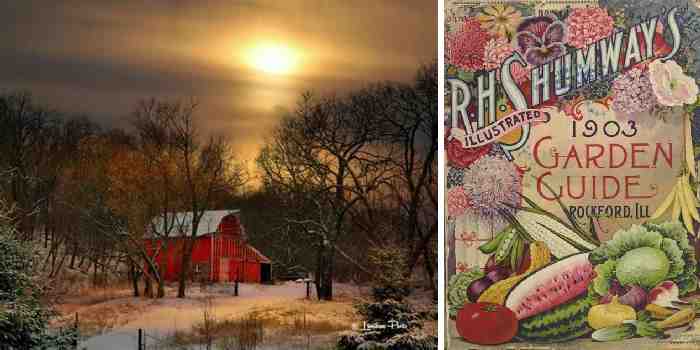
A personal favorite is Shumway Seeds of Randolph, Wisconsin. Their large catalog is like the old ones used to be, much of it in black and white. They use old-timey illustrations and offer seed in small and large quantities. Shumway now carries plants and nursery stock in addition to seeds. I've had many years of good service from them.
Park Seed of South Carolina, Seed Savers Exchange of Iowa, Victory Seeds in Oregon, and Baker Creek seeds of Mansfield, MO offer all a gardener could want
There are other companies across the country. Park Seed of South Carolina, Seed Savers Exchange of Iowa, Victory Seeds in Oregon, and Baker Creek seeds of Mansfield, MO offer all a gardener could want. Several of these have extensive offerings of heirloom seeds which appeal to many gardeners these days.
I remember seeing seed catalogs at the grandparents' house. They went through them carefully in the short days of winter, but didn't order. When it came time to plant, they went down to the local hardware store for seeds, or planted what they had saved. In those days there were very few hybrids. The old standard improved sweet corn, Burpee's Golden Bantam, was open pollinated. My grandparents planted it, along with Hickory King, the white corn favored in my family for making corn meal. These and other popular varieties could be found locally almost anywhere. Fordhook lima beans, obviously a Burpee variety, appeared in many meals at their house. Big Boy tomatoes, also from Burpee, led the way in the tomato rows. In this way, the catalogs served as sales manuals, reminding buyers of the trusted varieties available locally.
These days there is still a kind of flowering of hope when the seed displays appear in grocery, hardware, and home improvement stores across the country. This has to come early in the year, usually in January, so gardeners who start their own plants can get the seeds in time to have the plants the right size when weather permits their planting. Cabbage often goes out first, followed by other cold-tolerant vegetables. Tender tropical origin plants like tomatoes must not be planted outside until after the last frost of the season, which means no earlier than Memorial Day in the U.P. Winters go on and on up there.
When I was a merchandiser for Burpee Seeds in the 2000s, my rounds took me across the icebound Upper Peninsula of Michigan to set up the displays and stock the seed packs. It was often a dreary and depressing trip on slippery roads. Stores gave up dozens of parking spaces to piles of snow that might not melt away completely until May. People came into the stores and hunched over against the wind, pulling coats and hats tightly around ears. But seeing the seed displays going up always made for smiles and conversation. There was hope that spring would come again some distant day.
Seed catalogs are seductive
Seed catalogs are seductive. The photos are always taken at the peak of the harvest, usually with polarized lenses. Colors pop. Carrots and beets are have been washed to show flame orange and carmine red. Tomatoes in seed catalogs never have worm holes, nor have chickens recently passed the rows to take a sample peck out of the best ones. Raccoons have never been in the corn and rabbits have never visited the beans. Leaves are never wilted. Deer never get closer to catalog vegetables than the next township. The people holding baskets of vegetables never seem to have sore backs or be sweating.
Nevertheless, the memory of produce grown within a bowshot of the kitchen is always sufficient to dispel the doubts. Broccoli, peas, potatoes, sweet corn, beans, summer squash, tomatoes, zinnias, nasturtiums, and hollyhocks all sing their siren song. But even if they never speak or sing, I'll come back to the garden every year.
Few have heard of Mary Frances Gurney (1858-1932), but most have read her words. They're posted in gardens around the world.
The kiss of the sun for pardon,
The song of the birds for mirth,
One is nearer God's heart in a garden
Than anywhere else on earth.
It all starts in the dream time in January in the seed catalogs. Time to get started!
Dr. Bruce Smith (Inkwell, Hearth and Plow) is a retired professor of history and a lifelong observer of politics and world events. He holds degrees from Indiana University and the University of Notre Dame. In addition to writing, he works as a caretaker and handyman. His non-fiction book The War Comes to Plum Street, about daily life in the 1930s and during World War II, may be ordered from Indiana University Press.