

By Dr. Bruce Smith ——Bio and Archives--September 23, 2024
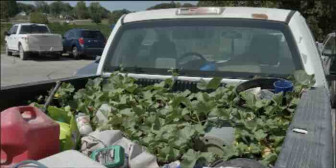
On a recent visit to one of those annoying mega discount chains specializing in imported stuff it was necessary to walk about halfway across their parking lot. Being naturally nosy in a good way, of course, I noticed a pickup truck with stuff showing in the back. I veered a bit to get a look down into the back. It must be an older truck because I’m actually tall enough to see over the sides. I could see the top of a fuel can, some planter tubs and buckets, junk that maybe looked like an old air conditioner, trash, and something green. It wasn’t fresh cut brush or tree limbs. I stopped. I moved closer. Hmmm. I think there’s something growing in there. I moved around to the side. Then I went back to the back end and fished out the phone and took this picture.(above)

Yes, sir. This has to be a truck garden.
I recently discovered that it’s possible to make fine topsoil in the back of a pickup truck. First of all, don’t clean it out for a year or two. Haul straw a few times. Move several loads of firewood. Let it sit outside under trees in the fall and winter. Neglecting it outside for two falls is even better. Don’t clean out the drain holes so all the organic matter accumulating back there can get nice and wet before slowly draining. Then wait. When I finally couldn’t stand it anymore I went to the recycling place and then to the trash drop. When I got home I ran the big magnet over the mass and picked out all the old hammer heads and busted tool parts. I had lost some screws in there, too. I parked headed up the hill and lifted the rock boxes (for weight) out of the back and began clawing at the accumulation with a sturdy leaf rake. It all moved back to the space between the bed and the tailgate, and some of it even went flying out on to the ground.

Then the broom came out and made it better looking. I dug the stuff out from the gap before the tail gate, then brought two big buckets of water from the downspout and sluiced it out and let it dry. I think there might be a gain of a mile or two per gallon with all that stuff gone out of there.
Now being a gardener myself, it became a challenge to identify this vine. Standing there I couldn’t quite decide. There’s a tendril up against the window, but lots of vines have those. The leaves aren’t spotted like a watermelon, and I don’t think the blooms are as big as some squash. Whatever was thrown in there could have come from the supermarket or from a home garden. Did it come from a hybridized seed so that it will produce something a little different from the parents? Did it use pollen from something out in the garden to yield an outcross? I can’t make up my mind.
I’d be grateful to you, dear reader, if you would give me your best guess on what this might be.
View Comments
Dr. Bruce Smith (Inkwell, Hearth and Plow) is a retired professor of history and a lifelong observer of politics and world events. He holds degrees from Indiana University and the University of Notre Dame. In addition to writing, he works as a caretaker and handyman. His non-fiction book The War Comes to Plum Street, about daily life in the 1930s and during World War II, may be ordered from Indiana University Press.