
By Ray d'Entremont ——Bio and Archives--July 25, 2026
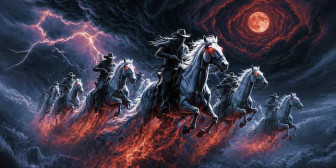
1. (Ghost) Riders in the Sky--The Highwaymen:
One night during a thunderstorm, 12-year-old Stan Jones rode into the hills with a grizzled cowhand to bring in the horses. As lightning flashed, the old guy told a tale about cowboys who lived wicked lives--cursing, drinking, fighting, and mistreating their horses--and were doomed to spend eternity riding across the sky, chasing the Devil’s herd. By 1948, Stan had become a Death Valley park ranger. One night his campfire sparked that terrifying memory and he wrote this song.

Our home in Quispamsis, New Brunswick, looked out on 10 miles of a major salmon river. We were blessed with fiery sunsets, partially due to the particulate matter from Irving’s Pulp Mill 20 miles downstream, I suppose. The cliffs staring back were the Kingston Peninsula, where Bob Nolan had lived with his grandparents. As a teen he went to Arizona to be with his dad. Later he moved to California where he worked as a caddy, a lifeguard, and a singer on the tent-show circuit. He wrote about “tumbling leaves,” but radio listeners kept requesting the “tumbleweeds song.” He had the good sense to change his lyrics accordingly. An ad that appeared in the LA paper: “Yodeler” for old-time act, to travel. Tenor preferred.” Tall and good-looking, with a great voice, Nolan soon became group leader. They had been in many western films, so when Hollywood had a contract dispute with Gene Autry, they offered the cowboy throne to Nolan. Hating the limelight, he suggested Leonard Slye, the guy who’d placed the ad founding Sons of the Pioneers. The studio had good sense too and changed Slye’s name to Roy Rogers. This tune was voted #8 in the Western Writers of America’s Top 100 Western Songs. Nolan’s “Cool Water” did even better, reaching #3.
I grew up country. Teenage Vic Mullin (later the 12-fingered 5-string banjo virtuoso on Don Messer’s national TV show for 7 years) lived just up the road and kitchen parties were de rigueur. Mon père loved stories, recited epic poetry, and gravitated to narrative songs. When he would insist that Vic sing this emotive frontier ballad, Vic was either playing coy or completely fixated on his fiddle. But if coaxed enough, or if threatened with bodily harm, he would sing. His bluegrass-y, perfect-pitch voice held us in awe. Following a benefit show in Kansas City by top Grand Ole Opry stars, 6′5″ Hawkshaw Hawkins had a commercial flight booked but gave his seat to Opry star Billy Walker because of a family emergency. Hawkins took the charter flight later with Cowboy Copas and Patsy Cline. No good deed goes unpunished. Hawkins—dead at 41.
This is a traditional night-herding/high plains trail song from the late 19th/early 20th century. Modern covers have been done by Colter Wall, Johnny Cash, and Linda Ronstadt. The singer rides his spotted horse while leading another and is headed north from Cheyenne, Wyoming, toward Montana for rodeo work (“to throw the hoolihan--a steer-handling maneuver) or range duties. The lyrics mix practical cowboy life--like cattle in coulees, stirrups, and bridal ready--with lonesome contemplation and a poetic request that when he dies his bones be tied to Old Paint so he can wander the old west forever. A more gritty verse tells of”Old Bill Jones,” whose wife died in a poolroom fight. Bill Boyd grew up working as a cowboy in Texas and learned traditional songs around campfires. His version was taped in 1934 so may not be the highest quality recording, but it captures all that pioneering energy of Western Swing while remaining true to authentic cattle drive campfire vibe and helped popularize the genre with its wandering, resilient cowboy spirit. His band appeared in six low-budget Hollywood Westerns in the 1940s, where Bill was often confused with actor William "Hopalong Cassidy" Boyd. His band had a big instrumental hit in 1935 too; when I was starting to play, it was one of the first songs country pickers learned--“Under the Double Eagle.” Most assume it’s American symbolism, but it was composed by an Austrian and references the two-headed eagle on the coat of arms of the former Austro-Hungarian Empire.
I designed and guided the first bus tour from Nova Scotia to Nashville and the Smoky Mountains. With 40 Bluenosers at the Grand Ole Opry, I passed a note to the stage for Hank Snow, thinking he’d enthusiastically welcome his fellow countrymen. He barely acknowledged us! After the show, fans mobbed the backstage door. No Hank! Several artists politely signed for a spell, but Marty was there, grinning and chatting until the last fan had his autograph. After a heart attack at 44, Marty was unwell. Someone asked why “he” had stayed. “I’d be nothing without you folks,” he said. He was still racing cars at that time too. But Hank did invite one gal from our bus to his home for dinner--an old girlfriend from his early career in Nova Scotia.
Marty was ¼ Cherokee & often referred to himself as a half-breed. Driving through El Paso late one night in 1959, he discovered that Rosa’s Cantina was closed and headed into The Badlands. A song started playing in his head about a cowboy who falls for a Mexican dancer: “I’m driving across the desert … to Phoenix … the song came like a motion picture & I could never forget the words to it. I put them down after I got to Phoenix … I didn’t know how it was going to end.” Recording it, Marty asked session guitarist Grady Martin, to play something Mexican-sounding. What resulted was one of the most iconic guitar tracks in country music history.
The Eagles' Desperado has been covered countless times, but Diana Krall makes it her own. Her velvety voice and tasty piano transform the song. There is no melodrama here--only wisdom, compassion—a tender reminder that the hardest walls to tear down are the ones we build around ourselves. This song needed a female voice to properly emote--don’t you think?
Written by Ian Tyson, it’s autobiographical--he rode rodeo himself. Suzy started singing in church at age 5. As a child, she was introduced to church friends of her grandmother’s, Roy Rogers & Dale Evans. She visited their home, hung out with their daughter, and ate TV dinners with them. They were incredibly kind to her and she credits them with her love for cowboy music. She plays piano, drums, and guitar. Best known for country, she can hold her own in folk and jazz as well.
My late father-in-law loved it, which says a lot about who he was. We performed the song at his funeral with my wife’s nursing school classmate on soloist-standby in the church, just in case she couldn’t finish. Gogi Grant was Myrtle Arinsberg, daughter of Russian Jews. She had won a contest at a Hollywood club and appeared in various talent shows. A record executive gave her the odd stage name; it wasn’t long before this song rose to #9 on Billboard. The following year she knocked “Heartbreak Hotel” from #1 with “The Wayward Wind.”
Roy and his wife Dale Evans were outspoken about their faith. They had one biological child, Robin, born with Down syndrome at a time when doctors routinely advised institutionalization. Instead, they brought her home, proudly included her in family photos, and cared for her lovingly until her death just before age two. Dale’s bestselling book Angel Unaware told how Robin became a blessing that drew the whole family closer; she donated the proceeds to help disabled children (I recommended the book to friends). The Rogers adopted four more kids, raising a warm blended family of nine with advocacy for adoption, while maintaining long, successful careers and using that celebrity platform for charity. Their lives exemplified integrity, compassion, and the belief that every child deserves love and dignity.
View Comments
A boy soprano, lifelong music lover, and serial starter of things, Ray has worn more hats than most people have ever owned. Music has been a constant companion.
His playlists are an eclectic mix of genres accessed by mood and time. Over the years, he variously played in mostly rock and electric blues bands, but jazz and country too, in the Runic Stones, X-Men of Note, Purple Splintered Night, Broken Vessel, Country Gold, Eddy & The Hubcaps, ORCA, Hardscratch Road 2.0, and several others. His wife of 57 years (high school sweetheart) doesn’t agree that he needs 25 guitars!