
By Dr. Bruce Smith ——Bio and Archives--November 25, 2024
Only in retrospect does it seem a monumental adventure. At the time it was an adventure, to be sure, but it was within the scope of normal at the time. It’s our changed times and changed culture now that make it seem almost scary.
One of the many things I learned relatively late in life was riding a bike. At the last place we lived with sidewalks I was still on tricycles. I had a fast one with a very large front wheel, but our new place out of town had a driveway with crushed stone. The tricycle was usable, but it was much more difficult, and the yard was not much better. Besides, there were no other kids with smaller tricycle wheels to outpace. Things would have to change.

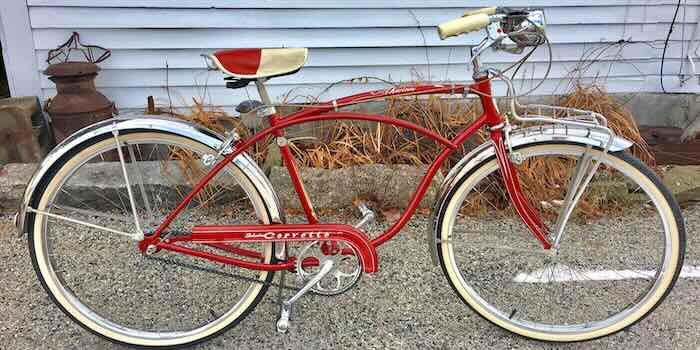
Both my brothers’ Schwinn Corvettes were available to me, but I had never ridden a bicycle of any kind. We lived on a hill with a country road out front. Had I started to ride down that steep hill I pictured myself burning up in the atmosphere like a satellite returning to earth, assuming I could maintain balance on re-entry. For a few years I had just avoided the topic anywhere I went, saying that I just didn’t want to ride, like that summer in Omaha when I visited my cousins. I could not admit that at my age I did not know how to ride a bicycle. (Shudder!)
Those early years of the 1960s went by in a hurry. When my brothers both moved out I decided it was time to take the bull by the horns. When the folks were gone one summer day I pulled out one of the Schwinns and pumped up the tires. I walked alongside it, trying to imagine how anyone could stay atop one while maintaining some kind of perch on the broad seat. I tried standing on one pedal without swinging my leg over, but that idea ended fast. Finally I lowered the seat all the way to the frame so I could straddle it with feet near the ground on both sides. On the gradual slope beside the house I figured out how to correct the tipping. After a few bumpy rides down and walks back up, I had it. With a few more trial runs toward the barn my confidence grew. I took it out on the road into a little swale, turned around and came back on the other side.
I could do it! Gradually I learned to use the hand brakes. These bikes had three gears, but no coaster brake. Life was better if I used the back brake first, it turned out. After twenty minutes on the test courses, I was ready for the Tour de France. I rode the rear brake down the nearest hill to the intersection at 23rd and Wernle Road, stopped at the stop sign, then turned south onto the flat section heading south. After fifty yards I slowly turned around and came back toward the intersection, thinking hard about how to head up the hill with some speed so as not to have to walk it the whole way. I swung wide, cut the corner off smoothly and went on to the sandy gravel lying there and went down hard. I have since prided myself on rarely having to learn a hard lesson more than once. In the many years since that day I have never tried to gain speed on a gravelly turn on a bicycle. I’m pretty cautious in cars on gravel roads, too. They can surprise you.
Suddenly I was liberated. I had a vehicle that required no license that gave me mobility as far and wide as my legs and the hills would allow. The bike had a rat trap on it so I could take map cases with food and soft drinks along with me. I could stop along quiet country roads most anywhere when I wanted a break. I got a county map and began to learn all the roads in my area. I could go past the homes of my school acquaintances since I knew them from riding the school bus. In those days it was not even questioned that I might want to be gone all afternoon on the long summer days. I had to be home by mealtime and avoid trouble, but trouble seemed much harder to find back then, even if one were seeking it, which I was not.
There were delights out in the Heartland countryside on those warm days. Farms lay all about. Whether dairy operations or hogs or poultry farms, I knew each of them by their wholesome smells. I saw the crops in their seasons, hay when it lay fragrant and drying in the sun, stubble fields dotted with straw bales in July, and the woodlots scattered about just so as they are in Wayne County, Indiana. East of me up on Greenmount Pike there was the Quigg Farm. Every time I went by the pasture that was near State Line Road I stopped at the water tank alongside the road to gaze at the sleek cattle and to get a drink of the excellent water that flowed day and night from a pipe fed by an artesian well into the tank for the cows. When I paused there I remember thinking how good it was to live in such a place.
I dipped into savings and bought a speedometer/odometer that ran off the front wheel. It was like having a tachometer in a muscle car. I could tell when I was approaching the red line and needed to power back. When I went away to school years later, I had put nearly a thousand miles on it.
Our town of 40,000 souls sat in the center of a county about 30 miles east to west. From our house to State Line Road (where Ohio was on the east side and Indiana on the west) was about three miles, and down to the little town of Boston was about five miles. It’s an area hilly with glacial moraines, so I learned all about biking on hills out there. There was a fearsome hill on Niewoehner Road about two miles from our house along the shortest road to Boston. It was impossible to pedal up it. I did that two or three times, then took easier routes around it. I decided to ride down it just once after I had gotten my road legs.
I wasn’t 50 yards down it when I realized I had made a mistake. Still too inexperienced to know to gradually apply the rear brake, I just had to let it roll. I think I was as frightened at the bottom of the hill as I ever was in my life. I looked at the speedometer as my life flashed before my eyes and I swear it said 40 miles per hour. Somehow I kept my balance on the smooth blacktop but when I slowed down I pulled into a driveway and just waited a bit as I waited for my heart rate to come down. Needless to say, that’s another lesson I only needed to learn once. Ever since then I have spent considerable idle time thinking about how to stop a car when the brakes go out. It’s comforting to know that the hand brake and the parking brake on a car are just levers attached to cables attached to brake pads on the rear wheels.
When 1967 rolled around I was fully mobile with a summer stretching out before me. I was 14 that summer. My girlfriend was gone to music camp in Michigan, so I rode during the summer for the sheer joy of it. It occurred to me one day that it would be fun to make a longer ride. The only person within riding distance that I knew that would welcome me was my grandfather who lived on the south side of New Castle, Indiana, some 35 miles away. I had never ridden even half that far in a single day, but I had heard my brothers had done it several years before, so why not? I asked my friend Jeff if he would go along, and he agreed. We picked a date, checked over our bikes, and made ready to leave the next morning.
It was really quite a distance and I wasn’t sure the folks would agree, but they did. Jeff’s folks agreed, too. That meant we had to go or just chicken out, but we thought we could do it. Communication was very different in those days. Our only hope of calling anywhere along the route would have been at a pay phone, and I had never heard of a phone card so I would have had to call collect or drop coins in the pay phone. There was no other way. When we left, we would really be on our own, riding isolated in the countryside across two counties. If there was trouble, we would just have to deal with it somehow. No one would know where we were until we arrived at my grandfather’s house. He knew we were coming, but everyone let us go our own way.
We planned the route very carefully. I had been over some of the roads a time or two with the folks, but we didn’t drive the route ahead of time. I marked the route on a map and told my dad how we planned to go. He approved. The weekday morning came with a fair weather forecast and I rode over to Jeff’s place to meet him and we set off across Richmond and out West Main Street beyond the WKBV radio studios and tower and out of town. We kept going. It was rather exhilarating.
We made a couple of jogs that brought us to the tiny town of Jacksonburg about 10:30 in the morning. This was before Interstate 70 was completed through that area. Today the highway goes right over the top center of Jacksonburg. In ’67 there was an old store there and I remember the very cold Pepsi that was so good in our dry throats. We packed sandwiches and snacks that we could eat any time. We sat in front of the store for a bit, then headed back out on the quiet country road. The store building is still there.
Our next destination was Hagerstown. We zigzagged across the countryside to the northwest and came onto Swoveland Road. I had never been on this road and it was the only stretch of gravel road we could not avoid. The wide balloon tires on my Schwinn were up to it and we were making good progress when we came to a downhill slope headed west. I was riding in second position just past the crest of a hill when a big farm dog came out and decided to give chase. I should have just ignored him or dismounted and run him off, but I had a bit of speed up when he decided to chase me way too close. On the loose gravel I was afraid to brake much and didn’t want to speed up, but the dog pushed me to go way too fast. About 2/3 of the way down the hill I wiped out in the gravel on the right side. The dog had already gone home. Jeff came back for me and I straightened the handlebars over the front wheel. We finished the gravel stretch and got back on the blacktop and limped into Hagerstown. The bike seemed to be okay. At a service station on the west side of town along Indiana 38 I was able to wet some paper towels and clean some of the dirt and dust out of my banged up knees and shins. We had lunch and decided to carry on.
From the west edge of Hagerstown to New Castle is eleven miles. From riding in the car with my grandfather I knew the turn at Hagerstown that would put us on a road that was a straight line to my grandfather’s house. I had traveled it many times in both directions. We caught it near the old Teetor home at the big curve and headed west. With blacktop all the rest of the way it was very pleasant but still a bit strange to be out there on our own. We passed a crossroad south of Millville where I had gone to a farm with my grandfather years before to get banty chicks. Some of those chicks eventually became my first flock. It was comforting to be there. The big white barn is still there today and I think I remember tall catalpa trees along the road. We only slowed at the stop sign and kept going. We were in sight of the goal when we passed the Frost sawmill, and then we were there. We had made it. My grandfather was watching for us from the porch and gave us his big grin and a handshake when we arrived tired but victorious. Everyone had trusted us to make it on our own and we had done it. It was a good feeling, and a better one than I felt in my knees.
We spent the night and the next day we put our bikes in the back of the Studebaker truck and made the run back to Richmond. We had stories to tell but mostly we were proud that we had trekked across the howling wilderness and lived to tell the tale.
I would have those some of those days back, but they are long gone now. I go back there in my mind now and then. When I do the days are sunny and the water from the Quigg spring is always quite cold on my face and in my throat in that season of plenty.
View Comments
Dr. Bruce Smith (Inkwell, Hearth and Plow) is a retired professor of history and a lifelong observer of politics and world events. He holds degrees from Indiana University and the University of Notre Dame. In addition to writing, he works as a caretaker and handyman. His non-fiction book The War Comes to Plum Street, about daily life in the 1930s and during World War II, may be ordered from Indiana University Press.