

By Mark Macneill ——Bio and Archives--July 15, 2026
Canadian News, Opinion | CFP Comments | Subscribe | Email Us
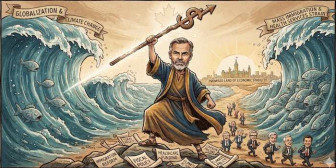
There is a peculiar season in Canadian politics, a season as recurrent as spring potholes and as brief as a Maritime summer. It arrives when a new prime minister steps onto the national stage, carrying not yet the burden of decisions but the promise of them. The public, exhausted by old quarrels, lends him the benefit of hope. The press, weary of yesterday's disappointments, rediscovers the language of possibility. Pollsters begin to speak in the warm tones of momentum.

And so it is with Mark Carney.
He entered office cloaked in credentials. In an age when political résumés are often stitched together from talking points and social media performances, Mr. Carney arrived with the imprimatur of central banking, international institutions, and a reputation for competence. To many Canadians, he seemed less a politician than an administrator summoned from a higher order of expertise—a man expected not merely to govern the machinery but to understand its hidden gears.
Yet political honeymoons are purchased on credit.
The bills arrive later.
The Canadian economy remains a stubborn contradiction. We are a nation rich in resources and poor in confidence, prosperous in aggregate and anxious in particular. The stock market may climb, yet the young family searching for its first home sees little evidence of prosperity. Government reports may celebrate growth, yet the grocery bill delivers its own weekly referendum on economic reality.
For years Canada has enjoyed the luxury of speaking as though wealth were a permanent condition rather than a perpetual task. We have debated distribution with greater enthusiasm than production. We have spoken endlessly of managing prosperity while devoting comparatively less attention to creating it.
The result is an economy that often resembles a magnificent inheritance gradually mistaken for an inexhaustible income.
Housing remains perhaps the clearest symbol of the national predicament. What was once a milestone of ordinary citizenship has become, for many, an object of speculation or inheritance. A generation raised on assurances of opportunity now confronts a market in which aspiration itself carries a premium. One does not need economic theory to understand the problem; one need only listen to parents wondering whether their children will ever live independently in the cities where they were born.

Against this backdrop, Mr. Carney's greatest political asset is not ideology but expectation. Canadians believe he understands economics. Whether that belief proves justified is almost secondary to the fact that it exists. Reputation, in politics, functions much like capital in finance: difficult to accumulate, easy to spend, and impossible to borrow indefinitely.
Sooner or later the conversation must move from credentials to outcomes.
The challenge before the government is therefore not rhetorical but arithmetic. Productivity cannot be increased through announcements. Investment cannot be summoned by press conference. Economic dynamism does not emerge from branding exercises or strategic adjectives. It arises from the slower and less glamorous work of building, permitting, innovating, competing, and producing.
These are not tasks that inspire standing ovations.
They are, however, the only tasks that matter.
The danger for any government enjoying a honeymoon is the temptation to mistake applause for accomplishment. Public affection is pleasant but fleeting. It is the political equivalent of favourable weather: delightful while it lasts, irrelevant to the structural integrity of the house.
Mr. Carney's government presently enjoys a measure of goodwill. Canadians appear willing to believe. They are prepared, at least for now, to grant time, patience, and the occasional benefit of the doubt.
But economics possesses a quality politics can never fully master: indifference.
Markets do not care about narratives. Productivity statistics are immune to charisma. Debt calculations remain stubbornly unmoved by eloquence. In the end, every government confronts the same unsentimental auditor.
Reality keeps the books. And reality, unlike the electorate, never experiences a honeymoon.
View Comments
C. Mark MacNeill is a lifelong student of legal history, political philosophy, and public affairs. He writes on issues ranging from constitutional and administrative law to public finance, governance, and Canadian political culture. His professional experience includes legal consulting, strategic advisory work, corporate governance, and public policy analysis.
He lives on Cape Breton Island, Nova Scotia