

By Institute for Energy Research ——Bio and Archives--September 14, 2015
Global Warming-Energy-Environment | CFP Comments | Subscribe | Email Us


The EPA does not place a dollar value on individual lives. Rather, when conducting a benefit-cost analysis of new environmental policies, the Agency uses estimates of how much people are willing to pay for small reductions in their risks of dying from adverse health conditions that may be caused by environmental pollution. In the scientific literature, these estimates of willingness to pay for small reductions in mortality risks are often referred to as the "value of a statistical life.” This is because these values are typically reported in units that match the aggregate dollar amount that a large group of people would be willing to pay for a reduction in their individual risks of dying in a year, such that we would expect one fewer death among the group during that year on average. This is best explained by way of an example. Suppose each person in a sample of 100,000 people were asked how much he or she would be willing to pay for a reduction in their individual risk of dying of 1 in 100,000, or 0.001%, over the next year. Since this reduction in risk would mean that we would expect one fewer death among the sample of 100,000 people over the next year on average, this is sometimes described as "one statistical life saved.” Now suppose that the average response to this hypothetical question was $100. Then the total dollar amount that the group would be willing to pay to save one statistical life in a year would be $100 per person ? 100,000 people, or $10 million. This is what is meant by the "value of a statistical life.” Importantly, this is not an estimate of how much money any single individual or group would be willing to pay to prevent the certain death of any particular person.The EPA primer goes on to explain that the estimated VSL is used to rate the effectiveness of proposed federal regulations in cost/benefit terms. For example (this is my example, not theirs), suppose a very stringent rule on the emission of soot from smokestacks theoretically would reduce deaths by 2,000 lives, but at an aggregate cost to the economy of $80 billion in forfeited GDP. With these numbers, even on its own terms, such a regulation would save lives at a price of $40 million per life. This is much more than typical Americans spend with their own money to reduce risks and prolong their lifespans, and thus it indicates that the proposed regulation is inefficient because it implicitly forces Americans to “spend” much more on reducing a particular risk, rather than on other goods and services that they value more. Now that I’ve explained it in my words, we can quote from the EPA primer to see that they feel the same way:
Agencies use estimates of values of risk reductions when conducting a benefit-cost analysis of a new policy or regulation that may affect public health. For example, many of the air and water pollution control regulations that are implemented by the EPA will reduce the risks of certain types of cancers, respiratory illnesses, and other diseases among large portions of the general public. Benefit-cost analysis compares the total willingness to pay for the health risk reductions from these policies to the additional costs that people will bear if the policies are adopted. These costs may come in the form of increased taxes, or, more commonly, increased prices of goods and services whose production, use, or disposal contributes to environmental pollution. The results of a benefit-cost analysis are presented to policy-makers and the public to help inform their judgments regarding whether or not a proposed policy should be adopted.According to this particular EPA document, the default Value of a Statistical Life (VSL) for use in regulatory cost/benefit analysis is $7.4 million, measured in 2006 dollars. If we use the Consumer Price Index to relate 2006 to 2015 dollars, the current VSL for such analyses is about $8.8 million. Thus, EPA’s own documentation admits that “saving lives” is not enough. In order to make sense, a proposed regulation must reduce deaths (in the aggregate) such that the implicit cost per life saved is no more than about $8.8 million. If it is higher than this, it means the regulation is inefficient, because it implicitly forces Americans to give up other potential uses of their income that they would have preferred to slight reductions in mortality rates. In this world, there are always tradeoffs, and even if a proposed regulation genuinely saved lives (in the aggregate, statistical sense), it wouldn’t make sense to impose it if it also caused too much damage to the conventional economy.
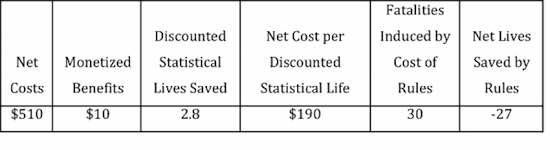
Third, the costs of compliance with regulations pose risks. Compliance typically reduces the amount of private resources that people have to spend on a wide range of activities, including health care, children’s education, and automobile safety. When people have fewer resources, they spend less to reduce risks. The resulting increase in risk offsets the direct reduction in risk attributable to a government action. Moreover, if that direct risk reduction is small and the regulation is very ineffective relative to its cost, then total risk could rise instead of fall. [Hann, Lutter, and Viscusi p. 4, bold added.]The authors then move on to analyze specific government regulations, using an estimate from “recent work by Lutter, Morrall, and Viscusi” that estimated “that an increase in income of about $15 million in a large U.S. population reduces mortality risk by one statistical death.” Specifically, Lutter, Morrall, and Viscusi “construct a model in which people can reduce their risk of death through self-protective measures, but risk increases with increases in risky behaviors, such as smoking, overdrinking, and being overweight.” They find empirically that these risky behaviors tend to decrease as people’s income increases. This is how they generate the estimate that (at that time) an increase in income of $15 million (in 1990 dollars) in a U.S. community went hand in hand with one life saved in the aggregate. Now for purists, I should note that it is not immediately obvious whether a reduction in income (through new government regulations, for example) would likewise cause an increase in (statistical) deaths. For example, suppose that people who are very disciplined and conservative (a) don’t smoke, drink, or overeat and (b) study hard in school and do a good job at work. In this case, we would also see a correlation between higher income and longevity, which wouldn’t necessarily cause more deaths if the government suddenly made everybody $1,000 poorer per capita. However, the authors of the monograph do summarize the scholarly literature to show that there is indeed evidence of a specific causal mechanism linking higher income directly to risk reduction, through the purchase of healthier (but more expensive) food, getting better medical care, etc. Thus, our authors proceed with their claim that a policy that makes the community $15 million (in 1990 dollars) poorer will cause (on average) one extra death compared to the baseline.
View Comments
The Institute for Energy Research (IER) is a not-for-profit organization that conducts intensive research and analysis on the functions, operations, and government regulation of global energy markets. IER maintains that freely-functioning energy markets provide the most efficient and effective solutions to today’s global energy and environmental challenges and, as such, are critical to the well-being of individuals and society.