

By Stephen-Perrott ——Bio and Archives--November 19, 2026
Imagine you are Rip Van Winkle, waking from a long slumber. Do you think you could make sense of the Western education system--or the contemporary Western university?

Imagine falling asleep while Western nations were celebrated for freedom and prosperity--and waking up to find the same nations lampooned as oppressive, hegemonic regimes that are products of evil colonial pasts. Imagine discovering that our noble quest for a colour-blind society is now considered racist, and that race, gender, sexual orientation, and other identity categories have replaced merit as determining factors for educational placement, employment, and promotion.
You would be shocked by a distorted emphasis on identity and the abandonment of traditional standards of excellence. You would be disturbed to see professionals losing their jobs for seemingly innocuous verbal remarks. You would struggle with an incomprehensible new reality that focuses on eliminating “micro-aggressions”--offences perceived by self-described victims that must be punished even if no offence was intended. You would be troubled to discover that once familiar standards of reasonable behaviour have been thrown out the window.
In the new woke order you witness school children being subjected to drag-queen story times, while teenage girls are expected to accept sharing locker-room facilities with males who identify as girls. Most disturbingly, you would discover that factual evidence and the search for truth have been entirely displaced by hypersensitive feelings.
What’s worse; not all peoples’ feelings are equal. In fact, the relative importance of anyone’s hurt feelings is measured by a convoluted intersectional analysis of their identity and victimhood status.

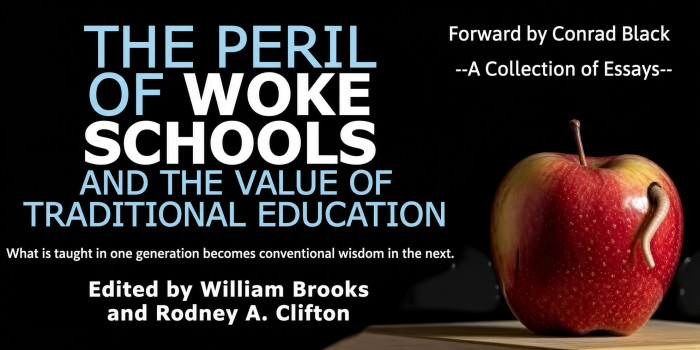
'The Peril of Woke Schools and the Value of Traditional Education' is a recent Frontier Centre for Public Policy publication co-edited by William Brooks and Rodney A. Clifton. With an insightful Foreword by Conrad Black, the editors and contributors shed valuable light on the troubling developments mentioned above. Together they expose the inherent contradictions in the social-justice model of progressive education that has captured almost all of the West’s formative institutions.
Readers of this book will learn how, under the umbrella of “Diversity, Equity, and Inclusion”, the progressive radicalism in education faculties has spilled into a wide range of academic disciplines. Most importantly, this collection of essays shows how “wokeness” has permeated the public-school system and ultimately, society at large. In the contributors’ view, this modern form of the totalitarian temptation has inflicted enormous damage on the Enlightenment foundations of liberal democracy.
Brooks and Clifton, both senior fellows of the Frontier Centre, are not merely editors, but significant contributors to the book. Brooks, for example, outlines how traditional education, rooted in the Judeo-Christian tradition, became secular and progressive. The irony, he argues, is that present-day, quasi-religious gatekeepers of our “progressive” school systems are more rigid than the devote Jesuit professors of the 1950s and 1960s. Clifton, for his part, rails against the “edu-babble” long ingrained in ed schools and now pervasive throughout the university landscape. He, and other contributors, provide a unifying thread that connects many of the seemingly incoherent phenomena described above.
Clifton identifies the central ideology of our decaying educational system as a form of neo-Marxism. In this account, the traditional Marxist proletariat—insufficiently motivated to undertake revolution—has been replaced by a variety of oppressed identity groups. These groups are supposed to be subjugated by a dominant class of alleged white supremacists. The contributors reveal evidence of an ongoing “long march” of the left through Western institutions.
One essay by Canadian journalist, Barbara Kay, focuses on developments within the Toronto District School Board. She illustrates how Jewish Canadians are being wrongly included in the oppressor category in discussions surrounding the Israeli-Palestinian conflict.
The collection is offered as an interesting buffet rather than a table d'hôte of intellectual nourishment. For the most part, the essays are arranged in no particular progression. Readers are free to focus on whatever topics or authors interest them most. I would suggest beginning with the opening essay on the “Ed-School Menace” by American scholar, Lyell Asher. As one moves from essay to essay contributors vary from micro to macro in their levels of analysis —overarching themes emerge, along with the collection’s general thesis.
Provided readers are willing to sample broadly from the buffet, the format works well. The contributors confront important issues through accessible writing styles that are refreshingly free of the edu-babble that Rodney Clifton refers to. The collection demonstrates that sophisticated arguments can be presented by professional authors in concise, plain English.
Will citizens find this book useful? The most likely readers will be members of a growing cohort of concerned parents and traditional educators who will welcome the contributors’ analysis with knowing nods. The book certainly broadens the intellectual scope of readers who are inclined to appreciate reliable evidence and rational arguments.
The collection, however, is unlikely to be welcomed in education schools across Canada and beyond. Neither will it gain much traction within the walls of the present-day university. Perhaps that’s precisely why it is worth reading.
In Washington Irving’s early nineteenth century tale, Van Winkle slept through the American Revolution and woke up to a radically changed world. He was obliged to determine what had happened while he was asleep, and decide how he should respond to the new order.
Readers of The Peril of Woke Schools and the Value of Traditional Education are confronted with a similar challenge. The book provides considerable fodder for thinking about the transformation of education and its enormous implications for civic culture. It raises issues that extend well beyond the walls of schools and universities.
The question is: will people wake up in time to confront these radical changes, or will they simply sleep through them?
View Comments