We begin with the reality that the United States and many other nations are at war with militant Islamists. They are a growing army of religious zealots murdering Christians, Jews, others who are not Muslim, and even other Muslims.
In my youth America knew how to win wars. In Europe it bombed Germany into submission, leading its allies in an invasion that left Germany divided for decades until the Soviet Union collapsed. In Asia Truman dropped two atomic bombs on Japan because they didn’t get the message when Hiroshima was destroyed on August 6, 1945. It took a second bomb on Nagasaki on August 9 to bring about Japan’s surrender.
Millions died in World War II but the alternative would have been the loss of freedom for millions worldwide.
If one spends any time learning history, the primary lesson is that war has been a constant factor from the beginning of what we call civilization about five thousand years ago.
The Bronze Age introduced new weapons that gave the residents of the Fertile Crescent in the Middle East a distinct advantage over invading nomadic people, but the invaders introduced chariots and it took the Egyptians and Babylonians a while to catch up. War has always been about new, more lethal weaponry.
Why would we be surprised to learn that the Assyrians who originated in what is now northern Iraq or the Islamic State (ISIS) were the most violent and bloodthirsty of the ancient world’s peoples? Known to all their neighbors by 1300 B.C.E., their army become a source of terror for the Middle East during the ninth century. They destroyed the Kingdom of Israel around 732 B.C.E., but the southern part of the Kingdom of Judah survived. In time the Babylonians would defeat the Assyrians.
Not all wars involved religion. The Greeks fought each other and then fought the Persians. Alexander the Great, a Macedonian, loved waging war and was very successful. The constant factor, however, was war and, of course, Rome would become the greatest empire of its time, beginning around 509 B.C.E., fighting three Punic wars with Carthage, but losing an estimated 400,000 in the first war and 150,000 in the second.
Eventually, Rome was so powerful it imposed a “Pax Romana” on the entire Mediterranean area it controlled. In time, Rome would be destroyed by the “barbarians”, Visigoths, Vandals, Ostrogoth’s, and Burgundians. By 476 C.E., the Roman Empire was history.
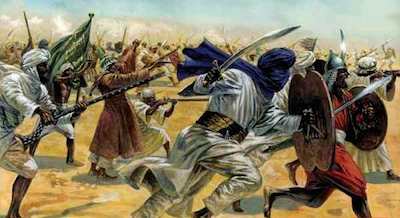
After establishing a group of followers in the Arabian Peninsula as the “last prophet”, proclaiming Islam as the one, true faith, Muhammad died in 632 C.E. Within ten years, the Arabs had conquered Jerusalem and were taking aim at Damascus and Cairo. Baghdad and the Libyan Desert were the next to be conquered. They moved on to Spain and Central Asia.
During his lifetime, Ali, Mohammad’s son-in-law, was the leader of the Arab forces. As noted in Samuel Willard Crompton’s ‘The Handy Military History Answer Book’, by the time the Arabs fought the Byzantines and the Persians they had also initiated the great split that remains today between the Sunnis and the Shiites.” Shiite means “follower of Ali.” The Sunnis wanted to elect their own caliph.
After taking the southern half of Spain, the Muslim army was poised to take all of Europe, but their 732 C.E. defeat in the Battle of Tours put an end to further expansion. Their momentum in Asia was stopped in 751 C.E. with a defeat in the Battle of Talas. As Crompton notes, “in the century that followed the Prophet’s death, the Arabs took over ninety percent of all the urban centers in the Western world, and their conquests equaled those of ancient Rome.”