

By John Treadwell Dunbar ——Bio and Archives--October 9, 2012
Travel | CFP Comments | Subscribe | Email Us
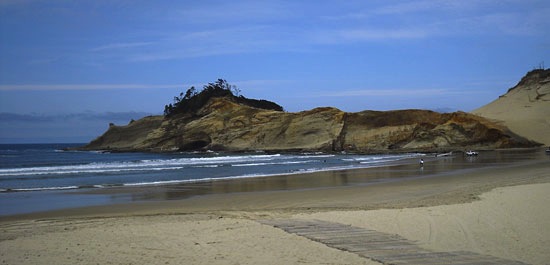 Devoid of the Willamette Valley crowds that descend on Lincoln City on the northern Oregon Coast during the pleasant months, the exquisite tranquility of forty-mile-long Three Capes Scenic Drive, and quaint ocean-side villages that dot this string of pristine pearls, is a surprising and pleasant respite few out-of-state visitors are aware of.
Beginning at tiny Pacific City three miles west of Highway 101, and meandering generally north past diminutive and sandy Cape Kiwanda, the two-mile lofty protrusion of Cape Lookout that juts out into the Pacific Ocean like the Titanic, and the rocky bulk of Cape Meares at the far northern end of the drive, this hidden gem of coast pulls us back year after year without fail.
Devoid of the Willamette Valley crowds that descend on Lincoln City on the northern Oregon Coast during the pleasant months, the exquisite tranquility of forty-mile-long Three Capes Scenic Drive, and quaint ocean-side villages that dot this string of pristine pearls, is a surprising and pleasant respite few out-of-state visitors are aware of.
Beginning at tiny Pacific City three miles west of Highway 101, and meandering generally north past diminutive and sandy Cape Kiwanda, the two-mile lofty protrusion of Cape Lookout that juts out into the Pacific Ocean like the Titanic, and the rocky bulk of Cape Meares at the far northern end of the drive, this hidden gem of coast pulls us back year after year without fail.
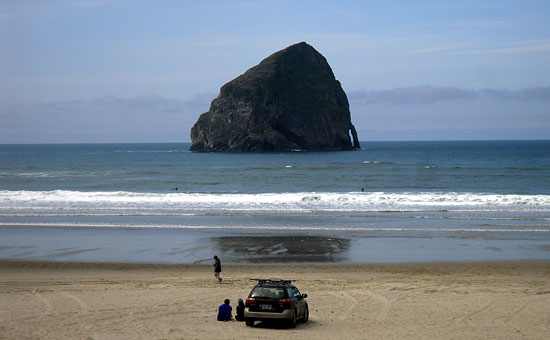
 Most visitors deploy their kites, Frisbees and screaming children at the Cape Kiwanda parking lot. Motor vehicles are allowed on the beach, unlike many other places along the coast, where families and friends picnic and frolic in view of the sandy protrusion named Cape Kiwanda, and one of the grandest and photogenic haystack rocks on the entire Oregon coast, Chief Kiawanda Rock.
For those with lungs and legs to spare, climbing high dunes near Cape Kiwanda and sliding down the steep descent is a popular activity, as are hang gliding and paragliding off the summit for those who don't know better. Like beaches up and down the Oregon Coast, these offer beach combing for hermit crabs, sand dollars and agates, and once Japan's tsunami debris begins to invade us in its radioactive glory, grinning human skeletons trapped in a tangle of two-by-fours, rusty nails, broken glass floats, and invasive marine species foreign to American soil that are certain to wreak havoc with our biological diversity and well-being.
Most visitors deploy their kites, Frisbees and screaming children at the Cape Kiwanda parking lot. Motor vehicles are allowed on the beach, unlike many other places along the coast, where families and friends picnic and frolic in view of the sandy protrusion named Cape Kiwanda, and one of the grandest and photogenic haystack rocks on the entire Oregon coast, Chief Kiawanda Rock.
For those with lungs and legs to spare, climbing high dunes near Cape Kiwanda and sliding down the steep descent is a popular activity, as are hang gliding and paragliding off the summit for those who don't know better. Like beaches up and down the Oregon Coast, these offer beach combing for hermit crabs, sand dollars and agates, and once Japan's tsunami debris begins to invade us in its radioactive glory, grinning human skeletons trapped in a tangle of two-by-fours, rusty nails, broken glass floats, and invasive marine species foreign to American soil that are certain to wreak havoc with our biological diversity and well-being.
 Has it really been that long? Thirty years ago my bonnie blond lass and I, and some shaggy brown mutt she adopted back home, set out from the Cape Lookout parking lot for the 5-mile round-trip hike to the very tip of the cape and back. We had the parking lot and the trail all to ourselves back in those days, unlike the small crowds today that have discovered one of the great hikes along the coast. We knew we weren't supposed to spend the night camping out on the end.
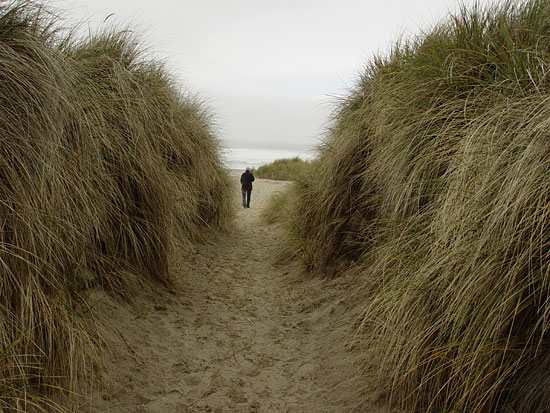 Just in case, we hauled along our tent and one cozy large sleeping bag, and other what-nots, and made the wandering trek through towering old-growth, and out along the very edge of hundreds of feet of nothingness where the muddy, slippery trail skirted the inevitable end of life with one careless miss-step. And once we reached the very end, with the shimmering, vast and wide-open Pacific wrapped around us on three sides, my bonnie lass and I embraced the wind and sun and exquisite view with open arms like Sunday Pentecostals hard at work, long before Leo DiCaprio and Kate Winslet memorialized their rapturous ecstasy on the prow of the Titanic.
And there we stood for the longest time, then sat on the old bench and cuddled and smooched, and waited for the setting orange sun to sink into the flat horizon, wondering if we should dare the powers-that-be and slink into the deep forest for the night like common criminals, or hoof it out in the dark. Decisions, decisions. And more touching.
And then I took my gal by the hand, and off we trudged into the towering forest of fir and green ferns, and soft, deep, springy beds of fallen pine needles where I set up our little tent for the long night, out of view and out of earshot. Warm and cozy, and giddy at our presumptuousness and brazen disregard for the forest-Nazis who surely had better things to do than harass a couple of love-struck, groping kids who couldn't keep their hands off each other.
Just in case, we hauled along our tent and one cozy large sleeping bag, and other what-nots, and made the wandering trek through towering old-growth, and out along the very edge of hundreds of feet of nothingness where the muddy, slippery trail skirted the inevitable end of life with one careless miss-step. And once we reached the very end, with the shimmering, vast and wide-open Pacific wrapped around us on three sides, my bonnie lass and I embraced the wind and sun and exquisite view with open arms like Sunday Pentecostals hard at work, long before Leo DiCaprio and Kate Winslet memorialized their rapturous ecstasy on the prow of the Titanic.
And there we stood for the longest time, then sat on the old bench and cuddled and smooched, and waited for the setting orange sun to sink into the flat horizon, wondering if we should dare the powers-that-be and slink into the deep forest for the night like common criminals, or hoof it out in the dark. Decisions, decisions. And more touching.
And then I took my gal by the hand, and off we trudged into the towering forest of fir and green ferns, and soft, deep, springy beds of fallen pine needles where I set up our little tent for the long night, out of view and out of earshot. Warm and cozy, and giddy at our presumptuousness and brazen disregard for the forest-Nazis who surely had better things to do than harass a couple of love-struck, groping kids who couldn't keep their hands off each other.View Comments
John Treadwell Dunbar is a freelance writer