

By Dr. Lawrence Sasaki ——Bio and Archives--November 8, 2026

Edgar Varese (1883-1965) wrote music comprising “sound masses”, static sonic objects placed here and there. Each sound mass was an entity, with an attack, decay, sustain, release, mimicking the composition of natural instrumental sounds, but using clusters of instruments to create each “sound object” such as in his composition “Hyperprism (1927)”.
Arnold Schoenberg (1864-1951) wrote in the style of “atonal music”. His approach was based on a twelve tone row, as in “Suite for Piano, Op. 25”, where each note was treated equally, the musical equivalent of DEI. Traditional music employed a hierarchy of intervals, with the consonant, such as the fifth, being more prominent than the dissonant, such as a seventh.
Anton Webern (1883-1945) too was a composer who explored atonal music. He also worked with a concept called Klangfarbenmelodie in which the “melody” is not the sequence of tones, but is the sequence of tone qualities. For example, he used Bach's Ricecar in 1934 as the basis for a klangfarbenmelodie where the scoring was focused on the sequence of instruments and not the sequence of notes.
Karlheinz Stockhausen (1928-2007) was an early exponent of electronic music. He pioneered the use of stochastic processes, random processes, to govern his composition. Stochastic processes form the basis for computer random number generation, essentially a computer version of noise. One of his earlier pieces is “Telemusik (1966)”
John Cage (1912-1992) explored different compositional techniques, including one he called prepared piano, where the sound of each note is adulterated using different techniques such as pads or nails or other sound altering techniques. It is said that his music became more and more bizarre, as when you explore the bizarre, you must push the envelop further and further to keep the interest of your followers.

One of his pieces is “4'33 (1952)”, where, in one performance, he went to a piano placed in the middle of Harvard Square, opened the piano, started a stop watch, and sat for 1 minute and 13 seconds. Then he stopped the stopwatch, closed the lid, stood and took his bows. The “music” was the ambient the sound of the traffic and pedestrians of the Square.
Steve Riech (1936-) pioneered a musical form called “phasing”. A performance includes a number of players, each playing the same melody, but at slightly different rates. As the piece progresses different combinations of the tones would create different sonic textures and patterns, eventually coming back to where they started. One is “Six Marimbas (1986)”.
This trend to modernism started with the Romantic composers arising during Beethoven’s late period. Early modernist, “impressionist”, compositions such as Erik Satie’s “Trois Gymnopédies (1888)” and Claude Debussey’s “Clair de Lune (1905)” are hauntingly beautiful, but melancholy and ultimately empty. Perhaps Gymnopédie No 1(1) presaged our current age of angst and loneliness.
In contrast, let us look at some of the earlier composers prominent during the Baroque period.
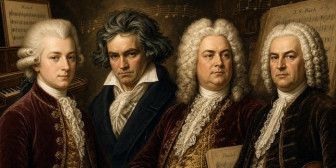
Mozart was a prolific composer producing a body of wonderful music. His life was dramatized in the play and later the film “Amadeus”. In it, we see the interplay between him and a rival, Antonio Salieri, who was jealous of Mozart's prodigious talent. At one point, Constanze, his wife, wanting to secure a prestigious position for Wolfgang, went to Salieri with some of Mozart's work.
Salieri took the manuscript and as the music played in his head, he fell in a deep reverie. Called back by Constanze, she asked again about the manuscripts. He replied that he would consider it, and asked her if she could leave them for further consideration. She said that she could not. “Wolfgang would be frantic if he found them missing. You see sir, they are originals.”
Salieri was incredulous as there was not a single change, erasure or correction of any type. I have to laugh as I sit here with an open text editor, typing, backspacing, deleting, changing, moving lines around to know that is not how it is for us mere mortals, but Amadeus was extraordinary.
In the play, Salieri, in disguise, commissions a work which would become “Requiem” all the while poisoning Mozart. The work is not finished. He pushes Mozart and helps him try to finish it, but Mozart dies before it is finished. Historians say, that while this makes for good drama, Mozart probably died from one of the many cholera epidemics common at the time. His last piece, “Requiem”, a requiem mass, was unfinished, completed by his student Franz Xaver Süssmayr, in the “style of Mozart”.
I consider Mozart's “Requiem” to be among the most sublime pieces of music ever. It is a heavily layered piece. it opens softly with bass strings, and then a single bassoon which gives way to a single clarinet, all to a counterpoint of strings. Other bassoons and clarinets join in, intricately woven together like a musical tapestry, then a crescendo of brass and strings. And then silence, giving way to the voices, also coming in layer upon layer. One can imagine the deceased being carried to heaven on the wings of angels.
Handel was born in Germany in 1685. He moved to London in his late ’30s focused primarily on opera. As interest in opera waned in London, he found himself contemplating retirement. Discouraged, he was presented with a libretto for “Messiah” by Charles Jennens(2), a literary scholar. He had crafted a libretto with carefully selected Old and New Testament scriptures of the Messiah. He wanted to counter the growing deism in England, a theology that denied the deity of Messiah.
Accounts indicate that Handel completed the work in 24 days, with few corrections in a 259 page manuscript, producing a masterwork of 2 and a half hours. He took little food during this time and the people around him despaired of his health.
After he wrote the “Hallelujah” chorus, Handel was quoted as saying, “I did think I did see all heaven before me, and the great God Himself.”
There is a tradition of audiences standing during the “Hallelujah” chorus. The tradition goes back to King George II standing when he was moved by the performance, and, as protocol dictates, everyone else stood with him. The story is a bit apocryphal, but the tradition remains. This is his most remembered work, but Handel himself took no credit for it, signing at the bottom “SDG”, Soli Deo Gloria, “To God Alone the Glory.”
Johann Sebastian Bach was a prolific composer. He is remembered mainly for his organ music, but he also wrote large orchestral works. When I was young, I took piano lessons and his two part inventions were part of the repertoire. They were amazing pieces of music as the right hand begins and then the left hand follows playing exactly the same as the right hand, but delayed in time.
A lot of his work was ecclesiastical, with many cantatas and motets. It includes the St Matthew Passion (BWV 243) and the St John Passion (BWV 245), which are set in Christ’s last days, and the Magnificat (BWV 243 / BWV 243a). He was Thomaskantor in Leipzig and Kapellmeister from 1717 to 1723 for Prince Leopold of Anhalt-Köthen.
I include his signature piece, “Toccata and Fugue in D Minor (BVW 565)”. Most people don't remember it by that name, but it is familiar to most people through the cinema, especially, the horror genre with movies such as “The Phantom of the Opera (1962)”. The piece of music was originally little considered, until it was re-discovered in a manuscript by Johannes Ringk and published in 1833, 85 years after Bach's death.
Ludwig Van Beethoven was born in Bonn, Germany, He was a child prodigy, just as was Mozart, and found patronage in Vienna, His career included many piano works, orchestral works and opera. At some point, he began to suffer hearing loss, eventually becoming completely deaf. He would compose the music in his head and commit it to paper. His later works, including the Ninth Symphony, launched the Romantic era, leading to humanist music. His final symphony is the first choral symphony. I include an extract, “Ode to Joy”, from the final movement of his Ninth Symphony.
“Ode to Joy”, “An die Freude”, is an ode written in 1785 by Friedrich Schiller and was noted for its celebration of the brotherhood of man. Beethoven's text is adapted from Schiller's ode. Beethoven's melody, but not Schiller's text, was adopted as the “Anthem of Europe” by the Council of Europe in 1972 and later by the European Union. God is not absent in Beethoven's rendering, as the last stanza used in the symphony, taken from the middle of Schiller’s ode, points to the creator.
You millions, I embrace you.
This kiss is for all the world!
Brothers, above the starry canopy
There must dwell a loving Father.
Do you fall in worship, you millions?
World, do you know your Creator?
Seek Him in the heavens!
Above the stars must He dwell.
Soli Deo Gloria.
Let every thing that hath breath praise the LORD. Psalm 150:6.
Notes and References
View Comments