

By Douglas V. Gibbs ——Bio and Archives--November 17, 2026
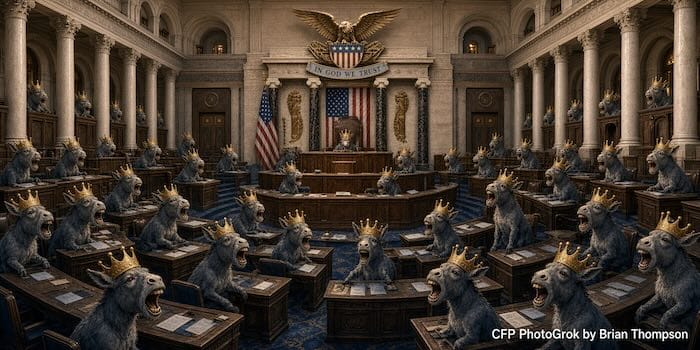
They say they're going to subpoena like beads on Mardi Gras. Fine. The problem is that there is no oversight clause in the Constitution. Not one word. The only thing either House is expressly empowered to compel is the attendance of its own absent members. Everything else is inference stacked on inference, and the Democrats are about to run a country on it.

Robert Garcia's entire transition message was two words: "Lawyer up."
They argue the GOP and Trump have engaged in an unprecedented assault on the democracy. What they are offering is a temper tantrum with a printing budget. That doesn't make it harmless, and it doesn't mean the answer is to do the same thing back.
Everything for them is about volume, and not one oversight argument is about a statute, a bill number, or an enumerated power. Volume is not legitimacy. Every subpoena issued to harrow a man rather than to inform a statute is an unconstitutional use of Article I against Article I.
The Constitution contains no general grant of inquisitorial authority. The word "oversight" appears nowhere in it. It's a coinage from the Legislative Reorganization Act of 1946. A statute, not a clause in the Constitution. Legislation doesn't make a power constitutional when the power isn't in the text. Only an amendment does.
They'll point at text that says nothing of the sort.
Article I, Section 1 grants "all legislative Powers.” It is about the authority to make, modify and repeal law. Nothing more. The Necessary and Proper Clause is auxiliary by its own words: means to an end, not a reservoir of implied powers. The impeachment clauses indict for a political trial and remove on Senate conviction, but say nothing about evidence-gathering machinery. Article II, Section 3 is a duty to speak, not to produce. Article I, Section 9, Clause 7 is transparency to the people, not congressional micromanagement.
The power to investigate and prosecute belongs to the executive branch. The power to subpoena and adjudicate belongs to the judicial branch. Everything the Democrats claim they will do to go after their opponents are based on powers and authorities that Congress does not constitutionally possess. There is a thing called Separation of Powers, and it is there for a reason.
Section 5, Clause 1 is the only express compulsion: a House may compel the attendance of absent Members. Members. Not citizens, not cabinet secretaries, not the President. Their investigative authority extends to their own behavior.

Any compulsion over anyone outside the legislative tent must come by statute, tied to the legislative power. The Tenth Amendment closes the category. Jefferson gave the test in 1791: "To take a single step beyond the boundaries thus specially drawn around the powers of Congress, is to take possession of a boundless field of power." A single step, not a balancing test, not the "penetrating and far-reaching" standard the courts and legislature has invented.
The counterargument thrown at me has been when in 1792 the House voted to investigate St. Clair's massacre. The founding generation did it, so doesn't that settle it? No. The founding generation giving itself a power by legislation is not the Constitution granting it.
Washington drew the line himself in 1796 when the House demanded the Jay Treaty papers. He conceded the House may ask where a treaty requires a law to execute. Inquiry incident to an enumerated function is permissible. Inquiry as a freestanding power to expose is not. That's the line, and everything since is trespass on the far side of it.
The Framers told us which branch they feared. Madison, July 21, 1787: "a powerful tendency in the Legislature to absorb all power into its vortex." In 1800, in Robbins, John Marshall argued the House was not the grand inquest of the nation.
If Congress can subpoena and punish noncompliance, Congress is acting judicially. A penalty with no jury, no Article III judge, no due process, no appeal. That isn't a check. That's a courtroom with worse rules and a mob swinging the gavels. Congress's own 1857 contempt statute confesses it by handing process to the executive to prosecute, because Congress can't execute. In 1881, Kilbourn v. Thompson struck down a House investigation of a private bankruptcy for exactly that reason.
What should happen? Every subpoena needs to name the bill it's associated; pending bill number, appropriation, or article of impeachment. On its face. No bill, no compulsion. Congress may ask and be refused. If they want process that binds like a court's, make it an Article III case and let the courts issue it. Where they want standing access, legislate a reporting duty.
Look at the military, because it's the model. The Framers didn't hand Congress a subpoena. They gave it Article I, Section 8, Clause 14: rules for the government and regulation of the land and naval forces. A rule-making power. Congress oversees the army by legislating; the Commander in Chief executes.
And if a President runs off the rails, defund the operation, or impeach him. What doesn't exist is a power to force his hand because a committee would have done it differently.
They take the gavels January 3rd. Gavels mean subpoenas with no floor vote. The expected sequence: Homeland Security, OMB, White House staff; contempt referrals to an Attorney General they'll call compromised; civil enforcement; then inherent contempt and fines, last used in 1935; then cabinet-level articles as mini-impeachments, each generating its own discovery, all timed for 2028.
How to respond? Don't refuse process. Bannon and Navarro went to prison for it. Document everything, negotiate scope, produce the tedious material, assert deliberative process and communications privilege over the rest, and force contested demands into Article III, where the executive has won and the clock runs in its favor. Pick a clean test case.
Then the politics writes itself. They promised cheaper gas and their record says otherwise; the price signal is the policy, and California built it in on purpose. Every week of Epstein and Nvidia is a week not spent on cost of living, the only thing they ever ran on. Gutfeld asked the question that belongs over the Oversight Committee door: "The point, if the point is obstruction, is what are you obstructing?"
Fifty-four seats, maybe fifty-six. Not sixty. D.C. statehood, court packing, a federalized election code all die at cloture unless they first blow up the Senate's own rules. The Republican job in the Senate isn't to win arguments. It's to hold sixty and make the price of losing it visible.
Two years is a long time to hold a hearing and a very short time to build a country.
So don't panic. Let them print their forests. Answer the subpoenas. Keep the deadlines. Litigate the scope. Put two years of receipts next to their hearing transcripts.
A Congress can compel a man to appear. It cannot compel the country to care. That's done by results, the one thing on the docket they cannot subpoena.
View Comments
Douglas V. Gibbs of Political Pistachio Conservative News and Commentary, has been featured on “Hannity” and “Fox and Friends” on Fox News Channel, and other television shows and networks. Doug is a Radio Host on KMET 1490-AM on Saturdays with his Constitution Radio program, as well as a longtime podcaster, conservative political activist, writer and commentator. Doug can be reached at douglasvgibbs [at] yahoo.com or constitutionspeaker [at] yahoo.com.