

By Sierra Rayne ——Bio and Archives--January 7, 2015
Global Warming-Energy-Environment | CFP Comments | Subscribe | Email Us


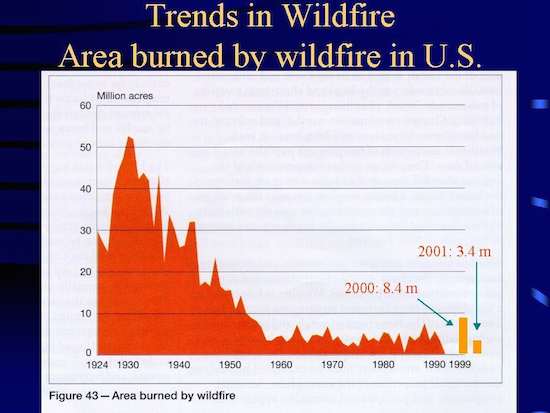 Recent data since 2000 by the US EPA shows the past 15 years has only seen between about 4 and 10 million acres burned each year, well below what was experienced during the first half of the 20th century. The take-home message is that land-use changes and management strategies cannot be neglected when looking at possible relationships between wildfires and climate change. Unfortunately, the media all too often just reports the possible climate linkage.
Reliable historical data out of Australia appears more difficult to obtain. The Australian Government's Department of Climate Change and Energy Efficiency has a report showing the annual area of forests burned by wildfire between 1990 and 2009. There does not appear to be any significant trend in the data. The report in no way suggests that wildfires are increasing in Australia due to climate change.
Similarly, a 2013 study in the International Journal of Climatology looked at "a data set of observed fire weather in Australia from 1973-2010" and concluded that "this study cannot separate the influence of climate change, if any, with that of natural variability." A recent report by Lloyd's of London on "Wildfire: A Burning Issue for Insurers?" showed no significant trend in wildfire area burned in Australia since their dataset began in the late-1990s.
F.H. McKinnell, a consultant in forestry and natural resources management from Western Australia, has an excellent essay on prescribed burning and wildfire in southwestern forests of Australia, and a graph showing the respective areas of prescribed burns and wildfires in this region since 1960. The area burned by wildfires over time is far smaller than that of prescribed burns, but as the fire management policies were changed for political reasons in order to reduce the prescribed burn areas, recent decades have seen a modest increase in wildfires area burned for this region.
A self-fulfilling prophecy is underway. The same groups of environmentalists -- within and outside of government -- that have been claiming anthropogenic climate change is increasing wildfires are the same types of groups which advocated for a change in forest management policies decades ago, leading to a reduction in prescribed burns and other activities which had kept wildfires at lower levels. In other words, advocate against forest management wildfire reduction strategies, and then when the wildfires become more frequent, intense, and/or larger, blame the increases on climate change. A perfect storm of nonsense.
Another article on the Bush Fire Front's website -- which is run by an experienced team of forest management professionals -- provides the following chart of wildfire (lower red line) and prescribed burn (upper green line) areas in Western Australia since 1950. As the prescribed burn area has declined, the wildfire area has increased.
Recent data since 2000 by the US EPA shows the past 15 years has only seen between about 4 and 10 million acres burned each year, well below what was experienced during the first half of the 20th century. The take-home message is that land-use changes and management strategies cannot be neglected when looking at possible relationships between wildfires and climate change. Unfortunately, the media all too often just reports the possible climate linkage.
Reliable historical data out of Australia appears more difficult to obtain. The Australian Government's Department of Climate Change and Energy Efficiency has a report showing the annual area of forests burned by wildfire between 1990 and 2009. There does not appear to be any significant trend in the data. The report in no way suggests that wildfires are increasing in Australia due to climate change.
Similarly, a 2013 study in the International Journal of Climatology looked at "a data set of observed fire weather in Australia from 1973-2010" and concluded that "this study cannot separate the influence of climate change, if any, with that of natural variability." A recent report by Lloyd's of London on "Wildfire: A Burning Issue for Insurers?" showed no significant trend in wildfire area burned in Australia since their dataset began in the late-1990s.
F.H. McKinnell, a consultant in forestry and natural resources management from Western Australia, has an excellent essay on prescribed burning and wildfire in southwestern forests of Australia, and a graph showing the respective areas of prescribed burns and wildfires in this region since 1960. The area burned by wildfires over time is far smaller than that of prescribed burns, but as the fire management policies were changed for political reasons in order to reduce the prescribed burn areas, recent decades have seen a modest increase in wildfires area burned for this region.
A self-fulfilling prophecy is underway. The same groups of environmentalists -- within and outside of government -- that have been claiming anthropogenic climate change is increasing wildfires are the same types of groups which advocated for a change in forest management policies decades ago, leading to a reduction in prescribed burns and other activities which had kept wildfires at lower levels. In other words, advocate against forest management wildfire reduction strategies, and then when the wildfires become more frequent, intense, and/or larger, blame the increases on climate change. A perfect storm of nonsense.
Another article on the Bush Fire Front's website -- which is run by an experienced team of forest management professionals -- provides the following chart of wildfire (lower red line) and prescribed burn (upper green line) areas in Western Australia since 1950. As the prescribed burn area has declined, the wildfire area has increased.
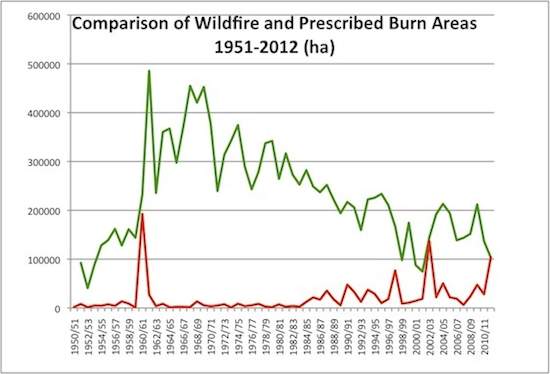 No need to invoke anthropogenic climate change. If you reduce your prescribed burns, fuel supplies will accumulate in the forest, resulting in more intense and larger wildfires.
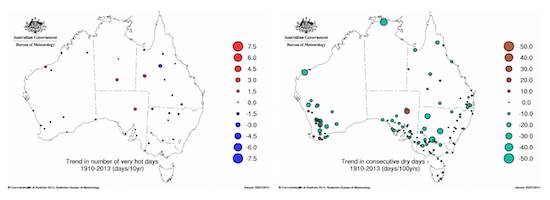
Looking back on Australia's climate since records began in the early 1900s reveals trends -- and absence of trends -- that run at odds with the man-made climate change causing wildfires narrative. There is absolutely no significant trend in number of very hot days for Australia since records began in 1910, and over the last 30 years the correlation is towards fewer -- not more -- of them. Looking at regional trends (see chart below) certainly doesn't yield anything compelling. No significant trends in hot days, either, since 1910 or 1984.
The negative -- not positive -- trend in the number of consecutive dry days since records began in 1900 is almost significant (p=0.08), and the past 30 years is nearly a perfect non-correlation. No climate change support for increasing wildfires here. The regional trends are nearly all negative, as the figure below clearly shows.
No need to invoke anthropogenic climate change. If you reduce your prescribed burns, fuel supplies will accumulate in the forest, resulting in more intense and larger wildfires.
Looking back on Australia's climate since records began in the early 1900s reveals trends -- and absence of trends -- that run at odds with the man-made climate change causing wildfires narrative. There is absolutely no significant trend in number of very hot days for Australia since records began in 1910, and over the last 30 years the correlation is towards fewer -- not more -- of them. Looking at regional trends (see chart below) certainly doesn't yield anything compelling. No significant trends in hot days, either, since 1910 or 1984.
The negative -- not positive -- trend in the number of consecutive dry days since records began in 1900 is almost significant (p=0.08), and the past 30 years is nearly a perfect non-correlation. No climate change support for increasing wildfires here. The regional trends are nearly all negative, as the figure below clearly shows.
 As I've previously noted, "there has been no statistically significant trend in Australia's average annual temperature since at least 1980 ... there hasn't been a significant trend for autumn temperatures in Australia since before 1970 ... there hasn't been a significant trend in Australia's average summer temperature since at least the mid-1970s."
From another prior article, "the trend in precipitation over almost all of Australia since 1900 has been either one of increasing precipitation or no trend whatsoever. Since 1970, there have been no significant trends in annual precipitation in any of the country's climate regions." A generalized debunking of the climate hysteria down under has also been previously presented.
Al Jazeera also made an attempt to link climate change to the recent wildfires in Australia, but ran into some well-deserved skepticism: "However, Fire Ecologist Matthias Boer -- from the Hawkesbury Institute for the Environment at the University of Western Sydney -- told Al Jazeera that caution needs to be taken when connecting climate change to the frequency and intensity of wildfires." Caution on climate change linkages in journalism. What a novel concept.
Overall, the evidence does not suggest the wildfires of late in Australia are caused by anthropogenic climate change. Look to changes in forest management practices and natural cycles instead.
As I've previously noted, "there has been no statistically significant trend in Australia's average annual temperature since at least 1980 ... there hasn't been a significant trend for autumn temperatures in Australia since before 1970 ... there hasn't been a significant trend in Australia's average summer temperature since at least the mid-1970s."
From another prior article, "the trend in precipitation over almost all of Australia since 1900 has been either one of increasing precipitation or no trend whatsoever. Since 1970, there have been no significant trends in annual precipitation in any of the country's climate regions." A generalized debunking of the climate hysteria down under has also been previously presented.
Al Jazeera also made an attempt to link climate change to the recent wildfires in Australia, but ran into some well-deserved skepticism: "However, Fire Ecologist Matthias Boer -- from the Hawkesbury Institute for the Environment at the University of Western Sydney -- told Al Jazeera that caution needs to be taken when connecting climate change to the frequency and intensity of wildfires." Caution on climate change linkages in journalism. What a novel concept.
Overall, the evidence does not suggest the wildfires of late in Australia are caused by anthropogenic climate change. Look to changes in forest management practices and natural cycles instead.View Comments
Sierra Rayne holds a Ph.D. in Chemistry and writes regularly on environment, energy, and national security topics. He can be found on Twitter at @srayne_ca

