

By Hymie Rubenstein ——Bio and Archives--March 16, 2025
Canadian News, Opinion | CFP Comments | Subscribe | Email Us
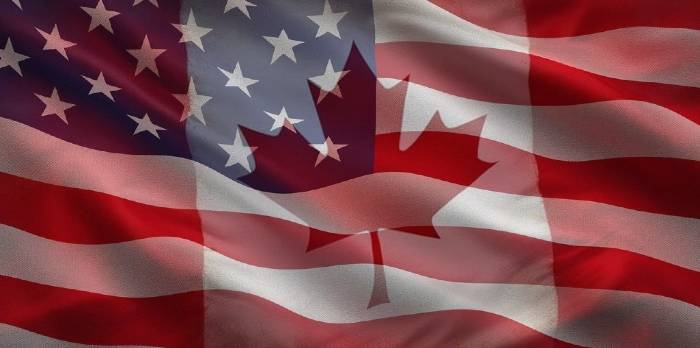
This news site’s motto – "Because without America there is no Free World" – has become even more meaningful since the re-election of Donald Trump on November 5, 2024. Today, more than ever before Canada and the Free World must be guarded by America by all who believe in free will and basic human dignity.

This was not always the case. The rebel colonists to our south have long been interested in absorbing the upper half of our shared continent by hook or by crook. Despite Thomas Jefferson’s confident assertion "The acquisition of Canada this year, as far as the neighborhood of Quebec, will be a mere matter of marching, and will give us experience for the attack on Halifax the next and the final expulsion of England from the American continent," American invasions during their revolutionary war and the War of 1812 were decisively beaten back. The cry of “54-40 or Fight,” adopted by President James K. Polk would have seen the border of the USA extend north to what is now Alaska. The years following their Civil War saw a number of invasions of Canada launched by Irish-Americans with the support of anti-British politicians and activists.
Most recently, the current inhabitant of the White House – that building set ablaze by English troops in 1814 in retaliation for the burning of the town that is now Toronto – has mooted Canada becoming his country’s 51st state. The juvenile vulgarity of his approach has provoked a wave of maple leaf clutching that has blinded Canadians to the many advantages that a voluntary North American union would bring.
Given our current antiquated and underfunded military system, being directly part of the most powerful fighting nation in the world is only one of many reasons why the Canadian people would be far better off as Americans than they are now, or have ever been since the creation of the Dominion of Canada on July 1, 1867.
Becoming part of the U.S. would give Canada access to the world’s most advanced military infrastructure, reducing its own defense burden while enhancing national security. This would be particularly beneficial in a world of increasing geopolitical tensions.

On March 12, Commerce Secretary Howard Lutnick said that “… the best way to actually merge the economies of Canada and the United States is for Canada to become our 51st state. If they want to merge it, that’s how you make it the 51st state.”
Lutnick’s comments came amid recent tension between the U.S. and Canada over tariffs. On March 11, President Trump said he was going to raise planned steel and aluminum tariffs against Canada due to a surcharge on electricity from the Ontario government.
A merging of the two countries would instantly remove these punishing tariffs, including those in Canada’s inefficient and anti-competitive dairy supply management system.
Trump has just doubled tariffs on Canadian steel and aluminum from 25 percent to 50 percent, while threatening to "shut down" the country's auto industry. The "only thing that makes sense" is for Canada to join the United States as a 51st state, he said. "This would make all Tariffs, and everything else, totally disappear."
Joining the U.S. would mean unified trade policies and the elimination of border management, making travel and business operations far more productive.
Integration would also bring Canada into the much larger, less regulated, and more capitalistic U.S. economy. This would create boundless opportunities for businesses, large and small. Eliminating international trade barriers and replacing them with standardizing policies would result in significant economic growth. Add to this the cutting of Canada’s high welfare-state income tax rates would put more money into people’s pockets. The abolition of the Canada Health Act would enhance private healthcare solutions, ensuring efficiency and fairness in the provision of medical services.
Despite the generally recognized economic benefits, a large majority of Canadians agree that Canada should remain independent in spite of Donald Trump’s contrary wishes, though three in ten (30%) would consider annexation if offered US citizenship and conversion of Canadian financial assets to US dollars.
More telling is that four in ten (43%) Canadians aged 18-34 would vote to be American if citizenship and conversion of assets to USD were guaranteed.
Likewise, Alberta lawyer Jeffrey Rath says a group of Albertans with connections in Washington are heading south to talk to the Trump administration about the province joining the US.
Converting Canadian to American dollars on a one-to-one basis – a demand that should be our make or break one – would instantly raise our standard of living by 30 percent.
Trump has repeatedly suggested that Canada should “become the 51st state,” but Mark Carney, Canada’s brand new prime minister, said on Sunday, March 9 that “Canada never, ever will be part of America in any way, shape or form.”
“But think about this for a second, why are American cars made in Canada? … Those jobs should be in America. And that’s what the president thinks, and that’s what he says and that’s what he’s going to execute,” Lutnick said on March 12.
If Trump succeeds in this execution, those jobs will continue to be in an expanded American country to the increased benefit of our thousands of auto workers who would instantly see a 30 percent increase in their earnings, an increase other workers would see as well.
Our tax burden would also decrease. Including federal, state, and local taxes, the average American pays approximately 24 percent of their income in taxes. The total tax burden for the average Canadian family, including federal, provincial, and local taxes, is some 46.1 percent of their income.
Perhaps most important of all, being absorbed by America would expose Canadians to a far more competitive economic environment which would promote hard work, innovation, and entrepreneurship. A union could incentivize lazy or less motivated individuals to participate more actively in the workforce, as reliance on the current Canadian welfare system would diminish.
In short, the U.S. offers a system that rewards hard work and innovation, while Canada provides a generous economic safety net that too many people exploit or are seduced to be dependant on.
The idea of Canada joining the United States as its 51st state is a contentious issue that is provoking strong emotions while raising concerns about national identity and shared values.
But do we really have a shared national identity and shared values? If so, are these radically different than those of our American neighbours?
In a New York Times interview published on December 8, 2015, Justin Trudeau said:
‘‘There is no core identity, no mainstream in Canada. There are shared values – openness, respect, compassion, willingness to work hard, to be there for each other, to search for equality and justice. Those qualities are what make us the first post-national state.’’
These same values are expressed by our American neighbours – not to mention scores of countries around the world – who became members of post-national state over 100 years before we did, no coincidence given that the founding fathers of both countries had internalized and codified British values in their respective constitutions in the 18th and 19th century.
Also, if the definition of nationalism is the presence of a single national identity rooted in ethnicity, language, and religion, then Canada is a "post-national state,” not only because of the uniqueness of Quebec but because we, and America, have always been de facto multi-cultural, multi-value states.
Indeed, the fluid and contestable nature of Canadian identity and common values, except for the vague ones enunciated by Trudeau, is shared with our southern neighbours, on the one hand, while 90 percent Canadians who live less than 100 north of the 49th parallel share more substantive beliefs and values with those immediately south of it than either does with peoples and cultures in far flung parts of their two countries, on the other.
Due to its multicultural nature, there is ongoing dialogue about Canadian identity and culture. A lack of definitive answers is even more reason to call ourselves – and our American cousins – post-national state citizens.
As part of America, our people would gain access to the global social, political, and economic clout of the United States. Canadians would find their voices amplified on the world stage, including the United Nations Security Council, where these voices would have power over decisions that shape the world.
Given the rapid movements to remove DEI preferences, green polices, affirmative action, and “wokeness” generally from American society, amalgamation with American would quickly lead to an end to these pernicious policies in a 51st state called Canada.
The problem of unchecked immigration and illegal overstays would now be taken seriously.
We would forget about pretending to defend ourselves and our territory with a make-believe military more concerned with tampons in men’s washrooms.
Canadians would no longer be subject to Article 15(2) of the Trudeau constitution which permits racial, gender, and ethnic discrimination to remedy “historically disadvantaged” groups and which has served to work against healthy white males.
More particularly, our troublesome and expensive “Indian problem” would be solved overnight as the special preferences for indigenous people in our 1982 constitution and elsewhere are declared null and void.
Canadians would no longer fear having all their civil liberties suspended by executive fiat as happened with the proclamation of the War Measures Act and Emergencies Act by Trudeaus the Elder and the Younger
We would be quickly and painlessly rid of the CBC. Canadians missing their steady diet of left-wing special pleading could subscribe to PBS or NPR instead.
We would also become part of a republic with an elected Senate rather than politically appointed one and we would have a locally elected president as our Chief Executive, Commander in Chief, and Ceremonial Head of State. This would make us a truly sovereign people as opposed to a constitutional monarchy headed by Charles III, the foreign King of Canada who solely owns most of Canada and is also the Head of State. (Only 9.7% of the total land mass of Canada is privately owned while the rest is Crown Land, territory administered on behalf of the Crown by various agencies or departments of the government of Canada. The Canadian Act has no provision for any Canadian to own physical land in Canada. Canadians can only own an interest in an estate).
To be sure, there would be several disadvantages to being voluntarily annexed by the United States. Overall, however, a possible union of people with similar beliefs, values, and institutions should not be blindly dismissed or resisted simply based on mindless flag waving or a hatred of Donald Trump.
In 1774, Samuel Johnson printed The Patriot, a critique of what he viewed as false patriotism. On the evening of April 7, 1775, he made a famous statement: "Patriotism is the last refuge of the scoundrel.” The line was not, as is widely believed, about patriotism in general but rather what Johnson saw as the false use of the term "patriotism" by William Pitt, the British prime minister, and his supporters. Johnson opposed most "self-professed patriots" in general but valued what he considered "true" patriotism.
The shrill comments of many commentators about Trump’s wish to peacefully absorb Canada tells me that Johnson’s notion of “false patriotism” is alive, if not well, in Canada.
View Comments
Hymie Rubenstein, a retired professor of anthropology at the University of Manitoba, is editor of —REAL Indigenous Report.