These claims about “Indigenous science” need to be closely examined, something that has never been attempted
We have heard all this before in Canada, where indigenization has long been entrenched.
Still, the institutionalization of a radical Indigenous assault on Western science, aided and abetted by the Trudeau Liberal government, took a dramatic leap in July 2022 with the appointment of Myrle Ballard, an Anishinaabe woman from Lake St. Martin Indian Reserve, as first director of Environment and Climate Change Canada’s (ECCC) new permanent division of Indigenous Science.
The marginalization of Western ways of knowing was reinforced on September 18, 2023, when the House of Commons’ science and research committee adopted a motion to “undertake a study of how best to integrate Indigenous Traditional Knowledge and science into government policy development; how to resolve conflicts between the two knowledge systems.”
Terming the relation between both “knowledge systems” as “conflicts” that need resolution denies the elementary observation that the two systems are irreconcilable because they are rooted in competing paradigms based on very different systems of knowing.
Much of what is termed If “indigenous” science is not conducted according to scientific methodology that relies on factual, verifiable evidence for its findings and explanations. Rather, it is based on opinion, hearsay, imagination, and faith ungrounded to empirical evidence or an objective theoretical framework.
Ballard implicitly denied this in her testimony before the House science committee when she argued indigenous and Western science are “both sciences.”
“For example, when we develop traditional medicines, we have the traditionalists, the medicine-makers who take the medicines from the land,” she said. “They know they have to take the plant or whatever it is they’re using from as far away from human contamination as they can. They have recipes that they use as well. That’s the same as in a lab. There are recipes that have to be tested. There’s the colour and the consistency. That’s the same as Western science.”
A close reading of the committee’s mandate on Indigenous Traditional Knowledge and the new Indigenous Science division in the environment department, together with their uncritical – read: “unscientific” – acceptance of the comments from witnesses, suggests that the government of Canada also accepts Western science as just one version of science.
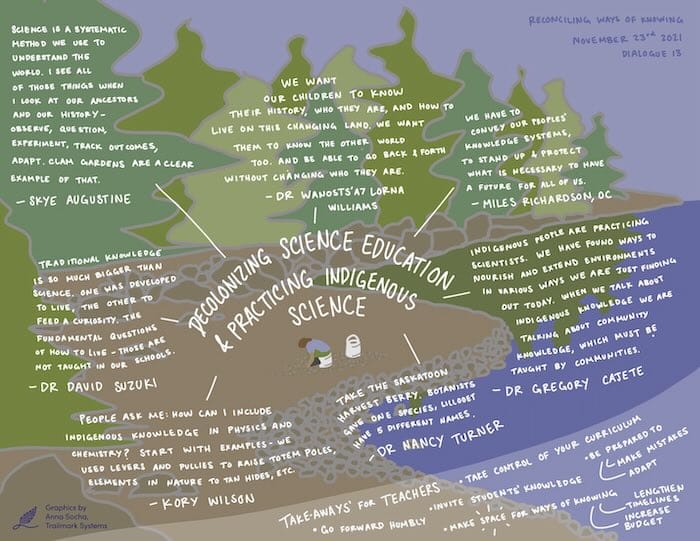
These claims about “Indigenous science” need to be closely examined, something that has never been attempted. This is no easy task, not the least because there must be at least 50 different systems of “Aboriginal science” in Canada corresponding to the country’s 50 different cultural and linguistic groups.
As for the content of “Indigenous science,” Jamie Sarkonak’s National Post analysis of the committee witness testimonies shows “Indigenous science, perhaps intentionally, is a difficult concept to pin down.”
“Advocates can’t define it in any consistent way, and frequently confuse science conducted by Indigenous people (i.e., long-term observational evidence on phenomena like caribou migration patterns) with non-scientific cultural beliefs that are somehow upheld as equivalent to the scientific method,” Sarkonak wrote. “There’s often a political, anti-colonial element to ‘Indigenous science.’”