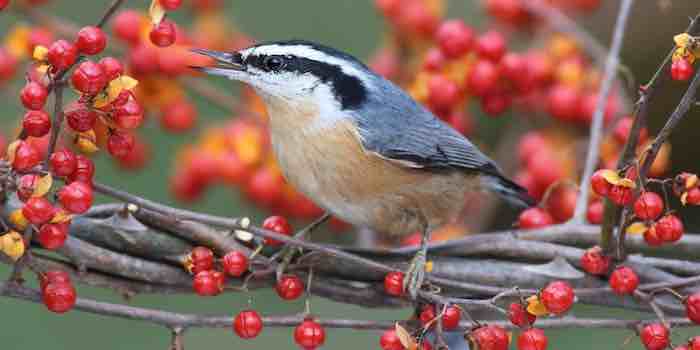
If there was a bittersweet Heaven, this was it
That delicate, yet hardy vine with the red-orange berries that so fascinated me as a youth thrived undisturbed in the woods right behind my house. I thanked God for this wonderful surprise. There it was—curling, climbing, decorating, entwining, hanging, threading and thrusting delicate curls with clumps of red-orange berries into the air. If there was a bittersweet Heaven, this was it.
This was the good old American Bittersweet of my youth that we searched for five decades earlier. Unlike its exotic cousin—the invasive Oriental Bittersweet--which chokes a forest with a kudzu-like vengeance, this was different. This vine did not choke the forest or dominate it; rather it complemented the forest, decorated it, and enhanced its beauty. It turns otherwise nondescript shrubs and small trees into works of art; and boring wild cedars into Christmas trees. Here the vine lived in harmony with other plant species. Against the bright white snows of winter, it provided a stark splash of vivid orange red color that lit up otherwise colorless woods. Here, in the midst of the remnants of this old pioneer farm, undisturbed by cultivation, safe from poisonous spray, protected from the blade, the mower, and fire, this vine had prospered for generations.
I stop frequently to study it, observe it, and photograph it. Its beauty is matched only by its tenacity. Its woody vine is tough and can grow to a diameter of 2-3 inches under the right conditions. It climbs in some places over thirty feet high. It clings tenaciously to the earth as well as to the trees and shrubs that host its vines. It is not unusual to see three or four vines wrap themselves around a small tree or shrub. The vine seeks the nearest host then curls delicately around the limbs and small branches until it slowly winds its way to the top. The berry clumps are tough and weather resistant. It is hard to pull a clump off with your hand. In fact, the berries last from fall through winter and into early spring.