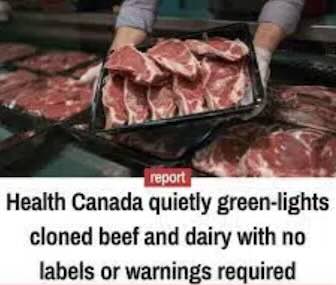
News of the plan circulated rapidly on social media, prompting thousands of Canadians to condemn it and pledge to switch to local meat providers.
Sylvain Charlebois, a professor at Dalhousie University, posted on X:
“By authorizing the sale of meat from cloned animals without mandatory labeling or a formal public announcement, Health Canada risks repeating a familiar and costly failure in risk communication. Deeply disappointing.”
Conservative MP Leslyn Lewis also issued this warning:
“Health Canada recently decided that meat from cloned animals and their offspring no longer needs a special review or any form of disclosure. That means, soon you could buy beef or pork and have no idea how it was bred. Other countries debate this openly: the EU has considered strict labelling, and even the U.S. has admitted that cloned-offspring meat is circulating.”
“But here in Canada, the public wasn’t even told. This is about informed choice. If government and industry don’t have to tell us when meat comes from cloned animals, then Canadians need to ask a simple, honest question: What else are we not being told?”
DuBreton, a leading North American supplier of organic pork based in Quebec, criticized the move, stating:
“Canadians expect clarity, transparency, and meaningful consultation on issues that directly touch their food supply. As producers, we consider it our responsibility and believe our governing food authorities should too.”
DuBreton conducted a survey and found that 74 percent of Canadians believe that “cloned meat and genetic editing practices have no place in farm and food systems.”
Believing in the safety of cloned foods has not been established, and for Canadian officials to attempt to sneak this into the public forum is a reprehensible move. This proves that these government officials have learned nothing about effectively testing products before using people as guinea pigs.
Going forward, I would trust very little and get in the habit of questioning everything.