Canada’s Right is Shifting Towards America's Right
A Republican named Trump might very well grace the corridors of the White House again soon, augmented by Trudeau’s growing unpopularity, power dynamics of the right could be enhanced considerably on both sides of the border.

F. Andrew Wolf, Jr. , Bio and Archives--July 10, 2024
Canadian News, Opinion | Comments | Reader Friendly | Subscribe | Email Us
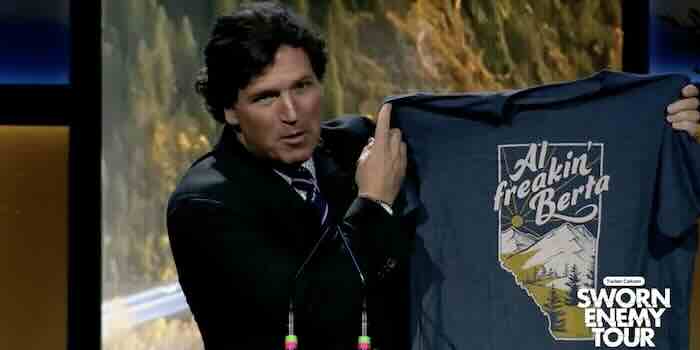
The Politico headline read, “Tucker Carlson wanted a fight with Team Trudeau. He got one.” What followed sets the tone for this essay
“CALGARY, Alberta — Justin Trudeau and his ministers fired back on Thursday against a political provocateur from south of the border: Tucker Carlson.
With speeches in Alberta that trashed Canada’s government, mocked LGBTQ people and knocked mainstream media, Carlson triggered outrage in Ottawa… .
The prime minister and his allies have spent months now linking their domestic political rivals to American-style “MAGA” politics. Carlson’s message, they argued Thursday, was conclusive evidence of Trumpism politics seeping into Canada.
“Don’t ask the question if it’s coming to Canada,” Transport Minister Pablo Rodriguez said. “It’s already here.”
The furor was precipitated in January of this year, when Tucker Carlson visited Canada. Speaking at an event hosted by Alberta premier Danielle Smith. The question is: Why did Carlson, known for courting the anti-establishment right in the U.S. come to Canada to critique its politics? Moreover, from whence did his rather considerable support materialize? What is going on in Canada? How could this happen?
For decades, U.S. “talking heads" have struggled to discern the ideological differences between Canadian Liberals and Conservatives, as they don’t align with the ideological differences between Democrats and Republicans in the US.
Since the 1980s, the right in the United States and Canada have worked to develop their relationship. Recently, anti-establishment right groups in both countries have found common ground that helps empower right-wing leaders and supporters in both countries.
In the ‘50s and ‘60s, Canadian political leaders in general worked to foster a national identity – one that was not dependent on either Britain or the United States. For years Canadian conservatism had long defined itself in opposition to the United States and its perceived tendency towards imperialism. The Liberal Party had traditionally pursued a course otherwise – one of economic cooperation across the border.
Canada was forging a sense of national identity, and America was becoming more interested in its internal political affairs. In April 1968 the country’s first leader to reach “celebrity” status was elected Prime Minister – Liberal Pierre Trudeau.
The political fallout was both unexpected by the Americans and unappreciated. Trudeau began distancing Canada from its southern neighbor, and not just in ideology, but in economic and political ties as well. The U.S. had instituted an embargo in 1960 against Cuba following the Cuban Revolution. To America's dismay, Trudeau strengthened ties with Cuba, declaring:
“Long live Cuba and the Cuban people, long live Commander Fidel Castro.”
Yet, America could live with Trudeau's socially progressive policies, economic partners, or even romantic partners (he briefly dated Barbra Streisand, 23 years his junior). What got the U.S.’s attention was his use (or abuse) of federal power. In October 1970, Trudeau made international headlines after giving the federal government the power to suspend civil liberties under the War Measures Act.
The problem was – this was peacetime. He said it was needed to deal with “insurrectionist activities.” Members of the Front de libération du Québec (FLQ) had kidnapped the deputy premier of Quebec and a British diplomat, and this after hundreds of bombings and robberies around the province had left six people dead. Trudeau declared a state of “apprehended insurrection” in Quebec.
The U.S. media struggled to reconcile Trudeau’s image as a progressive liberal leader with his actions under the War Measures Act. The New York Times published an interview with Trudeau, trying to grasp how an ostensibly progressive leader could engage in such action.
Issues continued to develop between the U.S. and Canadian left, while the 1980s saw closer ties between the Canadian and U.S. right. Conservatives were swept into power in 1979, resulting in the first Liberal defeat in 16 years. Though Trudeau continued as Prime Minister for another term, the 1984 election of Brian Mulroney resulted in Canadian conservatives shifting right, embracing policies that were closer to the ideology of the right in the U.S.
Reversing the strategy of past decades, Mulroney aimed to further develop the relationship between the two countries. Despite the Liberals still being the party in power in Canada, just prior to the 1984 Canadian federal election, President Reagan invited Mulroney to the White House. America was paying closer attention to Canadian politics, allowing the new prime minister to forge closer relations with the U. S.
Yet, conservatives from the two countries remained ideologically at odds on several major fronts. Mulroney’s government was severely criticized by Reagan for imposing sanctions against South Africa during the apartheid era.
But as the new millennium approached, conservatives in Canada – especially conservatives in Alberta – nudged the Progressive Conservative Party further to the right. Eventually, in 2003 it merged with another conservative party, establishing the current Conservative Party of Canada .
Today, even the Canadian anti-establishment right has gained more power domestically; moreover, connections with the U.S. have strengthened. In 2022 mainstream media reported their own versions of a truckers’ “statement” of dissatisfaction with the Trudeau government. A trucker convoy took over the central business district of Ottawa to protest the vaccine mandate for truck drivers crossing the Canada-U.S. border. The trucker convoy seemed to signal how the ideologies of the U.S. and Canadian right had converged.
Financial ties between anti-establishment right conservatives in both countries quickened.
U.S. contributions to the trucker convoy through crowdfunding websites were substantial.
As a result of the considerable flow of funds from the U.S., GoFundMe took down the convoy’s donation page; U.S. Republicans like Ron DeSantis protested the action, demanding immediate refunds to U.S. donors. One news agency estimated that over half of identifiable donations came from south of the border.
The anti-establishment right in the United States is making every effort to strengthen their counterpart in Canada. Hence, the ideological gap between the Liberals and Conservatives in Canada is growing larger as the anti-establishment right gains more influence in the Conservative Party. Moreover, despite significant differences (e.g. their views on abortion and gun control), the Conservative Party in Canada and the Republican Party in the U.S. grow closer together.
With the very real likelihood that a Republican named Trump might very well grace the corridors of the White House again soon, augmented by Trudeau’s growing unpopularity, power dynamics of the right could be enhanced considerably on both sides of the border. That's why Tucker Carlson was in Canada earlier this year.
View Comments