Christians - The Minority of Canada
For now, however, several generations are groping for meaning and purpose in life – and they’re trying to find it beyond the walls of the sanctuary.

F. Andrew Wolf, Jr. , Bio and Archives--September 22, 2025
Canadian News, Opinion | Comments | Reader Friendly | Subscribe | Email Us
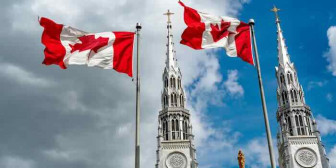
The Christian faith’s share of the Canadian population slipped below 50 percent over the past few years, and virtually no one said much about it. The reality of that occurrence carries more weight than one might imagine.
Christian affiliation has slipped to 44 percent, down from 53 percent in the 2021 Statistics Canada census. Fresh ISSP data from spring 2025 places it even lower, at 42 percent.
Canada now resembles Britain, Australia and France, where Christianity has lost its majority status
Data like these indicate a global transformation is altering the religious landscape throughout the Western world and beyond. A new survey from Pew Research reveals the extent of the movement away from Christianity: from 2010-2020, Christians became minority religions in Australia (falling from 67 to 47 percent), France (57 to 46 percent), the United Kingdom (62 to 49 percent) and Uruguay (61 to 44 percent).
Canada now resembles Britain, Australia and France, where Christianity has lost its majority status, and while the non-religious have yet to become the majority, the latest tranche of data from the 2021 census shows the proportion of non-religious Canadians has more than doubled in the past 20 years — to 34.6 per cent, up from 16.5 per cent in 2001.
In Canada, contrary to what some believe, the primary mechanism fostering the decline is not Donald Trump’s support among white evangelicals or sexual abuse scandals or any other “clickbait” headline -- even though such beliefs can reinforce negative stereotypes among people already tempering their visits to the pews. Rather, the problem is internal -- slow but steady erosion within the flock, itself.
With the advent of the 1960s, baby boomers ceased attending regular Sunday services, while maintaining their identification as a Christian. Unfortunately, their offspring just stopped attending church altogether -- each generation since then has slipped further away — a trend echoed in that large island “down under.”
The retreat from Christianity, globally, occurred differently varying with the demographics and culture within the country. Britain and France’s withdrawal began in the 19th century, while the shift has been more recent and rapid in Canada and Australia. The issue often becomes problematic when religion and politics become aligned or otherwise with each other.
Nowhere is this better represented than in Quebec, where the break with Catholicism was remarkable. Prior to 2020, three-quarters of the people in that province self-identified as Catholics, even while most lived essentially secular lives. Then debate arose concerning Bill 21.
Generational drift away from religion mingles with disillusionment over the Christian right’s moral stance
Suddenly, one heard, “I’m Quebecois. I’m laïc (i.e. secular) now” -- identifying as Catholic lost its relevance. In a short time, cultural identity was delinked from Catholicism and anchored anew in state secularism, sending Catholic affiliation into obscurity.
Underpinning these shifts lies another issue: the state has assumed responsibility for many of the church’s traditional functions -- especially social services -- a typical characteristic development in modern societies.
In Australia, younger people are moving more to the left, away from typical conservative positions on such issues as climate change and sexuality, asserts Joel Carret in an article on The Conversation website.
That pattern also reflects Canada’s experience, where generational drift away from religion mingles with disillusionment over the Christian right’s moral stance.
Early indications are that this trend is spreading, with Uruguay in South America joining the ranks of Christian non-majority countries.
For churchgoing Canadians, the decline is as disconcerting as it is palpable -- empty pews and silent parish halls abound. While it is true that immigration has helped offset a precipitous decline in Canada, as many newcomers arrive from countries (like Ukraine) with higher rates of affiliation -- the movement away from Christianity appears to be ineluctable.
Yet, not all Christian denominations are in decline. Orthodox Christianity, buoyed somewhat by Ukrainian refugees, is expanding in Canada, with new churches being built or shuttered ones reopened.
While the shifting patterns are unquestionable, there are those within the faith who are reluctant to admit that Christianity is now essentially a minority phenomenon around the Western world and this now includes Canada. Thus, many remain ensconced in denial about the reality of today and the rather unfavorable prospects for tomorrow.
The future, of course, is yet to be recorded, and current trends point to further decline in religious sensibilities
The tectonic shifts are significant and tangible. Christianity once anchored Canadian identity, politics and moral authority. But that’s changed in this country, unlike in the US where the Christian right still suffuses religion with national identity and vice versa. For a century, churches were Canada’s cultural backbone: a center of political discourse, social networking and social services. That psychosocial infrastructure has essentially disappeared.
The loss has ramifications. Young Canadians today often encounter religion through fleeting moments on YouTube, scrolling 8-second “clickbait headlines” or a cursory glance at an AI-generated discourse on how terrible evangelicals are and how the guy in the White House is coming for you.
But, here’s the thing:
What’s been lost is more than Sunday school and sermons from the pulpit. It’s two millennia of shared learning, art and a visible presence that even non-believers once drew from and some relied upon for direction, meaning and purpose. The secular state cannot replace that; nor in a pluralistic democracy, can it provide a cohesive set of shared values to hold onto and live by.
What remains is a question of fundamental import for Canada: what can take the place of a majority culture, now that the church is no longer looked upon as a source to help people find meaning in their lives?
The future, of course, is yet to be recorded, and current trends point to further decline in religious sensibilities. But tumult from the unexpected — from nuclear missteps to economic collapse to political upheaval — could reset the religious landscape in unpredictable ways. For now, however, several generations are groping for meaning and purpose in life – and they’re trying to find it beyond the walls of the sanctuary.
View Comments
F. Andrew Wolf, Jr. is retired from the USAF (Lt. Col.) and university teaching (Western Humanities and the Arts, Philosophy and Political Philosophy). His education includes (PhD-Philosophy Univ. of Wales), (MTh-Texas Christian Univ.), (MA-Univ. South Africa), (BA-Texas Lutheran Univ.) and conversations with his wonderful wife. He has an abiding interest in and passion for what is in the best interest of a multipolar world.
F. Andrew Wolf, Jr. is published through both US (American Spectator, The Thinking Conservative, The Daily Philosophy, Academic Questions: National Association of Scholars) and international media (International Policy Digest, Eurasia Review, Cairo Review of Global Affairs, Middle East Monitor, Times of Israel).