Excellent: Ryan defends tax cut by emphasizing growth
The argument every Republican would make if they understood basic economics

Dan Calabrese , Bio and Archives--October 25, 2017
American Politics, News | Comments | Reader Friendly | Subscribe | Email Us
 I can't overstate how important this is, and in a positive way. Republican politicians have lost their way on tax policy since the Reagan years. Back then, it was understood that cuts in marginal rates and simplification of the code would free up capital that was otherwise a) being paid to the government; or b) being used to comply with tax-driven manipulation of private behavior. The result of this would be more robust economic growth.
That this worked in the 1980s cannot be seriously disputed. The Reagan tax cuts of 1981 delivered sustained, robust growth. It was also true that Congress spent like drunken sailors during that time, and we saw consistent budget deficits as a result. But it wasn't because federal revenues suffered from the tax cuts. Federal revenues soared. If spending had merely been kept to the rate of inflation, we would have been running surpluses by the end of Reagan's second term.
I can't overstate how important this is, and in a positive way. Republican politicians have lost their way on tax policy since the Reagan years. Back then, it was understood that cuts in marginal rates and simplification of the code would free up capital that was otherwise a) being paid to the government; or b) being used to comply with tax-driven manipulation of private behavior. The result of this would be more robust economic growth.
That this worked in the 1980s cannot be seriously disputed. The Reagan tax cuts of 1981 delivered sustained, robust growth. It was also true that Congress spent like drunken sailors during that time, and we saw consistent budget deficits as a result. But it wasn't because federal revenues suffered from the tax cuts. Federal revenues soared. If spending had merely been kept to the rate of inflation, we would have been running surpluses by the end of Reagan's second term.This is historical fact, and it's lost on many voters and even on many Republican politicians, who either don't remember it, don't understand it or don't think it matters because today's voters and media will never accept it. Republicans have become squeamish about cutting taxes, as Democrats and the media (but of course I repeat myself) emphasize "who wins and who loses," and always seem to come to the conclusion that tax cuts are morally indefensible because "the rich" benefit - as if it helps a poor person when you stick it to "the rich." (Hint: It doesn't.) Also, Democrats/the media constantly tout the static analysis of the Keynesians at the Congressional Budget Office in order to claim that tax cuts will balloon the deficit, completely ignoring the lesson of history that shows tax cuts unleash capital, spur growth and broaden the base - resulting in more revenue, not less. So it would really help if some high-profile Republican not only understood this history, but was able to argue it clearly and convincingly. And it would really help if that high-profile Republican was, say, the Speaker of the House. Jackpot:
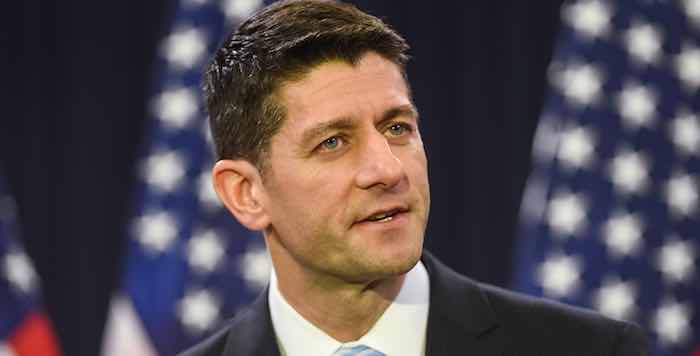
The U.S. Republican tax cut plan that President Donald Trump wants passed by the end of the year is unlikely to trigger a big deficit expansion because it will spur more investment and job growth, House of Representatives Speaker Paul Ryan told Reuters in an interview on Wednesday.
“We believe that we’ll get faster economic growth,” Ryan said. “We don’t anticipate a big deficit effect from this tax reform because we will broaden the base and lower the rates, plug loopholes and get faster economic growth. ... Those things combined, we believe, will give us faster growth and a more resilient tax code.” Democrats have painted the tax plan as a gift to the rich and corporate America that would balloon the federal deficit and add to the $20 trillion U.S. national debt. While the broad parameters of the tax proposal have been made public, detailed legislation has not yet been unveiled. One of the key elements of the plan is to slash the corporate income tax rate to 20 percent from 35 percent. Ryan said the plan would help U.S. growth. “The reason we’re trying to do it with this timeline is we want to get a 3 percent economy. We’re sort of limping along, growing between 1 and 2 percent, and that is so far underneath our potential as a country,” he said.
That's exactly right, of course, and it needs to be emphasized as much as possible - not only by Ryan but by Republicans who are talking about the tax plan back in their districts. GDP growth is everything here. Since Obama became president we haven't seen a single year reach 3.0 percent annualized growth, and the average during the Obama presidency was only 1.9 percent. That is horrendous. Obama is the first president of the post-Depression era not to hit 3.0 percent growth in a single year, and he had eight tries. Yet you're not going to achieve a goal if you're not trying to achieve it, and Obama wasn't trying. He was focused on redistributing wealth and expanding the power of the federal government to mandate and regulate the business community. Obama never believed growth was essential to prosperity, and his policies reflected that. So did the results of his policies. We've emphasized this many times here: Revenue to the Treasury is always right around 18 percent of GDP, regardless of tax rates. If you want the government to take in more money, what you need to do is accelerate growth. Lower rates and a simpler code will do that, particularly when the rate reductions start with taxes on corporate profits and investment returns. That is the most productive capital in the entire economy, and that's where this tax cut is focused. It's a very encouraging development that Ryan knows how to express this. Now he needs to teach the rest of his caucus to do the same.
View Comments
Dan Calabrese——Bio and Archives
Dan Calabrese’s column is distributed by HermanCain.com, which can be found at HermanCain
Follow all of Dan’s work, including his series of Christian spiritual warfare novels, by liking his page on Facebook.