Executive Orders and the Myth of Permissive Power
We are awakening to this truth. We see through the noise, past the slogans, into the heart of the matter: LIberty is persevered not by silence in the Constitution, but by adherence to its voice;

Douglas V. Gibbs , Bio and Archives--October 15, 2025
American Politics, News | Comments | Reader Friendly | Subscribe | Email Us
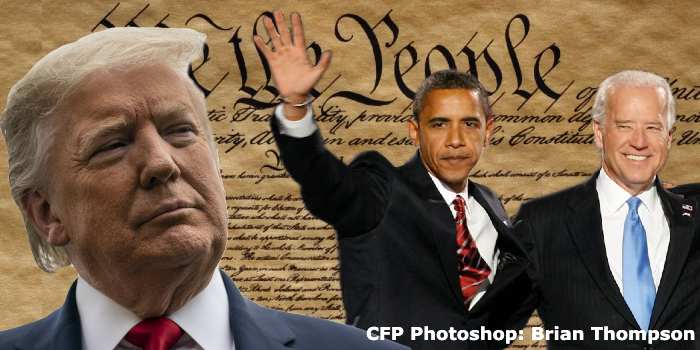
Democrats are sounding alarms about President Trump’s alleged authoritarianism. Their multiple “the sky is falling” predictions attempted to cast him as a Hitleric, fascist, white supremacist dictator-in-waiting. But, the reality is, the Court of Public Opinion isn’t buying it.
Stark difference between Trump’s use of executive orders and that of Obama or Biden
Since before President Donald Trump’s first term began in 2017, they’ve warned that his presidency would spell the death of democracy (though we are, in fact, a federal republic) and that he would rule by executive order. Ironically, these are the same voices who cheer when courts micromanage other branches in violation of Separation of Powers, called to pack the Supreme Court, and push to eliminate the Electoral College.
They championed President Barack Obama’s use of executive orders, even when he thumbed his nose at Congress on January 14, 2014, declaring:
- “We are not just going to be waiting for legislation… I’ve got a pen, and I’ve got a phone. And I can use that pen to sign executive orders and take executive actions and administrative actions…”
He was signaling his intent to bypass Congress if gridlock persisted. Obama’s interpretation was constitutionally flawed. While executive orders may be used to direct the executive branch in carrying out existing law or enumerated powers, his use of “administrative actions” implied a circumvention of Congress. Like his Democratic Party predecessors, Obama planned on stretching his presidential authority beyond its constitutional bounds. Even the Brookings Institution noted that the issue wasn’t the use of executive orders per se, but that Obama was employing them to enact policies not codified through legislation.
Today, critics accuse President Trump of elite overreach and warn of populist backlash. Yet, there’s a stark difference between Trump’s use of executive orders and that of Obama or Biden. The latter viewed executive orders as tools to sidestep Congress, and the media and courts largely turned a blind eye. Trump, by contrast, has used executive orders to execute existing laws and constitutionally granted powers; not to legislate from the Oval Office.
Unlike his Democratic predecessors, President Trump has respected constitutional boundaries
Let’s not forget that the Democratic Party was home to presidents like Woodrow Wilson, Franklin Delano Roosevelt and Lyndon B. Johnson… the first two being men who issued executive orders by the thousands (FDR alone signed 3,728 ranking as the most of any President) and all of them justified their actions by claiming that constitutional silence implied permission. That is not how the Constitution was designed. It is not a document of silence. Federal authority in the Constitution exists as expressly enumerated powers. What is not granted is not authorized.
Unlike his Democratic predecessors, President Trump has respected constitutional boundaries. His executive orders have focused on executing existing law: immigration statutes, regulatory rollbacks, the Civil Rights Act of 1866 (addressing birthright citizenship), and the Alien Enemy Act of 1798 (signed by and used by President John Adams during peacetime to deport criminal invaders). These are not acts of overreach; they are corrective measures aimed at restoring constitutional balance after more than a century of executive aggrandizement.
When challenged by activist judges seeking to micromanage President Trump’s actions, he has charged directly into the judicial arena, defending his actions under Article II, Section 3:
“He shall take Care that the Laws be faithfully executed.”
The voters, the true Court of Public Opinion, are watching. And, they are beginning to see through the myth of Permissive Interpretation (the idea that executive power is allowed simply because the Constitution doesn’t forbid it). They are beginning to recognize that Trump’s use of executive orders do not cross the constitutional line—it reinforces it.
The debate over executive orders reaches beyond politics. The whole argument is foundational. It speaks to whether we are governed by the rule of law or by the whims of political power. President Trump’s approach, rooted in originalist fidelity and constitutional restraint stands as a rebuke to the more-than-a-century-long drift toward executive fiat. While his critics cry tyranny, what they truly fear is accountability: a presidency that respects the limits of its authority and dares to restore the balance the Framers intended. We the People, he recognizes, are the true guardians of the Republic, and the reality is we are awakening to this truth. We see through the noise, past the slogans, and into the heart of the matter: that liberty is persevered not by silence in the Constitution, but by adherence to its voice.
View Comments
Douglas V. Gibbs of Political Pistachio Conservative News and Commentary, has been featured on “Hannity” and “Fox and Friends” on Fox News Channel, and other television shows and networks. Doug is a Radio Host on KMET 1490-AM on Saturdays with his Constitution Radio program, as well as a longtime podcaster, conservative political activist, writer and commentator. Doug can be reached at douglasvgibbs [at] yahoo.com or constitutionspeaker [at] yahoo.com.