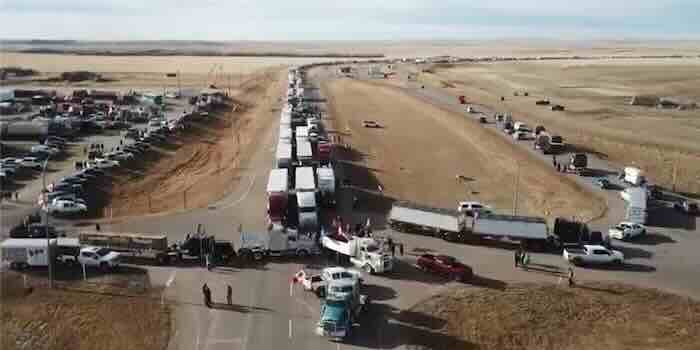
Burns also contended that “the conduct of Alberta’s provincial government and Canada’s federal government are entwined with the RCMP.” The arrests of the Coutts Four on the night of February 13 and noon hour of February 14, were key events in a decision by the Clerk of the Privy Council, Janice Charette, and the National Security Advisor to the Prime Minister, Jody Thomas, to advise Prime Minister Justin Trudeau to invoke the Emergencies Act. Chief Justice Paul Rouleau, in submitting his Public Order Emergency Commission Report to Parliament on February 17, 2023, also cited events at the Coutts Blockade as key to his conclusion that the government was justified in invoking the Emergencies Act.
Justice David Labrenz cautioned attorney Burns regarding her language, after Crown prosecutor Stephen Johnson objected to some of the language in the opening statement of Olienick’s counsel. Futher discussion about the appropriateness of attorney Burns’ statement to the jury is behind a publication ban, as discussions occurred without the jury present.
Justice Labrenz told the jury on July 12, “I would remind you that the presumption of innocence means that both the accused are cloaked with that presumption, unless the Crown proves beyond a reasonable doubt the essential elements of the charge(s).” He further clarified what should result if the jurors were uncertain about which narrative to believe: the account by the Crown, or the account from the accused lawyers. Labrenz stated that such ambivalence must lead to an acquittal; As such a degree of uncertainty regarding which case to trust in does not meet the “beyond a reasonable doubt” threshold for a conviction.”