Kangaroo Court Convicts
Canada’s Fact-finder Senator
Cultural Genocide Hoax Seduces the Gullible
Colin Alexander , Bio and Archives--February 7, 2020
Canadian News, Opinion | Comments | Reader Friendly | Subscribe | Email Us
 Canada’s Prime Minister Justin Trudeau’s Liberal government is paying off complicit print media and planning to license internet media. Free speech is now under attack as it was in the United States under FDR and under fascist and communist regimes since then.
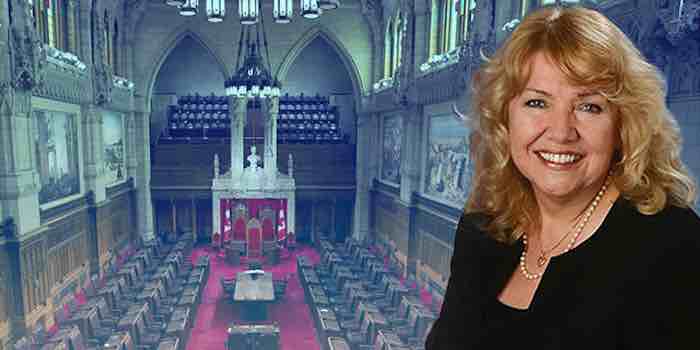
As an example, last May Senators suspended their colleague Lynn Beyak, a Conservative. At the time of writing, they’re trying to go around again. The grounds for the first suspension? Beyak published letters from Canadians lamenting the marginalization and lack of self-reliance in Aboriginal communities—letters allegedly racist! In reality, no honest person could say they implied biological inferiority. Beyak’s real crime was a speech delivering mild fact-finding criticism of the misnamed Truth and Reconciliation (TRC) report about Indigenous children in residential schools.
Canada’s Prime Minister Justin Trudeau’s Liberal government is paying off complicit print media and planning to license internet media. Free speech is now under attack as it was in the United States under FDR and under fascist and communist regimes since then.
As an example, last May Senators suspended their colleague Lynn Beyak, a Conservative. At the time of writing, they’re trying to go around again. The grounds for the first suspension? Beyak published letters from Canadians lamenting the marginalization and lack of self-reliance in Aboriginal communities—letters allegedly racist! In reality, no honest person could say they implied biological inferiority. Beyak’s real crime was a speech delivering mild fact-finding criticism of the misnamed Truth and Reconciliation (TRC) report about Indigenous children in residential schools.Truth and Reconciliation (TRC) report
Chief inquisitor—on the also misnamed Ethics Committee yet!—was Senator Murray Sinclair, Indigenous author, having no independent credibility, of that TRC report. Assistant inquisitor—also on the Ethics Committee!—was Senator Dennis Patterson, a former architect of race-based education of Indigenous youth for multigenerational welfare dependency and perpetual exclusion from the high-tech economy. Evidently, it hasn’t bothered the Speaker (and General Manager) of the Senate, George Furey, a Liberal appointed by Trudeau, to have Sinclair sitting in judgment over a critic of his own work. As related by Canada’s J.O. Wilson in A Book for Judges, case law and natural justice require that no adjudicator should hear a case when there’s even a remote connection. The grounds for renewing the suspension? Beyak failed to satisfy the trainers at the Orwellian re-education operation the Senate mandated for her return to good graces. They wanted her to internalize the TRC’s falsehoods and exaggerations, and the idea that white privilege causes all the woes of Aboriginal peoples today. How do you explain the fact that so many Asian Canadians have risen from the bottom to surpass everyone else, including whites?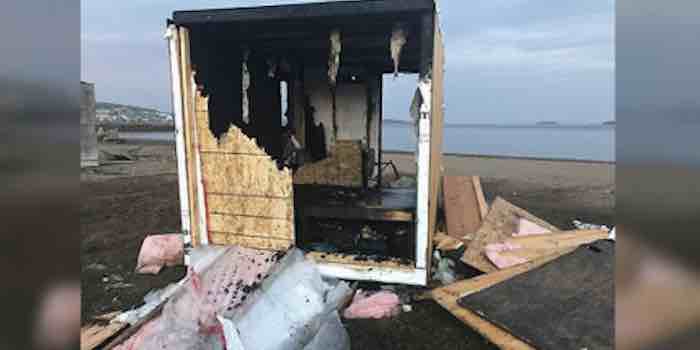
Housing in Iqaluit. Until fire destroyed it in July 2018, this packing case, smaller than a single-car garage, insulated for winter, was home for five Inuit. The alternative could have been to join up to fifteen other Inuit in a three-bedroom house of 1,200 square feet. Is it even possible to deliver schooling to children living like this? According to Indigenous Affairs Minister Carolyn Bennett and, evidently, to Canada’s Senators and mainstream news media, it’s racist to call these conditions squalid. (Photo: Qaumariaq Inuqtaqau)
Foundational falsehood in Sinclair’s TRC report
Here’s the foundational falsehood in Sinclair’s TRC report:The establishment and operation of residential schools were a central element of … policy, which can best be described as "cultural genocide”.However bad the administration of some schools actually was, any reminder of the real genocide of Armenians, Ukrainians and Jews is repulsive. Sinclair’s hoax justified a multi-million dollar payout for residential-school graduates, even those who benefited from their education. It also provided cover for the failure of Indian leadership and for maladministration under successive federal governments, continuing under Indigenous Affairs Minister Carolyn Bennett today. Why didn’t Sinclair demand the advantages he had when growing up in the real-world city of Selkirk, Manitoba? The short answer may be that, as a lawyer and former judge, he’s a member of the leadership that doesn’t speak for followers, and who profit from the misery of the underclass. Senator Kim Pate said this when summing up a debate about the excessive number of Indigenous women in prison:
[T]he overrepresentation of Indigenous peoples in prisons, particularly Indigenous women, is rooted in the historical and systemic discrimination that is our racist and sexist legacy of colonialization [sic]. The atrocities of residential schools, the forced, state-sanctioned removal of Indigenous infants and children, the so-called Sixties Scoop and ongoing discrimination and discriminatory treatment continue to cause unimaginable grief and intergenerational trauma.
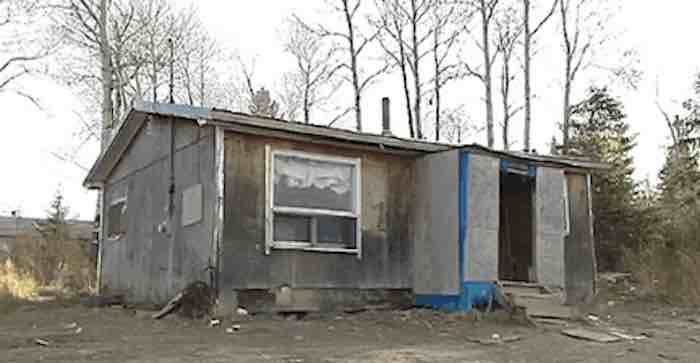
Nine people, including four children died in a shack-fire like this, no running water and no electricity, in Pikangikum in northern Ontario. Federal Indigenous Affairs Minister Carolyn Bennett said the deaths underscore the need to improve living conditions on reserves. "We are with them," she said. "My job always is to do everything in our power to prevent the preventable." She added, with all the capacity for immediacy at her command, “We are in the process of beginning that, one step at a time." Picture, Faith Strang's Facebook page.
But is any of that true? Here’s one of the letters Senator Beyak posted on her website. It’s from the late Cece McCauley, Honorary Chief of the Inuvik Dene Band, who was orphaned in early childhood, and with her sisters attended the convent school in Fort Providence:
Thank you for opening up the much-needed controversial debate on the positive side of the residential schools. … We spent ten years in the residential school. They were the ten best years of my life.Graduates from residential schools included two federal cabinet ministers, three territorial premiers, numerous creative artists, and a renowned Inuit thoracic surgeon. Noah Carpenter was born on the trapline and graduated from residential high school in Inuvik in 1963. That was before progressive education and social promotion took hold. It doesn’t have to take generations to solve the problems. Today, instead, tens of thousands of Indigenous children are farmed out in care that’s seldom satisfactory. They come from the unguarded concentration camps that are the drug-infested and violence-wracked remote settlements and the urban slums. Even today, templates for effective education could include well-run residential schools like Athol Murray College in Wilcox, Saskatchewan, and Southeast Collegiate in Winnipeg. The latter, not mentioned by Sinclair, was founded by Indians in 1995 and it’s run by Indians! Think too of the great Irish writer Brendan Behan. Jail in Borstal, reform school, from age 16 to 18, contributed to his eventual success.

On giving thanks for his commitment to Indigenous issues, the Tsuut'ina First Nation near Calgary (formerly Sarcees) bestowed the traditional headdress on Prime Minister Justin Trudeau, and gave him an aboriginal name Gumistiyi, which translates as the one who keeps trying. Unfortunately, there’s a chasm between trying and results. In fact, the gap that Mr. Trudeau promised to close between the underclass and his much-vaunted Middle Class continues to widen exponentially.
The authoritative 1966 Hawthorn report said that in 1962 a total of 146,596 Indian students were in all schools. Of these, 8,391 students were boarding, and 1,490 of them attended neighbouring provincial or territorial schools. Altogether, the number of students in residences at that time was, therefore, less than six percent of the total. The other 96 percent were attending day schools in their home communities. The total number of students in all schools in 1962 approximately equalled the estimated number of 150,000 who attended residential schools over their entire 150 years of operation. Sinclair’s commission had no verification process for what people told them, and there’s anecdotal evidence that some former students were coached to compound with invention the worst of what they experienced. There’s no evidence that Sinclair’s commission talked to the many good people who ran successful schools. In sum, it couldn’t possibly follow that residential schools caused all Indigenous troubles today.
The foundational challenges
Canada has never resolved this two-part question: Should Indigenous youth carry forward a separate culture, a separate identity and a separate livelihood based on the obsolete traditions of the fur trade? Or should young people be enabled as full-fledged Canadians for all aspects of the high-tech economy—as required by the UN’s Convention on the Rights of the Child?Marginalized Indigenous communities have the highest male youth suicide rate, and almost the world’s highest incarceration rate. Housing and living conditions for the uneducated, the unskilled and the all-but-unemployable compare with the favelas of Rio de Janeiro. In 1995, the special report on suicide Choosing Life, published by the Royal Commission on Aboriginal Peoples, said this:
Aboriginal youth described both exclusion from the dominant society and alienation for the now-idealized but once-real “life on the land” that is stereotypically associated with aboriginality. The terrible emptiness of feeling strung between two cultures and psychologically at home in neither has been described in fiction and in art, as well as in testimony given before the Commission. If they have few positive role models or clear paths to follow, Aboriginal youth may be forced to turn to one another, building tight bonds against a hostile world. This inward-looking subculture may reinforce hopelessness and self-hate, and their exits may appear to be the oblivion of drugs and alcohol—or death.With the fur trade long ago extinct, the only acceptable option is to enable Indigenous youth for the high-tech economy. There have been forward-looking Indigenous leaders in the past. When affirming Treaty Six in 1876, Chief Poundmaker said he expected next generations to advance in civilization like the white man. In his 1967 Lament for Confederation speech, Chief Dan George said this to deaf ears:
Oh God! Like the thunderbird of old I shall rise again out of the sea; I shall grab the instruments of the white man’s success - his education, his skills - and with these new tools I shall build my race into the proudest segment of your society.Today’s Indigenous youth want to hear that kind of inspiration, and also to see a real implementation plan. The human cost of their marginalization is unconscionable and the cost to taxpayers is unsustainable. Why can’t Canada’s Senators understand that?
(Colin Alexander was publisher of the Yellowknife News of the North and the advisor on education for Ontario’s Royal Commission on the Northern Environment. He has family living in the arctic Nunavut territory.)
View Comments
Colin Alexander——Bio and Archives
Colin Alexander’s degrees include Politics, Philosophy, and Economics from Oxford. His latest book is Justice on Trial, Jordan Peterson’s book and others show we need to fix the broken justice system.