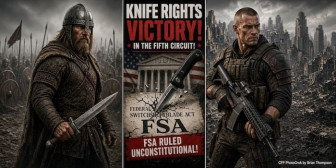
It begins with a man, a blade, and a duty
But the courts are catching up, one category at a time. Suppressors. Body armor. Now, blades. In Blanche, the Fifth Circuit went further still, holding that the right to keep and bear necessarily implies the right to acquire, because the right "wouldn't mean much" without the corresponding right to buy, sell, and carry across state lines. You cannot have a right to keep a thing and no right to obtain it.
That is ordinary good sense. But good sense, as the case itself seems to note, is not always a requirement in court.
The Left has spent a century insisting the Second Amendment is a collective relic; a militia clause with a footnote about personal ownership. Every decision like this one strips that away. Bruen forces the government to prove its modern regulations match the America's history and tradition. And the history is uncomfortably long. It does not begin in 1958, when Congress banned switchblades in a fit of hysteria over juvenile delinquency. It does not begin in 1934, or 1791, or even 1689.
It begins with a man, a blade, and a duty.
The seax came before the musket. The musket before the rifle. The rifle before whatever the next century invents that we cannot yet imagine. The technology will keep moving. The word, “arms,” was chosen precisely so that it would not have to.
The duty underneath it is the load-bearing wall. A free state is not secured by a standing army alone, no matter how large. It is secured by a people who are themselves armed, and therefore themselves responsible. Strip the arms, and you strip the responsibility. Make the right a privilege, and the duty becomes somebody else's job – which is exactly how a republic slides into a client state of its own bureaucracies.
So keep the word whole. Arms. All of them. The knife before the gun, and whatever comes after.
Because the right was never the beginning. It was the tool. The duty came first – the duty to the security of a free state – and the right exists to make that duty honorable and real.
The Saxons understood that. They were named after their knives.