Krugman Ignores IPCC on Climate Economics
Climate change, climate consensus, climate economics, IPCC, Paul Krugman
Institute for Energy Research , Bio and Archives--July 1, 2014
Global Warming-Energy-Environment | Comments | Reader Friendly | Subscribe | Email Us
One of the recurring themes in my posts here at IER is that apologists for government intervention in the name of fighting climate change routinely ignore what the “consensus” says. Then these same people have the audacity to wag their fingers at the “deniers” out there who disagree with them.
Today’s example is a recent essay by Paul Krugman. As we’ll see, he confidently tells his readers “what we know” about the economics of climate change, even though he’s just making it up. The latest IPCC report repudiates Krugman’s statement.
What Do You Mean “We,” Krugman?
Krugman opens his column in his characteristically confident style: There are three things we know about man-made global warming. First, the consequences will be terrible if we don’t take quick action to limit carbon emissions. Second, in pure economic terms the required action shouldn’t be hard to take: emission controls, done right, would probably slow economic growth, but not by much. Third, the politics of action are nonetheless very difficult.We can stop right there, and safely disregard the rest of Krugman’s column. Why? Because his first two points don’t fit together. If Krugman thinks immediate action “done right” wouldn’t slow economic growth by much, then delaying such action will not “be terrible.”
Using the IPCC, Just Like a Good Boy
To show why Krugman is just making stuff up, I don’t need to go to some obscure right-wing data archive. Nope, I’ll just reproduce the following table taken from page 16 of the Working Group III Summary for Policymakers from the Intergovernmental Panel on Climate Change (IPCC) that came out earlier this year: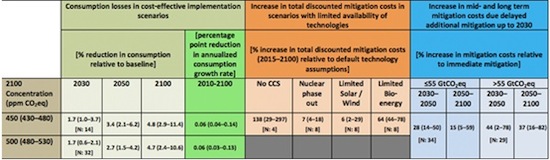 There’s a lot going on in this table, and for a fuller explanation, refer to my earlier blog post that called out Joe Romm playing fast-and-loose with his readers. For our purposes here, the important information is contained in the blue columns on the far right. These show the percentage increases in the total (undiscounted) mitigation costs necessary to achieve the far-left (brown cells) atmospheric concentrations of greenhouse gases in the year 2100, for the years 2030-2050 and also for 2050-2100, for two different scenarios of total emissions (either below 55 gigatons of CO2-equivalent, or above).
In other words, these blue cells show us how much a delay of government action through the year 2030 will increase the cost necessary to achieve the specified (and very aggressive) atmospheric concentrations for the year 2100, shown on the far left of the table in the brown cells. Specifically, the blue cells show that by “doing nothing” about climate change until the year 2030, even in a high-emission baseline scenario, the IPCC’s best guess of the cost of achieving the aggressive outcome rises by 44% in the years 2030-2050 and 37% in the years 2050-2100.
Thus Paul Krugman has painted himself into the same rhetorical corner where Joe Romm trapped himself. Both of these climate alarmists are trying to have it both ways: On the one hand, they’re telling us that the burden on the economy from achieving even aggressive climate goals will be no big deal, if the government acts now. On the other hand, they warn us that delay will prove catastrophic.
Yet to repeat, the IPCC itself contradicts their claims. If the IPCC is correct about their climate claims, then as the table above shows, delaying government mitigation efforts through the year 2030 does indeed make it costlier to achieve a given climate objective. But, the increase in not “terrible” as Krugman describes it; it is around 40 percent higher than the costs of achieving the goals under immediate action, even in the worse of the two IPCC scenarios. (In the low-emission scenario, for the latter half of the 21st century the cost only rises a mere 15 percent, as one of the blue cells indicates.)
Furthermore, I should point out that the cost increase drops dramatically if we weaken the atmospheric target. I didn’t include it in the table above (because it was already too cluttered), but the actual IPCC report shows that for a more modest target of limiting atmospheric greenhouse gases to 550 ppm by the year 2100, the cost penalty from delaying action until 2030 is 15-16 percent in the high-emission scenario and a piddling 3-4 percent in the low-emission scenario. Indeed, for this more modest target for 2100 atmospheric concentrations, the optimistic scenario shows the bottom range of the cost estimate from delay being negative. In other words, the IPCC’s own table (not shown above, you have to click the link) shows the possibility that delaying action until the year 2030 might be advantageous.
There’s a lot going on in this table, and for a fuller explanation, refer to my earlier blog post that called out Joe Romm playing fast-and-loose with his readers. For our purposes here, the important information is contained in the blue columns on the far right. These show the percentage increases in the total (undiscounted) mitigation costs necessary to achieve the far-left (brown cells) atmospheric concentrations of greenhouse gases in the year 2100, for the years 2030-2050 and also for 2050-2100, for two different scenarios of total emissions (either below 55 gigatons of CO2-equivalent, or above).
In other words, these blue cells show us how much a delay of government action through the year 2030 will increase the cost necessary to achieve the specified (and very aggressive) atmospheric concentrations for the year 2100, shown on the far left of the table in the brown cells. Specifically, the blue cells show that by “doing nothing” about climate change until the year 2030, even in a high-emission baseline scenario, the IPCC’s best guess of the cost of achieving the aggressive outcome rises by 44% in the years 2030-2050 and 37% in the years 2050-2100.
Thus Paul Krugman has painted himself into the same rhetorical corner where Joe Romm trapped himself. Both of these climate alarmists are trying to have it both ways: On the one hand, they’re telling us that the burden on the economy from achieving even aggressive climate goals will be no big deal, if the government acts now. On the other hand, they warn us that delay will prove catastrophic.
Yet to repeat, the IPCC itself contradicts their claims. If the IPCC is correct about their climate claims, then as the table above shows, delaying government mitigation efforts through the year 2030 does indeed make it costlier to achieve a given climate objective. But, the increase in not “terrible” as Krugman describes it; it is around 40 percent higher than the costs of achieving the goals under immediate action, even in the worse of the two IPCC scenarios. (In the low-emission scenario, for the latter half of the 21st century the cost only rises a mere 15 percent, as one of the blue cells indicates.)
Furthermore, I should point out that the cost increase drops dramatically if we weaken the atmospheric target. I didn’t include it in the table above (because it was already too cluttered), but the actual IPCC report shows that for a more modest target of limiting atmospheric greenhouse gases to 550 ppm by the year 2100, the cost penalty from delaying action until 2030 is 15-16 percent in the high-emission scenario and a piddling 3-4 percent in the low-emission scenario. Indeed, for this more modest target for 2100 atmospheric concentrations, the optimistic scenario shows the bottom range of the cost estimate from delay being negative. In other words, the IPCC’s own table (not shown above, you have to click the link) shows the possibility that delaying action until the year 2030 might be advantageous.
Conclusion
Like Joe Romm, Paul Krugman has spent years lecturing the “deniers” about the “consensus” on climate change. Yet also like Romm, Krugman simply makes stuff up in his own discussions, effectively denying the very consensus he claims to support. To show his mistakes, we don’t need to quote unorthodox climate scientists. No, we just need to quote the IPCC’s latest report. It shows that “delaying action” on climate change—even for another 16 years—won’t be disastrous. In light of the uncertainties surrounding the topic, I would go further and argue that policymakers should wait for more information, in order to look before they leap. They needn’t listen to the alarmists who claim that such delay would spell catastrophe; the IPCC itself says the alarmists are wrong.View Comments
Institute for Energy Research——Bio and Archives
The Institute for Energy Research (IER) is a not-for-profit organization that conducts intensive research and analysis on the functions, operations, and government regulation of global energy markets. IER maintains that freely-functioning energy markets provide the most efficient and effective solutions to today’s global energy and environmental challenges and, as such, are critical to the well-being of individuals and society.