Manitoba NDP Minister Again Under Fire For Derogatory Charlie Kirk Comments
Fontaine reshared a post on Instagram that called the slain 31-year-old political commentator a "racist, xenophobic, transphobic, Islamophobic" individual;

Hymie Rubenstein , Bio and Archives--September 18, 2025
Canadian News, Opinion | Comments | Reader Friendly | Subscribe | Email Us
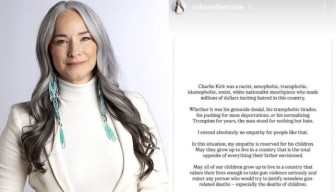
Manitoban Indigenous politician Nahanni Fontaine was recognized as a "beacon of advocacy and leadership" in April 2024.
According to her "Humble Beginning Stories" biography, Fontaine "embodies the spirit of resilience and dedication in her role as a Canadian provincial politician."
Though a member of the Sagkeeng Anishinaabe Indian Band, Fontaine was raised in Winnipeg's hardscrabble Point Douglas neighbourhood, home to about one-third of the city's indigenous population.
The adversities Fontaine experienced growing up, including alleged childhood sexual abuse, did not prevent her from pursuing an advanced education, including earning a Master of Arts degree in native studies at the University of Winnipeg.
Her biography claims, "These academic achievements laid the foundation for her profound understanding of Indigenous rights and social justice issues."
Fontaine's political career soared when she was elected as the Member of the Legislative Assembly of Manitoba for the inner-city riding of St. Johns, abutting Point Douglas in 2016. In the 2023 election, she received 61 percent of the popular vote in this perennial NDP stronghold. As a self-professed advocate for marginalized aboriginal communities, Fontaine has spearheaded legislative initiatives aimed at enhancing the safety and well-being of indigenous women, girls, and two-spirit individuals.
In 2023, Fontaine's leadership was further recognized when she was sworn in as Minister of Families, Accessibility, and Gender Equity.
Despite this rise in power, Fontaine's time in office has been marred with controversy.
On March 10, 2021, Fontaine was removed from the House for the rest of the day for saying the Progressive Conservatives, then the party in power in Manitoba, "just don't give a crap" about missing and murdered Indigenous women, girls, and two-spirit people.
Worse outbursts soon followed.
Fontaine's steady rise in influence was severely damaged after she used her privileged position to block the use of American Sign Language (ASL) for people with hearing disabilities at a graduation ceremony for indigenous women on Thursday, June 26.
Sign-language specialist Sheryl LaVallee shared the graduation ceremony stage alongside various speakers, allowing members of the audience who communicate using ASL, a visual language comprised of hand movements and facial expressions, to be included in the conversation — a fundamental social justice right that Fontaine quickly discarded.
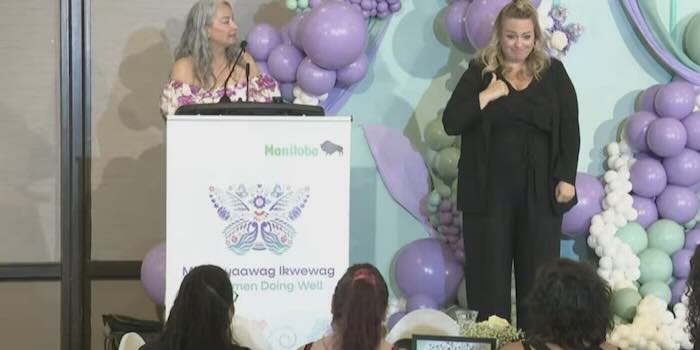
Nahanni Fontaine, Manitoba's minister responsible for accessibility, has apologized for comments she made about a sign language interpreter while preparing to speak to reporters following a speech during a graduation event she hosted for Indigenous women on Thursday, June 26, 2025. (APTN)
Following her speech to the crowd, Fontaine shared a grievance with her press secretary, Ryan Stelter, not knowing her microphone was still turned on.
Stelter congratulated Fontaine on her speech. Fontaine replied, "I was thrown off," not knowing she was being recorded by APTN News, which posted its contents online. "It wasn't great, but because the woman [LaVallee] — she shouldn't have been on the stage."
Fontaine then said she couldn't see the left side of the stage due to the interpreter and that "all I could see was her…"
"Frantic hand movements?" was Stelter's disparaging interruption.
"Yes! I'm like, #, why did I have her on the stage?" added Fontaine, "Jesus, I'm like 'you need to leave'."
This is the same Nahanni Fontaine who, in late March, announced that the Manitoba government is allocating $1.6 million to support resources and programmes for two-spirit and transgender Manitobans.
"We've heard directly from two-spirit, transgender, non-binary, and gender-diverse Manitobans about why visibility is truly lifesaving," said Fontaine.
"Two-spirit, queer, trans, and gender-diverse peoples, who are choosing to live authentically and joyfully in a world that too often meets them with ignorance, transphobia, and homophobia, deserve to be seen and celebrated, today, and every day."
Authentic and joyful living for deaf individuals was met by Fontaine's appalling ignorance on graduation celebration day.
Deborah Owczar, who is deaf, said the interpreter was removed from the stage for the rest of the ceremony, depriving her and her daughter access to ASL participation during the first annual Mino'Ayaawag Ikwewag Celebration of Indigenous Women Graduates.
Owczar said when she saw the video of Fontaine's comments the day after the event, it "was just like a knife right in the back, adding salt to the wound."
"I feel like my certificate is completely ruined. I got it from this event, now, when I look at it, it's associated with these negative memories, not with my accomplishment. I look at my certificate and I think about what was said," Owczar told CBC News through an ASL interpreter.
Owczar's daughter Stephanie Jebb, who is also deaf, said she was shocked by the minister's comments, adding Fontaine's facial expressions throughout the video communicated an "obvious lack of respect."
"She used such harsh, foul language. It was extreme," Jebb said. "It really just tainted the entire experience."
"When you disrespect the interpreter, you disrespect the Deaf community," Owczar said.
Fontaine's critics have good reason to say she has an anti-deafness phobia.
Presumably on orders from Manitoba Premier Wab Kinew, Fontaine issued an apology the next day, saying her comments were an expression of frustration over her "poor planning ensuring clear sight lines for all graduates," ignoring that both women were facing the seated audience and that ASL translations are most effective when the speaker and signer are standing side-by-side.
"I also sincerely apologize to the deaf community and to all Manitobans for my comments," Fontaine said, adding she apologized directly to the interpreter, LaVallee.
This apology, sincere or not, did not prevent the Manitoba Progressive Conservative caucus from calling for Fontaine to resign from her role as cabinet minister responsible for accessibility.
"I was appalled; it was shameful," said Jodie Byram, the PC critic for families and accessibility.
- "I do feel like she needs to resign. She is to advocate for individuals of the deaf community and she totally, it was quite obvious and apparent, just absolutely disrespected those in the deaf community."
In one of her two apologies, Fontaine said, "My comments did not acknowledge that signing is not simply 'hand movements,' but a full and rich language used by thousands of Manitobans every day," and that she's "heard clearly from deaf Manitobans and community members of the harm my comments caused."
She also said she's committed to learning from the incident.
Less than three months later, Fontaine has learned nothing about her arrogant dismissal of people whose handicaps or beliefs she abhors.
And again, she has been forced to make an apology for outrageous words after facing a backlash for reposting callous remarks about American conservative activist Charlie Kirk, who was brutally assassinated on September 11 during an event at Utah Valley University.
Fontaine reshared a post on Instagram the very next day that called the slain 31-year-old political commentator a "racist, xenophobic, transphobic, Islamophobic" individual. Despite extending condolences to Kirk's family, Fontaine's post went on to say that she has "absolutely no empathy" for him. "The man stood for nothing but hate," read her post, in part. It has since been removed.
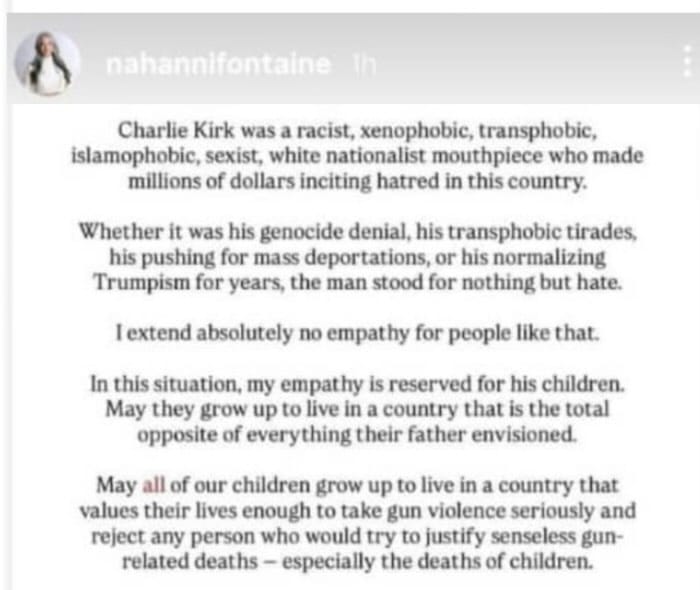
Nahanni Fontaine Instagram Post Image courtesy of Instagram
The post drew swift criticism online, with opponents calling the language derogatory and once again urging Premier Wab Kinew to discipline or dismiss her.
In response to a request from CBC Manitoba, Fontaine's press secretary on Friday, September 12, released a statement from the minister:
- "I apologize for sharing a post yesterday on the murder of Charlie Kirk. Violence has no place in our democracy. Political debate is achieved with words and discussion," it read. "In a world too often divided, we should strive to show empathy to everyone, even those we don't agree with."
On the same day, Premier Wab Kinew revealed that he had spoken to Fontaine after he found out about the post and asked her to issue an apology. "Asked her" was surely an understatement.
"I wrote my will before the last election … because I recognize that there is a non-zero possibility that being a person in the public eye, I can be, you know, somebody who has some violent thing like this happen," Kinew told reporters on September 12.
"I asked our minister to apologize because I want us to be … a force for openness and dialogue and taking the temperature down," Kinew said.
"It would be too easy to show her the door. It is a much harder task to say we're going to work through this together, and I am going to try to help you understand why we need to bring people together and not divide people at this time," he opined.
He added, "I don't believe in cancel culture, and I think people need to be brought along and shown if we want a society that is one where we can express (ourselves) freely and have debate, then we need to be showing empathy and compassion for people even when we don't agree with them."
The episode has intensified debate over the tone of political speech in Canada and America.
It also raises questions for the NDP Manitoba government about standards for cabinet communications during periods of horrific and divisive conflict.
Christopher Adams, an adjunct professor of political studies at the University of Manitoba, said the original repost by Fontaine speaks louder than her apology.
"When you share something, you're implicitly saying that you support what's being said," Adams said.
- "The fact that the minister is sharing something, which is really a piece that criticized the man who was assassinated, is sort of crossing the line for a cabinet minister."
Fontaine needs to learn to take more of a pause and "do some discerning" before responding to situations, Adams also said.
More important still, he opined that "We're seeing this as a bit of a pattern."
"We understand Nahanni Fontaine stands up for the protection of the vulnerable, for the rights of Indigenous peoples, for those who are marginalized. We have no doubts about that; she's been very consistent in her messaging on that.
"[But] someone's been murdered, and then to talk nasty about that person, that's different than taking positions on social issues. That's the lack of judgment," Adams said.
Other critics have been much harsher.
Kevin Klein, owner of the Winnipeg Sun and a former member of Manitoba's Legislative Assembly, said:
- "My disappointment in Premier Wab Kinew could not be stronger. Why is he afraid to hold Minister Nahanni Fontaine accountable? This is not about politics; it is about standards…. She dismissed his [Kirk's] life entirely because she disagreed with his politics. That was not just a lapse in judgment. That was an elected minister celebrating the murder of a political opponent. And the Premier's response was to ask her to apologize.
- "And yet the Premier refuses to act. Kinew told reporters he would not remove a minister from cabinet over a social media post. That is not leadership. That is fear. Manitobans are left to ask the obvious: what does Nahanni Fontaine have on Wab Kinew that makes him so unwilling to hold her accountable? Why is he so afraid to lead?"
Klein rightly points out the need for leaders to truly lead by showing that public office carries not just privileges but responsibility for their conduct. Instead, Kinew took the easy way out by asking Fontaine to apologize and carry on as usual.
That is not leadership. That is evasion. And it is a betrayal of every Manitoban who expects more from their leaders.
Hymie Rubenstein, editor of REAL Indigenous Report, is a retired professor of anthropology at the University of Manitoba and a senior fellow at the Frontier Centre for Public Policy.
View Comments
Hymie Rubenstein, a retired professor of anthropology at the University of Manitoba, is editor of —REAL Indigenous Report.