Milton Friedman, Climate Change, and a Carbon Tax
They can’t simply cite other economists on the matter and claim to speak for Friedman himself

Institute for Energy Research , Bio and Archives--August 1, 2018
Global Warming-Energy-Environment | Comments | Reader Friendly | Subscribe | Email Us
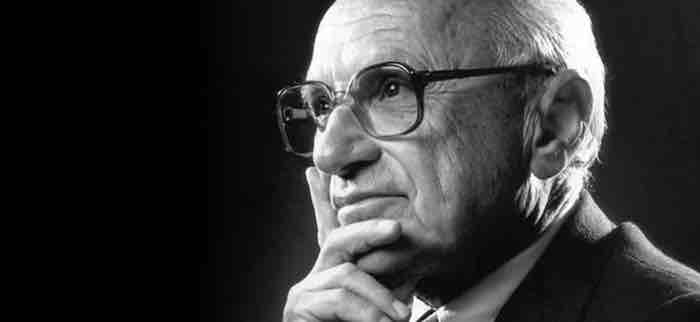 In 2014, Bob Inglis chaired a forum at the University of Chicago titled, “What Would Milton Friedman Do About Climate Change?” Two Chicago economists argued that Friedman would have applied the textbook analysis of “negative externalities” to the issue of climate change, and therefore would have supported a carbon tax. The only problem is, they gave no actual quotes of Friedman supporting a carbon tax, even though he died in 2006. Furthermore, there is at least one quotation from Friedman in which he denounces the fear-mongering of the global warming movement. Contrary to the claims of a few academics and retired government officials, a U.S. carbon tax is not a “conservative free market solution” to the issue of climate change.
Friedman’s Views on Climate Change and Carbon Taxes
I confess I did not sit through the entire 71-minute video of the forum. However, assuming the Forbes coverage of the event is accurate, neither Inglis nor the two U of C economists actually presented quotes from Friedman talking about climate change or carbon taxes specifically. Instead, they quoted him talking generically about pollution and using taxes to correct negative externalities. It’s not as if we’re discussing a free-market icon like Adam Smith who never had a chance to pontificate on climate change. Milton Friedman died in 2006, five years after the release of the IPCC’s third assessment report, and a year after the Kyoto Protocol went into force; I’m pretty sure Friedman had heard about man-made global warming. I looked myself and asked some colleagues, and nobody could find Friedman specifically writing on what actions—if any—the government should take in light of the potential problem of manmade climate change. To repeat, since Friedman was alive and quite nimble of mind well after the issue became a hot-button political topic, it is disingenuous to say things like this at the aforementioned forum:The media always reports that there’s near consensus among scientists about the effect of human activity on the climate. What gets less attention is that I think there’s even greater consensus, starting from Milton Friedman and going to the most left-wing economist you can find, that the obvious practical solution is to put a price on carbon. It’s not controversial.Furthermore, although I couldn’t find any quotes from Friedman talking about carbon taxes or cap-and-trade specifically—and apparently, neither could Inglis or the U of C professors—someone did point me to the following blurb Friedman gave in 1999 to Thomas Gale Moore’s Climate of Fear: Why We Shouldn’t Worry About Global Warming:
This encyclopedic and even-handed survey of the evidence of global warming is a welcome corrective to the raging hysteria about the alleged dangers of global warming. Moore demonstrates conclusively that global warming is more likely to benefit than to harm the general public.Now to be sure, Inglis et al. could come back and say, “Well, the natural science and the economic estimates of the impact of climate change have changed since 1999, and so it is possible that Friedman would have changed his mind if he were alive today.” This may be true, but the reader can see that the matter-of-fact claims of what Friedman would have thought about climate change are dubious at best. Since Inglis et al. never actually quote Friedman supporting their position—even though he was active up until 2006—and since I can quote him explicitly condemning it in 1999, the burden of proof is on Inglis et al. They can’t simply cite other economists on the matter and claim to speak for Friedman himself.
Why Some Economists Do Not Favor a Carbon Tax or Cap-and-Trade
Before closing this post, I want to clarify that even if we stipulate the “natural science” contained in popular climate models, it does not necessarily follow that an economist must favor aggressive government action to fight climate change. In other words, I am not arguing in this post that only “denier” economists could dispute the policy proposals put out by Inglis & Co. At IER in 2013 we hosted a conference specifically designed to educate the public and media on this matter. We had presentations from myself, Ross McKitrick, Ken Green, and David Kreutzer explaining the technical and pragmatic problems with carbon taxes in the real world. If you click on my summary posts for each participant, you will see that none of us said, “Al Gore is a big fat liar, this is all bunk.” No, we took the analysis beyond the usual sound bites of “the science is settled” and showed that the proposals to tax carbon do not follow from the standard analysis. There are all sorts of hurdles to surpass in going from “many scientists believe carbon dioxide emissions alter the climate” to “the government should tax carbon emissions.”Conclusion
Despite what Bob Inglis and a couple of economists from the University of Chicago would have you believe, Milton Friedman did not obviously support a carbon tax, and if anything he more likely would oppose it given what he actually said. Furthermore, plenty of solid economists today actively oppose a carbon tax, because they do not think it will deliver the benefits that its advocates claim.View Comments
Institute for Energy Research——Bio and Archives
The Institute for Energy Research (IER) is a not-for-profit organization that conducts intensive research and analysis on the functions, operations, and government regulation of global energy markets. IER maintains that freely-functioning energy markets provide the most efficient and effective solutions to today’s global energy and environmental challenges and, as such, are critical to the well-being of individuals and society.