Mother Charged With Aiding To The Delinquency Of A Minor For Allowing Son, 5, To Walk Outside Alone
A judge named Brian Smalls, like many liberals, decided that the law does not matter

Milt Harris , Bio and Archives--September 6, 2026
American Politics, News | Comments | Reader Friendly | Subscribe | Email Us
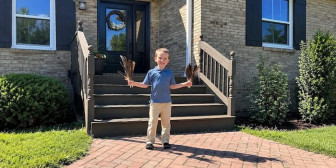
A judge named Brian Smalls, like many liberals, decided that the law does not matter. As a result, a mother of five has been charged with contributing to the delinquency of a minor.
Karyann Parkinson had the courage to raise her son responsibly, but unfortunately, she found herself entangled in the complexities of wokeism. Her son, Sam, is five years old.
In June, Parkinson took him on a bike ride around their neighborhood. After they returned home, Sam asked if he could walk back to a pond they had passed to collect goose feathers. Because he was capable and independent, and because he would be walking near friends' homes along the half-mile route, his mother agreed to let him go.
This walk was not along a major highway. They lived in a gated community, with 25 mph roadways. It’s a nice place with 24-hour security and three golf courses. That morning, she watched him cross the same two streets six times.
On that day, a passerby saw him walking alone and called security. Shortly thereafter, a security guard stopped him and asked why he was alone. The guard informed him that his mother had made a mistake. He told the boy that bad people would try to take him if he walked alone. When the guard asked Sam to get into his truck so he could take him home, the boy refused because he didn't know the guard. Instead, Sam chose to walk back to the house with him.
This scene is almost inconceivable to me. As a young boy, my friends and I ran, walked, or rode our bikes everywhere. This was a young boy walking past the houses of people who knew him and his family. It’s a gated community, for God’s sake, with 24-hour security. The person who called for security sounds like a busybody who overreacted. The guard was also out of line for unnecessarily scaring the child.
Then it got worse; instead of just taking Sam home and talking with his mother to understand the situation, he drastically inflated the matter by calling the police. Three police units arrived quickly, as though it was a bank robbery. Then a security vehicle and two Child Protective Services workers showed up as well.
Parkinson described how things unfolded:
"What really got me so upset that day was when he came home with the guard, and his eyes were wide and he looked stressed out… and told me, 'He said we broke the rules and we're not allowed to do that, and there are bad people in our neighborhood who want to hurt me.’ Before that, he was totally happy and confident to go explore."
When Parkinson asked the guard to show her where in the homeowners' association rules it said the boy could not walk around alone, that’s when he called the police. Then, when Parkinson would not allow the police to question Sam to decide whether he was capable of walking alone, they summoned CPS.
If all of this sounds a little Gestapo-ish, I’m with you. Parkinson put it this way. "For parents, I think it's really concerning. Is it your right or that of others to decide that your kid is capable? I didn't let police make that decision."
Parkinson, who is a law clerk, was also eight months pregnant at the time. When everyone left, she "genuinely thought it was all over." On June 18, just a week before her due date, two police officers arrived with a warrant for her to sign, ordering her to go to trial. Two days later, she received a letter informing her that Child Protective Services (CPS) was investigating her. Shortly after, she gave birth but was terrified that someone might attempt to take her newborn baby away.
When her trial date rolled around, her lawyer, Andrew Gordon, who took the case pro bono, was confident the charges would be dropped. Largely because of the Reasonable Childhood Independence Law, which states that neglect is only when you put your kids in serious, obvious danger. Virginia had unanimously passed the law, which ironically was sponsored by former state senator Jill Vogel, a lawyer whom Parkinson had worked for while she was still in law school.
Lenore Skenazy is a well-known advocate for childhood freedom and the founder of the "free-range parenting" movement. She served as the investigative journalist and advocate who first broke the story about Parkinson's controversial conviction in Reason Magazine.
"Parkinson is no newbie to parenting. She graduated Brigham Young University in 2012 with a degree in family science. She then became a family life educator and spent three years as a live-in behavioral specialist at a residential treatment center. There, she and her husband, a marriage and family therapist, oversaw the care of 35 girls."
The Reasonable Childhood Independence Law was specifically designed for situations like this. However, Judge Brian Smalls completely disregarded what was right. Instead of upholding the law, he convicted Parkinson of a first-degree misdemeanor, which carries a potential jail sentence of up to six months. He suspended the sentence, contingent upon "good behavior" and compliance with the conditions set by Child Protective Services (CPS). Additionally, the state placed Parkinson on Virginia's child abuse and neglect registry, where she will remain for a duration of seven years.
The child-abuse registry, which could prevent her from volunteering at her children's school, is "more disturbing to me than the criminal charge," said Parkinson. "It's quite onerous."
Jonathan Adler, a law professor at William and Mary who attended the proceedings, said the trial was "even worse than this story suggests."
Jay Rogers, the President of Alpha Strategies and a contributor to the Daily Signal, wrote:
"A 5-year-old walking a supervised sidewalk in a gated community with paid guards on every corner isn't a crisis. It's a Tuesday.”
He added that the fact that the judge disregarded the law is "the part that should make every parent in the country furious" and that the delinquency of a minor charge is a law "built for wayward teenagers, not a 5-year-old collecting feathers."
This situation is a clear example of government overreach, and Parkinson and her legal team are appealing. Gordon's defense strategy for the appeal emphasizes the lack of evidence showing actual harm, along with a direct contradiction of Virginia's state laws.
Since the appeal moves the case from the Williamsburg-James City County Juvenile and Domestic Relations District Court to the Circuit Court for a de novo trial (a completely fresh review), Gordon is preparing to address two major legal flaws.
The defense will emphasize that the state's case is based solely on speculative worst-case scenarios. Gordon intends to show that the 5-year-old child was never in imminent danger, as the walk occurred on a sidewalk with crosswalks, within a secure gated community with a 25 mph speed limit and 24-hour security.
The appeal rests on statutory interpretation. In 2023, Virginia Governor Glenn Youngkin signed the Reasonable Childhood Independence Act into law. This legislation states that "neglect" does not include permitting a child to engage in independent activities—such as walking to a park, playing outside, or staying home alone—as long as the parent makes a reasonable judgment about the child's capability and safety.
Gordon plans to argue that the local authorities and the lower-court judge made a significant legal error by overlooking this state-level protection. By penalizing a mother for her considered decision to allow her child to walk a half mile to collect feathers, the prosecution directly contradicts the intent of Virginia’s statutory framework.
Judge Smalls unjustly punished a mother of five children. Let’s hope she and her family receive financial restitution, in addition to overturning this injustice.
View Comments
Milt spent thirty years as a sales and operations manager for an international manufacturing company. He is also a four-time published author on a variety of subjects. Now, he spends most of his time researching and writing about conservative politics and liberal folly.