Now There’s Something You Don’t See Every Day--Training For the Fair
Survival in Tough Times: If John Adams and thomas Jefferson drove past that farm, I think they both might smile, then look at me and say, “Now there’s something you don’t see every day!”
Dr. Bruce Smith , Bio and Archives--June 23, 2026
HeartlandLifestyles | Comments | Reader Friendly | Subscribe | Email Us
We are still privileged to see little glimpses of a good world here and there if we take the time to notice.
I was on a smooth county road off the old National Road about forty miles west of Indianapolis. It wasn’t a scene I was looking for, but I recognized it as soon as it came fully into view.
It’s farm country out here with fields of corn and soybeans just getting a good start after a rainy spring. I see a broad green lawn with shade trees around a well-kept and rather up-to-date farmhouse.
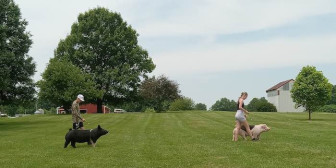
Behind is an assortment of farm buildings with feed bins but no silos. There is no hay barn so it’s not a cattle operation. The buildings are mostly low to the ground so I’d expect it to be a hog farm. As I come closer to the driveway I look to the right again and up across the open lawn next to the house. What’s this? Two people are out there with sticks and something on a lead like big dogs. I glance at the road and back toward the house again as I slow down a bit. It looks like two teens, each with show sticks, and each with a lead on an animal low to the ground. They aren’t leading dogs, they’re leading good-sized pigs! Then I understand. These are 4-H kids training their swine for the showmanship part of the county 4-H fair.
I smile and go past, but then I smile more, slow down, and turn around at the next intersection before going back. When I get closer I’ve rolled the window down, but the kids pay no attention to me. They’re intent on their training routine, walking straight lines back and forth across the lawn, gradually getting closer to the road. The pigs are walking alongside each of them. When I stop they look over. “Mind if I take a picture?” I ask. They smile and say it’s fine, go ahead. I take a couple of shots, but I don’t linger. When I turn around again and go past, they’re focused on their training. When I wave they wave back. I drive on with a bit of a lump in my throat.
One of the comforts that comes with living in the Heartland is knowing that there are scenes like this one when I least expect them. As I drive on I’m reminded of America’s rural roots. What I have just seen is the continuation of Jefferson’s democratic vision for the country. The National Road was Jefferson’s idea. Here, in the old Northwest Territory, the vision plays out just a few miles from where sturdy pioneers trekked along its broad route heading for Ohio, Indiana, Illinois, and points west. The scene I have witnessed was what Jefferson hoped would transpire long after the frontier line passed beyond the Scioto, the Wabash, the Illinois, and the Mississippi. Today his dream is alive and doing well. We are here to witness it and celebrate it every time we drive through the beautiful Heartland of America.
John Adams and Thomas Jefferson both passed away on July 4, 1826, so when the big day arrives this year it will be 200 years since their passing and 250 years since our founding in 1776. The grand experiment in self-governance continues with its ups and downs. No doubt both of them would be concerned about where some of the paths the country has taken since their day, but it is fair to say that both would certainly be astonished and proud of much of what they would see were they to drive down that same county road with me. If we drove past that farm at the right time of the day, I think they both might smile, then look at me and say, “Now there’s something you don’t see every day!”
View Comments
Dr. Bruce Smith (Inkwell, Hearth and Plow) is a retired professor of history and a lifelong observer of politics and world events. He holds degrees from Indiana University and the University of Notre Dame. In addition to writing, he works as a caretaker and handyman. His non-fiction book The War Comes to Plum Street, about daily life in the 1930s and during World War II, may be ordered from Indiana University Press.