Obama Assaults Democracy by Rejecting Popular Consent
Could Barack Be Anything Besides a Manchurian Candidate?

Kelly O'Connell , Bio and Archives--February 20, 2011
Cover Story | Comments | Reader Friendly | Subscribe | Email Us
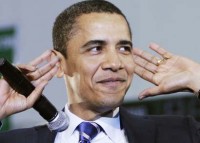 Does the "Will of the People" matter when government is run by a cadre of demigods? After all, is it really immoral to force Americans to do the good and avoid the bad? Contra, one can argue the very cornerstone of US constitutional theory is summed up in the doctrine of Consent of the Governed, since without acknowledging the popular will, every other act by government is tyranny. Yet, former constitutional instructor Barack Obama constantly ignores and even flouts this principle in action.
Remember the Declaration's immortal words:
Does the "Will of the People" matter when government is run by a cadre of demigods? After all, is it really immoral to force Americans to do the good and avoid the bad? Contra, one can argue the very cornerstone of US constitutional theory is summed up in the doctrine of Consent of the Governed, since without acknowledging the popular will, every other act by government is tyranny. Yet, former constitutional instructor Barack Obama constantly ignores and even flouts this principle in action.
Remember the Declaration's immortal words:We hold these truths to be self-evident, that all men are created equal, that they are endowed by their Creator with certain unalienable Rights, that among these are Life, Liberty and the pursuit of Happiness. -- That to secure these rights, Governments are instituted among Men, deriving their just powers from the consent of the governed...In ignoring America's convictions, the current administration forfeits legitimacy, because each act done against consent furthers bitter reaction to non-representational government. For example, 75% of Americans want Obamacare amended. Yet the liberals in power treat us as children. Such a posture is an inversion of historic European Natural Law doctrines of self-government. Does Obama believe himself so wise to want all rights of the people vested in him for safe-keeping? Hasn't this idea been attempted already in the USSR? The following essay examines Obama and the Consent of the Governed.
I. History of Popular Consent: Vox Populi
According to the Dictionary of the History of Ideas, the notion of Popular Sovereignty, ie Will of the People, is traced back to at least the Demos of ancient Greece, or democratic assembly. Famously, the right to vote belonged to free, native male citizens of the city of Athens, leaving out more persons than had the franchise. Ancient Rome had a fascinating political development, beginning with a kingdom, evolving into a Republic, adding elements of democracy, then lapsing back to tyranny via an emperor. Popular votes were held, and would-be rulers understood elected positions were more likely if one balanced gravitas with levitas, or a regal bearing offset by the common touch. During the Middle Ages, much political philosophy developed in the Church, and by individual writers like Marsilius of Padua and Machiavelli. Probably every important modern idea on the state emerged at least in outline during this period. As already mentioned, the general idea of social contract has its own story:The history of the social contract covers three compelling elements, according to Sir Ernest Baker, in Social Contract, Locke, Hume, Rousseau. The first is Roman Law, the second are biblical teachings, and the third, Aristotle's Politics. Writes Baker, "Very large elements of political liberalism were based on a conflation of three sources--the teachings of the Bible, the doctrines of Roman Law, and the principles of Aristotle's Politics. The Bible taught that the powers that be are ordained of God; but it also taught that David made a covenant with his people. It was the doctrine of Roman Law that quod principi placuit legis habet vigorem ("That which pleases the prince has the strength of law" ); but it was also the doctrine of Roman Law that the reason why this was so was that "the people, by the Lex Regia passed into regard to his authority and power. The principle of Aristotle's Politics might seem to favor a monarchy of the one best man; but they also favored a clear distinction between the king and the tyrant, and they endorsed the right of the masses not only to elect the magistrate but also call him to account."
II. Locke & Constitution
The Declaration was composed as an introduction to the Constitution. Cornerstone to the American theory of the rule of law, was inverting the singular authority of a king, or a cabal of legislators, into empowering "The People." This idea developed from centuries of European ferment before use against royal tyranny, most famously in the American Revolution. Father of the Enlightenment, John Locke, is rightly regarded a prime mover of the US Declaration and Constitution. Some passages of the Declaration are almost word-for-word renditions of Locke's Second Treatise on Government, the most influential original source of modern political ideas. Locke is also a colossus of classical liberalism. Locke was able to achieve the almost impossible -- becoming the greatest advocate for Conservative government stability, while allowing the possibility, or even duty, of rebellion against the rule of tyrants. Even more impressive, Locke was able to square this with his Puritan theological constructs. For example, consider Locke's Second Treatise on Government, Chapter 19, Sec. 221: "Of the Dissolution of Government."There is therefore, secondly, another way whereby governments are dissolved, and that is, when the legislative, or the prince, either of them, act contrary to their trust. First, The legislative acts against the trust reposed in them, when they endeavour to invade the property of the subject, and to make themselves, or any part of the community, masters, or arbitrary disposers of the lives, liberties, or fortunes of the people.And from Sec 226:
Thirdly, I Answer, That this Doctrine of a Power in the People of providing for their safety a-new by a new Legislative, when their Legislators have acted contrary to their trust, by invading their Property, is the best fence against Rebellion, and the probablest means to hinder it. For Rebellion being an Opposition, not to Persons, but Authority, which is founded only in the Constitutions and Laws of the Government; those, whoever they be, who by force break through, and by force justifie their violation of them, are truly and properly Rebels.This language on principled revolt is echoed in the Declaration:
That whenever any Form of Government becomes destructive of these ends, it is the Right of the People to alter or to abolish it, and to institute new Government...
III. Obama, Natural Law & Communism
A. Obama's Litany of Self-Referential Rule
There is a long list of unpopular Obama decisions, which most Americans could probably name with great accuracy. As the following poll numbers show, Americans simply do not like Obama's policies. Consider: ObamaCare --75% of Americans want it changed. Half oppose Obama's new budget spending; 67% favor states enforcing immigration laws--with 48% favoring beefed up borders, opposing Obama's position; Only 25% favor Obama's Treasury Sec Timothy Geithner & DOJ chief Eric Holder; Just 31% believe Obama's America is headed in the right direction; 55% think Obama did not cut enough spending in new $3.7 trillion dollar budget; 57% believe the bailouts were bad for the US; On Obama's high-speed rail program, 46% reject; 27% want an electric car in the next decade; 68% believe Big Gov & Biz work against Americans; 80% think terrorism a bigger threat than war; 75% believe ObamaCare will cost more than promised; Only 33% believe ObamaCare must be funded if not repealed; Just 21% want Obama's Internet regulations; 66% want Gov spending trimmed by 10%; Only 27% see USA as inherently racist; 29% believe Barack claim repeal of ObamaCare will increase deficit; Over half think taxes can be cut while budget balanced; 56% see Israel as an ally, Only 18% believe Obama myth greatness of America came from government; etc., etc. etc. The issue we must examine now, dreary it may be--is whether Obama's unpopular positions are deplored because they are a dose of bitter, but healthy medicine? Are they likely to solve our problems in the here and now? Further, will his policies accomplish anything in the longterm? Unfortunately, Barack's disastrous ideas almost universally are not good for the present, or future. So, not only is Barack repeatedly making unpopular choices, but they are decried for being disastrous ideas defended by stupid, leftist rhetoric.B. Natural Law Government Model
There is a Natural Law political model. In fact, it is the same one used by our Founders. Said Massachusetts patriot James Otis about the Natural Law in 1764,The rules of moral conduct implanted by nature in the human mind, forming the proper basis for and being superior to all written laws...Such theories are founded upon Consent of the Governed, rule of law, with a government of separated powers, and limited state might, a default towards freedom, and a capitalist economy where all persons can develop their talents in the marketplace. Says Thomas Jefferson on the Natural Law:
The moral law to which man has been subjected by his Creator, and of which his feelings, or conscience as it is sometimes called, are the evidence with which his Creator has furnished him. The moral duties which exist between individual and individual in a state of nature accompany them into a state of society... their Maker not having released them from those duties on their forming themselves into a nation.
C. Progressive's Arrogant Leadership
One of the most notable aspects of Communist rule, were crazy decisions made by arrogant, smug, and very often mentally unhinged rulers, such as Stalin, Lenin and Mao, who between them killed at least 150 million innocents. But what is the hallmark of such humanistic government?- Autocratic and typically uninformed decision-making (like Mao's Great Leap Forward, whose ill-advised policies killed perhaps 40 million Chinese).
- Refusal to accept tradition as meaningful. Therefore experience is treated as a laughingstock.
- Failure to use success as a goal; and substitution of political dogma in its place.
- Utter fixation on leadership via philosophical innovations, instead of statecraft or logic.
- Dismissal of the notion of Human Rights.
- Refusal of Popular Sovereignty, or any actual democratic processes.
- Banning of any religious expression, or biblical groups.
- Usurpation of the Arts and Sciences as tools of the deified State.
- Refusal to allow opposition, or any genuine free speech.
- Demonizing of various powerful opponents, until outlawed, or killed.
- Commandeering of procreation as a State defined undertaking.
- Rise of pseudo-leadership by demagogues.
- Ultimate ruination of the economy and society.
IV. Summary: Consent, the Foundation of Political Legitimacy
Pollster Rasmussen reports "just 28% believe federal government today has the consent of the governed." This creates several problems for Obama. First, most Americans do not experience government as representational. This is dangerous because it breeds a fatalistic and cynical populace increasingly disconnected from Washington, and all that implies. Second, it forces a constitutional crisis. For, despite Barack's poisonously smug demeanor in every setting, and claims of constitutional mastery, this creates a de facto lawless regime. For if Obama is continually defying the will of the people at every turn, he has created an anti-constitutional tyranny, and therefore must be stopped. In conclusion, we have a constitutional, Natural Law duty to see Obama driven from office by impeachment. Because the only moral government, according to our Constitution, is one that derives its legitimacy from the Consent of the Governed, an idea Barack had refused to honor since gaining office.View Comments
Kelly O’Connell is an author and attorney. He was born on the West Coast, raised in Las Vegas, and matriculated from the University of Oregon. After laboring for the Reformed Church in Galway, Ireland, he returned to America and attended law school in Virginia, where he earned a JD and a Master’s degree in Government. He spent a stint working as a researcher and writer of academic articles at a Miami law school, focusing on ancient law and society. He has also been employed as a university Speech & Debate professor. He then returned West and worked as an assistant district attorney. Kelly is now is a private practitioner with a small law practice in New Mexico.