Offshore Wind Issues on Both Coasts
A scandal in plain sight: the wind industry is destroying the fishing industry

Jack Dini , Bio and Archives--October 4, 2024
Global Warming-Energy-Environment | Comments | Reader Friendly | Subscribe | Email Us
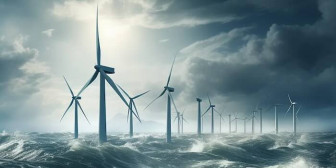
East Coast
The Biden Administration has approved nine offshore wind projects. These propose building a total of 13 gigawatts of offshore wind capacity. However, only two of these projects are actually under construction or completed- Vineyard Wind, located off the coast of Massachusetts, and South Fork Wind, located near the coasts of Rhode Island and New York.(1)
South Fork Wind just came on line. This is a six hundred million dollar white elephant in the middle of the ocean, and it’s getting paid four hundred million of taxpayer money to do so.
Denmark’s Orsted, the worldwide leading offshore wind developer, recorded a $575 million loss in the second quarter
So, what does the New York consumer get for all of this more than generous support? The consumer gets wind power costing four times as much as the current cost of power in New York.
Stop and consider. Even when the developer gets two thirds of the cost paid by the taxpayer, offshore wind power is still four times as expensive. And of course, that doesn’t even touch the cost of maintaining backup power for the times when there’s no wind. (1)
Many of the projects proposed prior to the pandemic have faced major setbacks. Some of the offshore wind farms in the US have actually been terminated as a result. One off the shore of New Jersey has been cancelled at a significant loss. Orsted, the Danish company responsible for the project, backed out on its development. Reportedly, Orsted lost about $5.6 billion worth of revenue in the process. (2)
Denmark’s Orsted, the worldwide leading offshore wind developer, recorded a $575 million loss in the second quarter. In part, the loss is the result of disappointing developments in the US. (3)
Orsted is not the only company experiencing this challenge with wind energy. BP Oil, which has a 50% investment stake in Equinov, cited a loss of $540 million in wind projects. The Norwegian company has similarly faced struggles related to costs of construction and operation. (4)
A scandal in plain sight: the wind industry is destroying the fishing industry
Recently, BP put its onshore wind business in the US, estimated to be worth $2 billion, up for sale as it trims its renewables business and sells off underperforming assets, BP also wrote down the value of its offshore US wind business by $1.1 billion last year after struggling to make progress on three projects on the east coast. (5)
New York state signed a contract in June to buy electricity generated by two large wind farms, Empire Wind 1 and Sunrise Wind off the coast of Long Island. These two projects will pay producers prices far above the break-even cost of generating electricity.
The projects are expected to begin in 2026 and 2027, with power delivered to Brooklyn (Empire) and Long Island (Sunrise). The state will pay $155 and $146 per megawatt hour, respectively. These prices are steep, at least four times the average grid cost paid over the past year. New Yorkers should be asking why. (4)
The offshore wind business off the East Coast is in turmoil. Operators have canceled projects from Massachusetts to Maryland that were due to be constructed in the next four years. Some have been delayed, while others have renegotiated their contracts at prices 30% to 50% higher than originally promised.
Over the last six months, investigative reporter Donna Andersen interviewed dozens of fishermen, government officials, and scientists and has uncovered a scandal in plain sight: the wind industry is destroying the fishing industry. (6)
Formerly productive scallop beds are dead. Cod has disappeared
Why now? In part because of the recent collapse of a giant wind turbine blade off the coast of Massachusetts, which scattered jagged pieces of fiberglass along the beaches of Nantucket, threatening the boats of fishermen and local tourists.
Electric power flows through a high voltage export cable for 66 miles and comes ashore in East Hampton, New York.
So far this year, the sea bass fishing is okay, But lobsters? There are no signs of life at all. Ever since the wind farms came to the ocean, lobsters have been hard to find.
Formerly productive scallop beds are dead. Cod has disappeared. (6)
Maine’s offshore wind plan calls for development of 3,000 MW of generating capacity, an amount that is roughly double the state’s average electricity usage. The viability of Maine’s offshore wind plan depends entirely on the massive transformation of the state’s grid from fossil fuel to electrification. It is clear that the citizens of Maine have not been informed of this vast transformation requirement. They have certainly not approved it says David Wojick. (7)
The offshore wind facilities will consist of great numbers of floating turbines operating on a scale and degree of reliability that hasn’t been verified to work in the real world. Such a plan makes the entire plan not only technologically speculative but also economically risky. The price tag for this project would be around $100 billion.
West Coast--offshore wind is an environmental catastrophe
California plans to install between 2,500 and 10,000 floating offshore wind turbines approximately 20 miles off the coast of San Luis Obispo and Humboldt counties. The estimated cost to install 25 gigawatts of capacity which equates to 10 gigawatts of steady power if adequate storage assets are available, is at least $100 billion. These costs don’t include the necessary investments in storage assets or additional high voltage transmission lines. Nor do they include the costs to maintain the floating turbines in a hazardous environment. (8)
No other significant energy option costs this much. Even nuclear, at its falsely inflated construction costs, is less expensive. Natural gas electricity generation with CO2 sequestration included is four times less expensive. Every imaginable renewable—solar, geothermal is far less expensive.
But beyond its eye-watering costs, offshore wind is an environmental catastrophe. (8)
Some examples:
- California’s treasured marine ecosystem will be disrupted. Imagine the impact on aquatic wildlife. Entanglements, collisions, broken cables, electromagnetic fields, low frequency noise, sedimentation from anchor use.
- Whales--the evidence that underwater sonar used to survey sited causes permanent damage to the ability of marine mammals to navigate and communicate in nearly indisputable.
- Electromagnetic fields emanating from subsea cables appear to produce birth deformities in juvenile lobsters. Note- Donna Anderson reported no signs of lobster in some East Coast locations. (6)
United Kingdom
The UK’s most up-to-date floating wind farm, Kincardine, lost 30 million pounds last year. This is a financial disaster. Floating wind is a key part of Net Zero. (9)
Summary
There is increasing evidence the US has reached the point of peak renewables as the pool of private investors shrinks and winning community approval becomes harder. Research by the Lawrence Berkeley National Laboratory showed roughly one-third of utility scale wind and solar applications submitted over the past five years were cancelled, while about half of wind and solar projects experience. (10)
Meanwhile, the challenges of grid synchronization and storage remain unresolved, and the technical problems for offshore wind turbines, in particular, are mounting.
The wholesale electricity prices proposed for offshore wind installation, even with subsidies, are higher than local area retail electric rates. Also, none of the proposed projects include the storage necessary to make them dispatchable.
References
- Willis Eschenbach, “Why is cheap wind power so expensive?”, stephenheins.substack.com, August 28, 2024
- “The problems with offshore wind energy,” boldbusiness.com
- Kennedy Maize, “US offshore wind: the struggle continues,” masterresource.org, August 21, 2024
- “WSJ why is New York paying so much for wind power?”, forums.macresource.com, August 24, 2024
- “BP puts $2 billion US onshore wind business up for sale,” principia-scientific.org, Septermber 24, 2024
- Donna Andersen, “Offshore wind decimating sea life – fishermen accuse govt of cover up,” principia-scientific.org, September 20, 2024
- David Wojick, “Maine’s massive floating wind folly—my report,” cfact.org, September 23, 2024
- Edward Ring, “Floating offshore wind- an environmental catastrophe,” californiapolicycenter.org, August 23, 2024
- Paul Homewood, “Floating wind farm lost 30 million pounds last year,” notalotofpeopleknowthat.wordpress.com, October 1, 2024
- Sallust, “The end of Australia’s renewables romance,” principia-scientific.org, August 29, 2024
View Comments
John William Dini, know to all as ‘Jack’, passed away at the age of 89 on June 17, 2026. He was born in Cleveland, Ohio on Nov. 14, 1936.
He published two books, a technical book on materials science and coatings and another on environmental issues. In retirement, he wrote extensively on various environmental issues for online publications.
He was a skilled leaded glass hobbyist, creating more than 20 lamps and many panels. He was a jogger for many years, competing in over 300 long distance races. He was a slow runner, not wanting to take the glory away from others. His secret was to start slow and taper. He and Anne traveled extensively, visiting over 70 countries.
He is survived by his wife, Anne, of 67 years, and sons Mike, Steve, and Paul. If you were to meet him somewhere, he would sum up his life as ‘peaches and cream’.