Back in 2008, if you happened to turn on CSPAN, you could have watched the
political theater starring top Democrats as they faced off against a regulator in a hearing before the House subcommittee on capital markets . The regulator calling for reform and accountability of government agencies was referred to as racist and his suggestions were akin to a "lynch mob." In psychology, we were refer to these types of baseless accusations as Projection. In political speak, we refer to these as Red Herrings.
Franklin Raynes, CEO of Fannie Mae, was the "victim" of this modern-day lynching. He was
protected by his fellow Democrats on the committee, even though he was found to have manipulated the truth and the numbers of this agency. According to a
report by House of Representatives Committee on Oversight and Government Reform:
"Franklin Raines earned more than $90 million from 1998 to 2003. Further, the Office of Federal Housing Enterprise Oversight (OFHEO) revealed in 2006 that some Fannie senior executives (including Raines) had manipulated accounting to bolster their pay from 1998 to 2004."
Only in political theater could this story be true and end with Franklin Raines riding off into the sunset with $90 million and exonerated of any accountability.
Likewise, fast forward to part two in the political theater of 2016. In sweet irony, and in a stunning display of confusing facts with fiction, Stephen Lynch (D-MA) quoted a 2015 Academy Award nominated movie,
The Big Short, as grounds to increase regulations and to cast blame on Credit Rating Agencies (CRA's) during an exchange with Thomas Butler, the Director of the Office of Credit Ratings. To clarify, these CRA's are comprised of
three companies who are given special authority by regulators to determine how safe a broad variety of loans are for investment purposes.
Rep. Lynch accused the CRA's of making record profits without instituting any changes or using their statutory authority to hold
themselves accountable and who are partaking in a "pay to play" rating system.
The scene Rep. Lynch cites from The Big Short opens with a hedge fund manager named Mark Baum who presses an analyst from Standard & Poor's about why it continued to rate exotic mortgage bonds highly in the face of mounting defaults:


 If it moves, tax it. If it keeps moving, regulate it. If it stops moving, subsidize it. -- Ronald Reagan
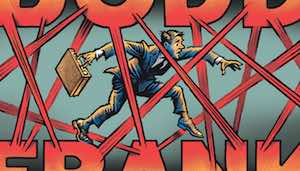
Enter Dodd Frank: legislation named after Democrats' Christopher Dodd and Barney Frank, which enacted 2,300 pages of banking regulations. What could have possibly gone wrong with 2,300 pages of new government regulations on banks? This: