Southern Alberta's 2013 Floods and Climate Change
Far greater caution was warranted in the media before linking these two topics

Sierra Rayne , Bio and Archives--April 17, 2014
Canadian News, Opinion | Comments | Reader Friendly | Subscribe | Email Us
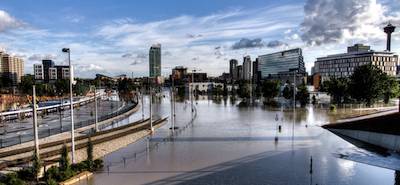
The floods killed four people, affected more than 8 percent of the province's land area, damaged almost 15,000 homes and 200 bridges, and required the evacuation of over 100,000 residents with total damages well into the billions of dollars. Now this is oil country, with the third largest oil reserves on the planet (~11 percent of total global reserves) sitting under a population of only 4 million. Alberta's oil sands are a significant source of greenhouse gases, comprising about 7 percent of Canada's emissions. So naturally, many in the media started to wonder if the floods were caused by anthropogenic climate change.
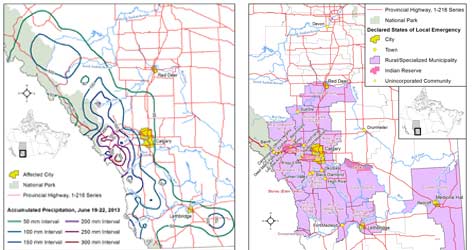 At the Vancouver Observer, Mike Soron penned a piece entitled "I believe the Alberta floods were driven by climate change." Well, that sounds like a rigorous scientific opinion. In the article, Soron states that "growing up in Calgary, I remember many floods, heavy rains, hail and tornadoes. But today, these events are more frequent and intense -- as climate change models have long said they would be." Others such as David McLaughlin, former head of the now-defunct National Roundtable on the Environment and the Economy, also linked the floods to climate change: "Denying that climate change is a cause is akin to putting your head in the sand -- in this case, your head in a sand bag." In response, Federal Conservative Party Immigration Minister Jason Kenney dismissed the climate change concerns, calling the floods a naturally occurring extreme event.
Andrew Nikiforuk went all-in for climate change concerns, stating that "Calgarians are now living a chronicle foretold by climate scientists ... Alberta, always a geography of maximum weather, is now climate change central in Canada due to exponential growth in human communities and all in the path of increasing floods, droughts, fires and hail storms." John Pomeroy, the Canada Research Chair in Water Resources and Climate Change Director at the University of Saskatchewan, was quoted as claiming "climate change could have played a factor in the deluge and resulting floods."
So who is right? Probably Kenney. If anthropogenic climate change was the cause of the flooding, particularly the damage seen in Calgary from the Bow River, then we would expect to see an anthropogenic climate change signature in the peak flow record with more extreme flood events occurring over time. But we don't.
Indeed, using data between 1911 to 2012 from the Environment Canada/Water Survey of Canada hydrometric database, we actually find strong and highly statistically significant negative temporal trends in the maximum instantaneous discharge (p~10-5, r=-0.43) and maximum daily discharge (p~10-5, r=-0.46) for the Bow River at Calgary hydrometric station. Over the past quarter- to half-century, the trends become non-significant, but the correlations are still negative.
At the Vancouver Observer, Mike Soron penned a piece entitled "I believe the Alberta floods were driven by climate change." Well, that sounds like a rigorous scientific opinion. In the article, Soron states that "growing up in Calgary, I remember many floods, heavy rains, hail and tornadoes. But today, these events are more frequent and intense -- as climate change models have long said they would be." Others such as David McLaughlin, former head of the now-defunct National Roundtable on the Environment and the Economy, also linked the floods to climate change: "Denying that climate change is a cause is akin to putting your head in the sand -- in this case, your head in a sand bag." In response, Federal Conservative Party Immigration Minister Jason Kenney dismissed the climate change concerns, calling the floods a naturally occurring extreme event.
Andrew Nikiforuk went all-in for climate change concerns, stating that "Calgarians are now living a chronicle foretold by climate scientists ... Alberta, always a geography of maximum weather, is now climate change central in Canada due to exponential growth in human communities and all in the path of increasing floods, droughts, fires and hail storms." John Pomeroy, the Canada Research Chair in Water Resources and Climate Change Director at the University of Saskatchewan, was quoted as claiming "climate change could have played a factor in the deluge and resulting floods."
So who is right? Probably Kenney. If anthropogenic climate change was the cause of the flooding, particularly the damage seen in Calgary from the Bow River, then we would expect to see an anthropogenic climate change signature in the peak flow record with more extreme flood events occurring over time. But we don't.
Indeed, using data between 1911 to 2012 from the Environment Canada/Water Survey of Canada hydrometric database, we actually find strong and highly statistically significant negative temporal trends in the maximum instantaneous discharge (p~10-5, r=-0.43) and maximum daily discharge (p~10-5, r=-0.46) for the Bow River at Calgary hydrometric station. Over the past quarter- to half-century, the trends become non-significant, but the correlations are still negative.
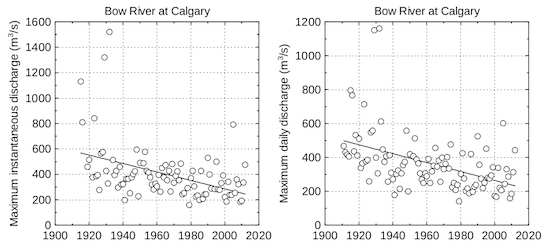 Consequently, we are seeing trends towards less severe flooding on the Bow River at Calgary over time, not more. Is this surprising? Not at all. During the peak of the flooding, a local newspaper published a flooding history for the region. Severe floods have happened before, and they will happen again. Interpreting the river's flood history is complex, though, since there are dams upstream of Calgary. Regardless, there are no increasing trends for maximum instantaneous/daily flow rates either including the entire data record, or just the periods after dam construction.
Floods integrate many factors, such as the intensity and duration of precipitation, prior moisture content of the watershed soils and any snowpack, vegetation cover, and the influence of human modifications to the landscape and the river channel itself. Attempting to reliably correct for these varying factors over the historical record and then tease out the direct impacts of anthropogenic climate change from natural cycles is effectively impossible. For those among the climate alarmism community that are so keen on "evidence based policymaking," perhaps they should give these caveats more attention before speaking in the media.
Consequently, we are seeing trends towards less severe flooding on the Bow River at Calgary over time, not more. Is this surprising? Not at all. During the peak of the flooding, a local newspaper published a flooding history for the region. Severe floods have happened before, and they will happen again. Interpreting the river's flood history is complex, though, since there are dams upstream of Calgary. Regardless, there are no increasing trends for maximum instantaneous/daily flow rates either including the entire data record, or just the periods after dam construction.
Floods integrate many factors, such as the intensity and duration of precipitation, prior moisture content of the watershed soils and any snowpack, vegetation cover, and the influence of human modifications to the landscape and the river channel itself. Attempting to reliably correct for these varying factors over the historical record and then tease out the direct impacts of anthropogenic climate change from natural cycles is effectively impossible. For those among the climate alarmism community that are so keen on "evidence based policymaking," perhaps they should give these caveats more attention before speaking in the media.View Comments
Sierra Rayne——Bio and Archives
Sierra Rayne holds a Ph.D. in Chemistry and writes regularly on environment, energy, and national security topics. He can be found on Twitter at @srayne_ca