The Battle Over God-Given Rights in 2019
A belief in the truths of the Declaration of Independence is an affirmation of belief in the truth of God’s existence.

Dennis Jamison , Bio and Archives--January 2, 2019
American Politics, News | Comments | Reader Friendly | Subscribe | Email Us
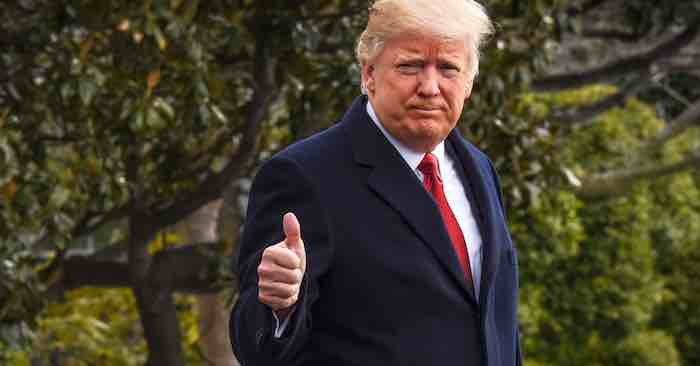 On December 7th last year, while Americans were still recovering from bewilderment in the aftermath of the national elections, and while there were public acknowledgements of the Pearl Harbor attack, President Donald Trump issued a presidential proclamation of a different nature, specifically regarding the Bill of Rights. Of course, the mainstream media did not pay much attention to the points the president made in that proclamation, which was also an acknowledgement of the U.N. Human Rights Day, but Trump made an incredible statement in what could normally viewed as a boilerplate recognition of regular holidays. An excerpt from the statement demonstrated that Trump is a genuine champion of God-given, human rights.
 Our nation was founded on the idea that our Creator endows each individual with certain unalienable rights. In the Declaration of Independence, Thomas Jefferson identified life, liberty, and the pursuit of happiness as among these fundamental human rights. Our nation has enshrined these and other rights, which Americans continue to enjoy today, in the Bill of Rights. On Bill of Rights Day, we recognize the key role of the Bill of Rights in protecting our individual liberties and limiting the power of government. The Founding Fathers understood the real threat government can pose to the rights of the people. James Madison, who introduced the Bill of Rights in the Congress, stated that the “essence of Government is power; and power, lodged as it must be, in human hands, will ever be liable to abuse.” That is why those first 10 Amendments to the Constitution, among others, protected the right to speak freely, the right to freely worship, the right to keep and bear arms, the right to be free from unreasonable searches and seizures, and the right to due process of law. As a part of the Constitution, the supreme law of the land, the Bill of Rights has protected our rights effectively against the abuse of government power for 227 years.Indeed, the words of the Declaration of Independence served as the foundation for the Bill of Rights, and the most powerful statement made referred to the inalienable rights granted by God, rights given by our Creator to human beings. Trump reaffirmed the foundation of the nation as it had been built by the Founding Fathers. He also vowed “to fiercely protect the eternal flame of liberty.” The president also affirmed that “We also remember all those around the world whose God-given rights have been violated and disregarded by authoritarian regimes, and we express our desire for the rule of law and liberty to one day triumph over all forms of oppression.” Trump’s reaffirmation of these fundamental values in 2018 returns full circle to what the Founders originally intended in sacrificing and pledging “their lives, their fortunes, and their sacred honor” for the cause for freedom.
Certainly, the Declaration of Independence served as a powerful statement to the rest of the world why freedom itself was essential — “to assume among the powers of the earth, the separate and equal station to which the laws of nature and of nature’s God entitle them…” It was the appeal to the concept of self-government and freedom from tyrants. And certainly, the consequences of the Declaration’s call to action altered the course of human history; the world had never witnessed a revolution like common colonists fighting to create a nation of freedom. The words of the Declaration of Independence summoned all people of conscience to fight for the noble ideals linked to freedom. Yet many today confuse conception with accomplishment. While the fundamental ideals inscribed in the Declaration had existed since ancient times by Thomas Jefferson’s day, the Declaration of Independence was more than any philosophical treatise. It was definitely a declaration of intent to separate from Great Britain, but Jefferson had skillfully woven into the core of the Declaration a manifesto for the freedom of all people, aligning with what Thomas Paine had claimed in “Common Sense”: that the cause of America was the cause of the world! Yet the world is in a state of confusion, and the people of the United States have little or no inclination to fight for the freedoms they have been given. The Millennials have been Indoctrinated by the educational system, the entertainment industry, and mainstream news outlets to embrace socialism, or a collective cluelessness that there is any real danger to the fundamentals of freedom in the 21st century. Yet, despite a willful ignorance or an inclination toward apathy, there is a battle in America over the notion of God-given rights. And, for those not connecting the dots, if human rights are not granted by God, mankind is destined for basic survival in a self imposed hell after eradication of freedom on the planet.
Under their guise of eliminating racism, prejudice and discrimination, the Democrats are once again attempting to manipulate, control and dominate people’s lives under new legislation that has little to do with God-given rights
The current struggle facing Americans in 2019 and beyond has originated with the Democrats and their “progressive” movement. Under their guise of eliminating racism, prejudice and discrimination, the Democrats are once again attempting to manipulate, control and dominate people’s lives under new legislation that has little to do with God-given rights. It is likely that a majority of Democrats do not have a healthy belief in God, let alone a healthy relationship with God, who is the one who grants the rights to Humanity. And if this is correct, it is likely that a majority of Democrats do not honestly believe in the Declaration of Independence! Unfortunately, a lack of faith in a Creator, or a relationship with in God, is not limited to one political party, nor a small portion of the population. So, while the Declaration of Independence formulates a framework and a premise for all people to declare their reliance upon freedom and rejection of tyranny, it is also an affirmation of faith. The crisis in America in this time, is a crisis of faith, and not just politics. That would be an easy fix - drain the swamp, obliterate the corruption at the core of the government. A belief in the truths of the Declaration of Independence is an affirmation of belief in the truth of God’s existence. The truths of the Declaration of Independence are a demand for what human beings should expect in their lives on this planet. The Declaration of Independence is still a call to people of conscience to fight for such noble ideals. Today, the existence of true freedom still depends upon those who cherish it. In 2019, all of the Americans who love the Declaration and the rights it reveals, and the rights outlined in the Bill of Rights, need to awaken to take action in alignment with President Trump’s Affirmation - otherwise it is just one man who loves America standing against all those who hate this beautiful country. After all, it is time for New Year’s resolutions!View Comments
Dennis Jamison reinvented his life after working for a multi-billion dollar division of Johnson & Johnson for several years. Currently retired from West Valley College in California, where he taught for nearly 10 years, he now writes articles on history and American freedom for various online publications.
Formerly a contributor to the Communities at the Washington Times and Fairfax Free Citizen, his more current articles appear in Canada Free Press and Communities Digital News. During the 2016 presidential primaries, he was the leader of a network of writers, bloggers, and editors who promoted the candidacy of Dr. Ben Carson. Jamison founded “We the People” - Patriots, Pilgrims, Prophets Writers’ Network and the Citizen Sentinels Network. Both are volunteer groups for grassroots citizen-journalists and activists intent on promoting and preserving the inviolable God-given freedoms rooted in the founding documents.
Jamison also co-founded RedAmericaConsulting to identify, counsel, and support citizen-candidates, who may not have much campaign money, but whose beliefs and deeds reflect the role of public servants rather than power-hungry politicians.