The Conquest of Quebec, September 13, 1759 - 250 year Celebration
Preface to the Adventure

Dick Field & Ken Tellis, Bio and Archives--March 6, 2009
Canadian News, Opinion | Comments | Reader Friendly | Subscribe | Email Us
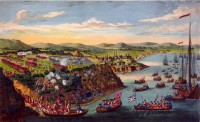 We begin the fantastic journey through the final years of the adventurous and wildly unbelievable past of the early settlement of North America by French and British people. Our story ends with the conquest of Quebec City, September 13, 1759, and the capture and surrender of Montreal in 1760. This last surrender while signifying the end of New France also heralded the beginning of the founding of the free and democratic countries of Canada (including Quebec) and the United States of America.
Unfortunately, at the present time, a group of extremist Quebecoise, claim it is an insult to them to celebrate the capture of the town of Quebec. They wish to destroy every vestige of the monuments and historical record of the defeat because they claim Wolfe and the British Army conducted a bloody campaign against the villages along the St. Lawrence and killed many innocent citizens. An understanding of the real story and the events of the time will illustrate clearly that a celebration of the Conquest should be considered as the beginning of a free Quebec and its liberation from the dictatorial regimes of the absolute monarchy of the French Kings. All parties have reason to celebrate this great turning point for all towards the free and peaceful societies they have established on the North American continent today. The Battle of the Plains of Abraham is of great significance for all. The problem with history is it tends to be selective, especially when 250 years go by and the true story is suppressed and distorted by the political restraints. While the war for North America was brutal, no party to the fight was entirely without stain; not the British, the British-colonial settlers and colonial militia; the French government, their soldiers and the colonial soldiers of New France or even the Native American Indians who occupied the lands and whose trade and alliances were being fought over. To understand how Canada came about, it is absolutely critical to know the real story. It is a history no schoolbooks will tell you. Not all of it is pretty and not all is socially acceptable in today’s world. Many Canadians and Americans have no understanding of the vital importance of the Conquest to all of us because when all this occurred there were no borders between New France and present day Canada and the USA. In telling this story, perhaps a more thoughtful and rational light will be shone on the significance of the Conquest.
Why was Quebec City Attacked?
The attacks on New France by the British Army and the British-colonial militias of New England did not occur because of an unwarranted greed for territory or trade. In fact, Quebec City had been captured previously by Sir David Kirke, a merchant adventurer, in 1629 but was returned to France when King Charles 1st of England made peace with France. To understand the situation at that time of the Conquest in 1759, it is necessary to understand that the French and the British in North America came to this new sparsely populated land for quite different purposes. Both the French and British began their settlements about the same time. The French in 1607 at Port Royal (Acadia) and 1608 at Quebec and the British in 1607 at Jamestown, Virginia, although they had made several failed attempts much earlier. The French government desired profitable trade with the Indians, principally furs while the British on the other hand desired to settle the land and farm as well as establish shops and businesses and towns. The very first British settlements were funded by private groups of investors that were looking to establish prosperous plantations as well as search for valuable minerals. Others came simply to improve their lot in life. The British and early Dutch settlers and traders also took to trading with the Indians for furs and animal skins. The French government justified their expenditures on the project under exhortation of the Catholic Church’s leaders whose intense desire was to convert the “Sauvages” to Christianity (the native people or Indians). Both countries were interested in exploration and the search for a way to the Pacific and thus the Orient by crossing the continent. The French chose the Gulf and St. Lawrence River areas to settle and to explore into the interior via the Great Lakes and the adjoining river systems, with the help of their Indian guides and paddlers. Most of the British early explorations were done by sea, coasting the inlets, bays and rivers of the Atlantic coast, north of the Spanish settlements in Florida and into the Artic and Hudson Bay, trying to find a sea passage to the Pacific Ocean, often at great cost of life and wealth of the government and their investors. All these courageous efforts by both counties were in themselves great adventures and a proud heritage of all those and their descendants that dared the wilderness and the unknown seas, but these are other stories to be explored by those interested. The main point to be born in mind is that the British settlement of North America far surpassed that of the French because of their home country’s different objectives. By the time of the Conquest and the fall of New France in 1760, there were some 1,300,000 British-American colonists in North America scattered in thirteen colonies along the Atlantic seaboard and inland, each with their own local government and containing many hundreds of towns and villages. The French by comparison had some 65,000 people in all North America and most of those, approximately 50,000, were settled near to or not far from the St. Lawrence River. While the British encouraged settlement and trade, the French government and their local officials prohibited settlement beyond Montreal in order to discourage their habitant farmers from leaving the land. They wanted them on the land with their families to work the farms of their Seigneurs (the land owners) and raise children. Only those who obtained the approval of the local authorities could engage in the fur trade or explore beyond Montreal. A significant exception were the priests of the Jesuit Order who had to be approved by the Church before they could bravely penetrate into the Indian villages of the interior to save the souls of the Indians for Christ, often at the cost being tortured, maimed or killed. The remaining few who were expected to go into the wilderness were the appointed explorers, usually French nobles or military officers, their soldiers and guides. When French trading posts were established, eventually a chain of forts reaching from Fort Frontenac (Kingston) through the Great Lakes and down Mississippi River to where New Orleans is now located, only enough settlers were allowed to settle near the forts, in order to supply their personnel with necessary food and skilled tradesmen. We cannot of course forget the famous Voyageurs who did the arduous work of paddling the fur traders and spent years in the wilderness. They began settlements as far west as Manitoba, intermarrying with local Indian tribes. Everywhere the French explorers went they claimed the territory for France, usually conducting a small ceremony and fastening a plaque on a post or large tree to mark their claim; their intent being to extend that claim to the line of encroaching British settlements to the south and east. Unfortunately, there was no such thing as an agreed border between their claims and the British settlements. Eventually, these massive territorial claims began to conflict with the growing English settlements, as well as the growing competition for furs. Both led to violence between French and British interests. Strangely, one additional element of serious conflict, rarely mentioned by historical writers, was the French government and the French Roman Catholic Church’s intent to make New France and North America a Roman Catholic Empire, with a special loathing of Protestant French Huguenots, numbers of whom had settled in the New England colonies. The backdrop to all this conflict of interests were the French and English European wars that spluttered on and off for many years. The effect on North America was such that whenever the mother countries went to war with each other, the colonies also went to war. However, flare ups often continued between the competing interests and the Indians whether the colonies were officially at war or not. One of the worst early confrontations occurred at the Dutch town of Schenectady at the northern end of the Hudson River in upper New York.Your Hosts
Your hosts for these adventures are Ken Tellis and Dick Field, both concerned Canadian citizens of British heritage. Both have huge concerns for the future of Canada and both feel that part of the answer is to outline the importance of knowing how Canada (including Quebec) and the United States of America came to be. This story is little known to our citizens, both in Canada and the United States. Dick is a WW2 veteran, a retired businessman and world wide traveler. Ken an ex sailor who has traveled the world lived in Quebec and raised a family in the French milieu. Both now live in Ontario. The story will unfold as fast as we can put together our episodes. We begin this first week of March 2009 and we will try to produce a dozen or so episodes ending the second week of September in time for the 250th year memorial date of September 13th 2009 celebrating the liberation of Quebec and the beginnings of Canada and the United States of America. We will adhere to historic timelines as much as possible but will flash back on occasion to recount certain episodes that will explain the particular episode or chapter we are recounting. You think the Wild West was adventurous? Follow this story and you will wonder why you ever fell asleep in history class. As they say on TV before an action movie; “Be aware that the contents of this story may include scenes of violence, murder, rape, pillage, torture, revenge, brutality, selfishness, cannibalism, trials and tribulations, starvation, man’s inhumanity to man together with courage, adventure and righteous behaviour. Please exercise parental guidance.” Chapter 1Schenectady, New York 1690
 It was a dark wintry night on February 8th, 1690. The snow blew straight from the North and the Dutch villagers of Schenectady were asleep in their warm beds, little suspecting their lives were to be shattered before the sun rose in the morning. Terribly cold though it might be outside, a far greater evil was quietly descending upon them along with that frigid wind.
Little did they know that the King of France, Louis XVI, had appointed Louis de Buade, Comte de Frontenac et de Palluau, Governor of New France with a mandate to attack and destroy all British outposts in New England and New York, and to spare the lives of none of its Protestant settlers, a part of his plan to build a new Catholic empire in North America.
Under Comte Frontenac’s orders, 114 Frenchmen under the command of Le Moyne de Sainte-Helene and his deputy Daillebout de Mantet joined by 96 Roman Catholic Sault and Algonquin Indians had started out from Montreal, New France, 200 miles to the north, about the middle of January to attack Fort Orange (Albany). Wearing snowshoes and dragging sleds of supplies they had crossed the frozen St. Lawrence River, traversed Lake Champlain and in the region of where Fort Edward would later be erected, they stopped while the leaders conferred as to how they were going to attack Fort Orange. The party resumed the march to where the trail diverged, one branch leading to Albany and the other to Schenectady.
Unfortunately for the Dutch citizens of Schenectady, the leaders of the expedition, after discussion with the Chief of the Indians, Kryn, changed their target to the village of Schenectady because they felt the risks were too great to attack Fort Orange. Their feeling was that Fort Orange was more strongly fortified and might be defended by local militia and British troops.
The invaders journeyed another 7 days towards the Mohawk Valley and on February 8, 1690 arrived a few miles from a trading post near Binnekil. At 4 o’clock that afternoon there was a blizzard, followed by a nor’wester with icy winds and a snow squall. Le Moyne de Sainte-Helene and his leaders held a final council.
The council decided not to wait until the morning for the attack because the men were half frozen, fatigued and hungry. Le Moyne then ordered his Indian scouts to cross the Mohawk River to scout the area and see if the Dutch had taken any counter measures to resist a surprise attack. The scouts returned at 11 p.m. and told the commander that no one was guarding the stockade and even the gate facing the river was unguarded.
Thus on the night of February 8, 1690 while the Dutch families, snug in their well heated homes, feeling very safe from any attack because the night was extremely cold and that no enemy would be foolish enough to venture out under such terrible conditions, horror descended upon them.
The invading Frenchmen and Indians crossed the frozen Mohawk River, silently entered the stockade and surrounded the quiet houses where the Dutch families were fast asleep. Then the Sault and Algonquin Indians let out a hideous war whoop that was the signal for the start of a bloody massacre that was to last for two terrible hours.
The doors of the houses were broken down with hatchets; the settlers leapt from their beds in their nightclothes only to fall before the tomahawks; women seized their children and ran into the streets where they were shot down alike by the French and Indians. Their scalps were then taken by the screaming Indians. Neither men women nor children were spared. The snow covered streets were soon littered with the bloody bodies of the dead and dying.
The houses of the village were then set on fire and nearly eighty homes were destroyed. The winter sky was illuminated by the flames as the screaming Indians with their bloody scalps hanging by their sides danced with joy. “No pen can write, and no tongue express,” wrote Pieter Shuyler, Mayor of Albany, in a letter to Governor Bradstreet of Massachusetts, “the cruelties of women bigg with child rip’d up and ye children alive throwne into ye flames and those Dashed in Pieces against the doors and windows.”
There was little resistance except at the small blockhouse that was located in a corner of the village. Here Lieutenant Talmage and 24 of his soldiers made a stubborn stand, but the doors were forced and all but 3 of the defenders killed, the latter taken prisoner.
Another plucky fight was put up by Adam Vrooman and his family. He had a fortified house and was determined to fight to the end. Unfortunately his wife had left the top half of the Dutch door partially open and an alert Indian shot her through the opening. His daughter ran out the side door and escaped but the baby she was carrying was torn from her grasp and smashed against the door. Adam’s brisk fight brought a parley and his life was spared but his son and a Negro slave were carried into captivity.
In the attack on Schenectady 60 died or were killed by the French and Indian invaders, these included 38 men and boys, 10 women and 12 children. Some managed to escape from the stockade to seek shelter with relatives and friends some miles away. Others perished of exposure because of the bitter cold.
One of the Dutch settlers Simon Schermerhorn, though badly wounded managed to get on his horse even as the massacre was taking place and ride off through the drifting snow to Albany, New York and reached it in the early morning hours of February 9, 1690, carrying news of the attack. Eventually, a party of militia from Albany and some Mohawk warriors pursued the French and Indian invaders and killed or captured some of them almost at the environs of Montreal, New France.
The breaking of dawn brought a grim scene as the French and their Indian allies began to collect their captives, supplies and 40 pack horses to begin their long journey back to Montreal, New France. They left behind the smoldering ruins of burnt homes and blackened chimneys still smoldering, the bodies of their innocent victims with heads decapitated lay on the bloodied snow where they had been butchered and scalped by the Sault and Algonquin Indian allies of the French.
The invaders finally gathered what was left of their force, collected their 50 prisoners and headed back to Montreal, New France in the afternoon. On the way back to Montreal, 19 of the French perished and the remainder were saved from starvation by killing some of the horses and eating them. Some of the prisoners were sold on the slave market in Montreal and others were ransomed. Only one prisoner escaped and got back to the region of Schenectady.
The inhabitants of the village of Schenectady had been caught unawares because they had failed to post any sentries, and had seriously misjudged the capabilities of the French and Indians to attack in the worst of conditions. The attack was so swift and deadly that the people were unable to defend themselves or offer any meaningful resistance.
This mission by the French and Indians while tactically successful was in reality a strategic failure because the real target of Fort Orange had been scrapped. It was at best a pyrrhic victory, having served no real purpose except to display their savagery towards the Protestant settlements of the British, regardless of nationality and so arouse the anger of the New England colonies and their Iroquois allies that the cauldron of anger would take but little more to boil over.
Watch for Chapter 2 – The Deerfield Massacre 1704
Read the personal tales of the survivors.
Ken Tellis is an ex sailor who has traveled the world lived in Quebec and raised a family in the French milieu. Ken can be reached at
It was a dark wintry night on February 8th, 1690. The snow blew straight from the North and the Dutch villagers of Schenectady were asleep in their warm beds, little suspecting their lives were to be shattered before the sun rose in the morning. Terribly cold though it might be outside, a far greater evil was quietly descending upon them along with that frigid wind.
Little did they know that the King of France, Louis XVI, had appointed Louis de Buade, Comte de Frontenac et de Palluau, Governor of New France with a mandate to attack and destroy all British outposts in New England and New York, and to spare the lives of none of its Protestant settlers, a part of his plan to build a new Catholic empire in North America.
Under Comte Frontenac’s orders, 114 Frenchmen under the command of Le Moyne de Sainte-Helene and his deputy Daillebout de Mantet joined by 96 Roman Catholic Sault and Algonquin Indians had started out from Montreal, New France, 200 miles to the north, about the middle of January to attack Fort Orange (Albany). Wearing snowshoes and dragging sleds of supplies they had crossed the frozen St. Lawrence River, traversed Lake Champlain and in the region of where Fort Edward would later be erected, they stopped while the leaders conferred as to how they were going to attack Fort Orange. The party resumed the march to where the trail diverged, one branch leading to Albany and the other to Schenectady.
Unfortunately for the Dutch citizens of Schenectady, the leaders of the expedition, after discussion with the Chief of the Indians, Kryn, changed their target to the village of Schenectady because they felt the risks were too great to attack Fort Orange. Their feeling was that Fort Orange was more strongly fortified and might be defended by local militia and British troops.
The invaders journeyed another 7 days towards the Mohawk Valley and on February 8, 1690 arrived a few miles from a trading post near Binnekil. At 4 o’clock that afternoon there was a blizzard, followed by a nor’wester with icy winds and a snow squall. Le Moyne de Sainte-Helene and his leaders held a final council.
The council decided not to wait until the morning for the attack because the men were half frozen, fatigued and hungry. Le Moyne then ordered his Indian scouts to cross the Mohawk River to scout the area and see if the Dutch had taken any counter measures to resist a surprise attack. The scouts returned at 11 p.m. and told the commander that no one was guarding the stockade and even the gate facing the river was unguarded.
Thus on the night of February 8, 1690 while the Dutch families, snug in their well heated homes, feeling very safe from any attack because the night was extremely cold and that no enemy would be foolish enough to venture out under such terrible conditions, horror descended upon them.
The invading Frenchmen and Indians crossed the frozen Mohawk River, silently entered the stockade and surrounded the quiet houses where the Dutch families were fast asleep. Then the Sault and Algonquin Indians let out a hideous war whoop that was the signal for the start of a bloody massacre that was to last for two terrible hours.
The doors of the houses were broken down with hatchets; the settlers leapt from their beds in their nightclothes only to fall before the tomahawks; women seized their children and ran into the streets where they were shot down alike by the French and Indians. Their scalps were then taken by the screaming Indians. Neither men women nor children were spared. The snow covered streets were soon littered with the bloody bodies of the dead and dying.
The houses of the village were then set on fire and nearly eighty homes were destroyed. The winter sky was illuminated by the flames as the screaming Indians with their bloody scalps hanging by their sides danced with joy. “No pen can write, and no tongue express,” wrote Pieter Shuyler, Mayor of Albany, in a letter to Governor Bradstreet of Massachusetts, “the cruelties of women bigg with child rip’d up and ye children alive throwne into ye flames and those Dashed in Pieces against the doors and windows.”
There was little resistance except at the small blockhouse that was located in a corner of the village. Here Lieutenant Talmage and 24 of his soldiers made a stubborn stand, but the doors were forced and all but 3 of the defenders killed, the latter taken prisoner.
Another plucky fight was put up by Adam Vrooman and his family. He had a fortified house and was determined to fight to the end. Unfortunately his wife had left the top half of the Dutch door partially open and an alert Indian shot her through the opening. His daughter ran out the side door and escaped but the baby she was carrying was torn from her grasp and smashed against the door. Adam’s brisk fight brought a parley and his life was spared but his son and a Negro slave were carried into captivity.
In the attack on Schenectady 60 died or were killed by the French and Indian invaders, these included 38 men and boys, 10 women and 12 children. Some managed to escape from the stockade to seek shelter with relatives and friends some miles away. Others perished of exposure because of the bitter cold.
One of the Dutch settlers Simon Schermerhorn, though badly wounded managed to get on his horse even as the massacre was taking place and ride off through the drifting snow to Albany, New York and reached it in the early morning hours of February 9, 1690, carrying news of the attack. Eventually, a party of militia from Albany and some Mohawk warriors pursued the French and Indian invaders and killed or captured some of them almost at the environs of Montreal, New France.
The breaking of dawn brought a grim scene as the French and their Indian allies began to collect their captives, supplies and 40 pack horses to begin their long journey back to Montreal, New France. They left behind the smoldering ruins of burnt homes and blackened chimneys still smoldering, the bodies of their innocent victims with heads decapitated lay on the bloodied snow where they had been butchered and scalped by the Sault and Algonquin Indian allies of the French.
The invaders finally gathered what was left of their force, collected their 50 prisoners and headed back to Montreal, New France in the afternoon. On the way back to Montreal, 19 of the French perished and the remainder were saved from starvation by killing some of the horses and eating them. Some of the prisoners were sold on the slave market in Montreal and others were ransomed. Only one prisoner escaped and got back to the region of Schenectady.
The inhabitants of the village of Schenectady had been caught unawares because they had failed to post any sentries, and had seriously misjudged the capabilities of the French and Indians to attack in the worst of conditions. The attack was so swift and deadly that the people were unable to defend themselves or offer any meaningful resistance.
This mission by the French and Indians while tactically successful was in reality a strategic failure because the real target of Fort Orange had been scrapped. It was at best a pyrrhic victory, having served no real purpose except to display their savagery towards the Protestant settlements of the British, regardless of nationality and so arouse the anger of the New England colonies and their Iroquois allies that the cauldron of anger would take but little more to boil over.
Watch for Chapter 2 – The Deerfield Massacre 1704
Read the personal tales of the survivors.
Ken Tellis is an ex sailor who has traveled the world lived in Quebec and raised a family in the French milieu. Ken can be reached at View Comments
Dick Field——Bio and Archives
Dick Field, editor of Blanco’s Blog, is the former editor of the Voice of Canadian Committees and the Montgomery Tavern Society, Dick Field is a World War II veteran, who served in combat with the Royal Canadian Artillery, Second Division, 4th Field Regiment in Belgium, Holland and Germany as a 19-year-old gunner and forward observation signaller working with the infantry. Field also spent six months in the occupation army in Northern Germany and after the war became a commissioned officer in the Armoured Corps, spending a further six years in the Reserves.