The UN’s Hollow Rhetoric vs. Trump’s Pragmatic Diplomacy
The United States, under the pragmatic leadership of President Donald Trump, is the true peacemaker, not the United Nations
Joseph A. Klein, CFP United Nations Columnist , Bio and Archives--August 20, 2025
American Politics, News | Comments | Reader Friendly | Subscribe | Email Us
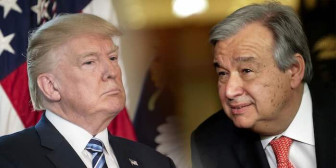
While United Nations leaders repeatedly call for peaceful solutions to conflicts that have broken out with increasing frequency in various parts of the world, the warring parties have ignored the UN and fought on.
Not with hollow rhetoric but rather with concrete steps toward achieving a realistic peaceful resolution
Irrespective of the circumstances, UN Secretary General Antonio Guterres has repeatedly fallen back on uttering moralistic declarations such as “There is no military solution. The only path forward is diplomacy. The only hope is peace.” Indeed, he used these exact words to criticize the Trump administration’s successful attack on Iran’s nuclear enrichment facilities following many years of fruitless diplomacy with the Iranian regime, which strung along Western negotiators with lies and deception!
The United States, under the pragmatic leadership of President Donald Trump, is the true peacemaker, not the United Nations. President Trump’s decisive military action that destroyed Iran’s nuclear facilities ended with a ceasefire between Iran and Israel. Moreover, during his first six months in office, President Trump has deftly used America’s economic leverage to bring about the end of fighting between Rwanda and the Democratic Republic of Congo, Cambodia and Thailand, and the two nuclear powers India and Pakistan.
Now President Trump is coordinating efforts to bring about a peaceful end to the war between Russia and Ukraine that began more than three years ago when Russia invaded Ukraine during the Biden administration. In all that time, the United Nations has been spinning its wheels with rhetoric calling for a permanent ceasefire and a diplomatic solution in accordance with the UN Charter. But the UN has utterly failed to advance the achievement of those lofty goals.
President Trump has committed to doing all that he can to end the Ukraine war and the horrific bloodshed that it has caused. Not with hollow rhetoric but rather with concrete steps toward achieving a realistic peaceful resolution.
President Trump is using a carrot and stick approach
President Trump is using a carrot and stick approach. This means coupling diplomatic outreach with the threat of secondary sanctions against the leading purchasers of Russia’s oil to deplete Russia’s most important source of revenue funding Vladimir Putin’s war machine if the Russian dictator continues to stall good faith negotiations. President Trump showed that he means business by announcing an additional 25 percent tariff on imports from India, to take effect later this month unless India stops buying Russian oil.
On the diplomatic front, President Trump agreed to meet face to face with President Putin on August 15th in Alaska to explore Putin’s willingness to engage in real negotiations at the highest level with Ukraine. Although no immediate ceasefire agreement emerged from that meeting, the summit set the stage for further diplomatic initiatives brokered by President Trump. These include President Trump’s efforts to arrange a direct meeting between Presidents Putin and Volodymyr Zelenskyy, to be followed possibly by a trilateral meeting that would include Trump himself.
In a spectacular display of unity among the United States, Ukraine, and America’s key European allies, President Trump hosted highly constructive meetings at the White House on August 18th with President Zelenskyy and various European leaders to discuss how to end the Ukraine war diplomatically. Attending the multilateral meeting that followed the bilateral session between Presidents Zelenskyy and Trump were European Commission President Ursula von der Leyen, British Prime Minister Kier Starmer, Finnish President Alexander Stubb, French President Emmanuel Macron, Italian Prime Minister Giorgia Meloni, German Chancellor Friedrich Merz, and NATO Secretary General Mark Rutte.
President Trump is a realist
President Zelenskyy thanked President Trump for his “personal efforts, to stop killings and stop this war.”
NATO’s Secretary General and the European leaders also lauded President Trump’s work in advancing the peace process. Finnish President Alexander Stubb, for example, praised President Trump’s peacemaking efforts. “I think in the past two weeks,” he said, “we’ve probably had more progress in ending this war than we have in the past three and a half years.”
A topic of crucial importance involved the concept of post-war collective security guarantees for Ukraine in lieu of its formal membership in NATO.
President Trump said that while Europe would be primarily responsible for providing such security the United States would also be involved. He ruled out putting American troops on the ground in Ukraine to enforce a possible peace deal, however.
President Trump is a realist. He knows that Ukraine will not be able to push Russia out of all the territory it has already conquered, no matter how much advanced weapons, money, intelligence, and other support it receives from the West. If Ukraine continues to fight on under the illusion that it can regain control of all its lost territory, including Crimea, the result will only be more needless suffering for the Ukrainian people. According to Gallup’s most recent poll of the Ukraine people about the war, which was conducted in early July, “69% say they favor a negotiated end to the war as soon as possible, compared with 24% who support continuing to fight until victory.”
President Trump also knows that although Russia has managed to take control of portions of eastern Ukraine and is slowly inching forward, Russia remains well short of Putin’s ambition to conquer all of Ukraine. Meanwhile, Russia has suffered huge casualties that are mounting daily, and its economy is tanking.
Ukraine faces a Hobson's choice
The bottom line is that the only way out of this endless loop of war is negotiation and a diplomatic resolution that will require compromise and concessions from both sides.
One possible framework would require Ukraine to cede to Russia territory already under Russia’s control (including Crimea) plus some land swaps in return for Russia’s acceptance of European deterrent security forces in Ukraine backed up by the U.S. If Putin digs in his heels, continues to make outrageous demands, and rejects the idea of deterrent security forces in Ukraine, then President Trump will have to use the most effective levers of American power to persuade Putin otherwise.
UN Secretary General Guterres has repeatedly called for a “just and sustainable and comprehensive peace” that “upholds Ukraine’s sovereignty, its territorial integrity and independence” in line with the UN Charter. Rewarding Putin’s acquisition by force of territory belonging to Ukraine, an independent sovereign nation, would fly in the face of this fundamental post-World War II rules-based global norm.
But it is easy for Mr. Guterres to deliver his pronouncements on what constitutes a “just and sustainable and comprehensive peace” from the comfort of his 38th floor office at UN headquarters in New York. It is quite another thing to produce such a peace on the ground in Ukraine when faced with the reality that Ukraine is unable to militarily push Russia out of the Ukrainian territory that Russia already occupies.
Ukraine faces a Hobson's choice. It can either accept a deal that costs it some of its territory but that is backed up by security guarantees to deter further Russian aggression. Or it can continue an unwinnable war that could drag on for years with diminishing support from the United States - a war that could wind up turning Ukraine into a failed state or worse.
As Georgetown University professor Charles Kupchan, who served on the National Security Council staff during the Obama and Clinton administrations, said, “ultimately, you have to allow pragmatism to trump principle.”
President Trump is advocating pragmatic diplomacy.
View Comments
Joseph A. Klein is the author of Global Deception: The UN’s Stealth Assault on America’s Freedom.