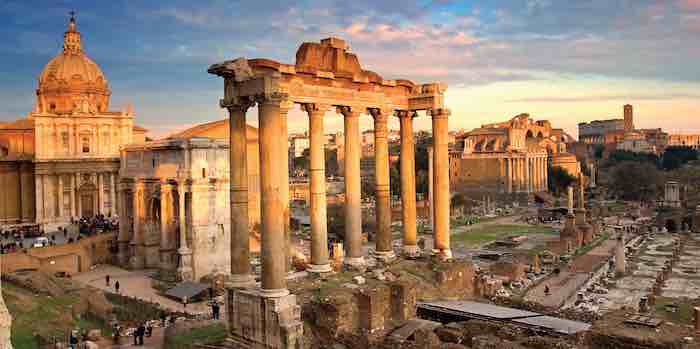
Christianity emerged in the Roman Empire just after the eclipse of the Roman Republic.
The Old Testament Israelites had been long established in the Middle East when the great upheaval resulting from the spread of iron metallurgy began in the 13th Century BC. Iron tools and weapons soon replaced bronze, and the new technology brought wars and social upheaval on a previously unknown scale. During that time the Israelites conquered and occupied Canaan after their 400-year exile in Egypt. The Middle East, then, was the setting for the later Old Testament prophets and the events of the New Testament.
Christianity emerged in the Roman Empire just after the eclipse of the Roman Republic. Once recognized as legitimate, and then as acceptable, Christianity spread to all areas of the Empire, which included North Africa, much of the Middle East, and Western Europe all the way to Scotland. Christianity gave us the idea that Church and State were separate realms, even when ecclesiastical and secular authorities meshed in practice. “Render unto Caesar. . .” suggested that the state and the church were not one and the same. This became a key concept in the 18th Century up to the present day.
As the secular power of the Roman Empire fractured and declined, the power of the Roman Catholic church grew and often supplanted it. For roughly a thousand years, the Church put its mark on Western Civilization in the area of the Western Roman Empire. The Church, led by the Papacy, fought its own battles with the secular authorities that emerged from the remnants of Roman rule. The Church battled the Holy Roman Empire, monarchs, Saracens, and even itself over the years of the Medieval period. Just as the Roman authority had waned, so civil authority eventually began to grow and unify toward the 14th Century. The conflict between Church and civil powers became part of the intellectual ferment that emerged with the dawn of the 15th Century. The fight continued to make Church and state separate. About 1490, when Europe emerged from the ravages of the Black Death, Western Civilization blossomed and grew northward and westward again.
The era of the Renaissance began in the chaos and disruption brought by the Black Death. The Church never regained its previous dominance once the Plague reached the southern European port cities. Uniquely powerful before 1347, the coincident growth of secular power and technology left the Church’s power weakened considerably, but mostly intact.
Renaissance scholars looked to the classical past, that is, to Greece and Rome, to understand their own civilization, and to answer questions of history and philosophy. The Classical Era handed up its preserved traditions in Greek and Latin. From these studies sprouted the intellectual ferment which became the Enlightenment of the 18th Century which we will consider next time.