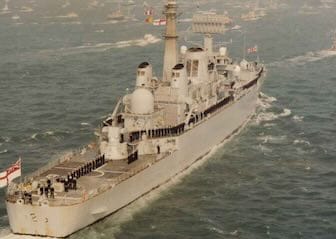
To some, it might just be an old piece of cloth. But it represents an era when the United Kingdom, United States and Canada stood firmly together—militarily, culturally and morally.
In 1982, HMS Bristol played a vital role in the Falklands War, helping to liberate a population from a military dictatorship. When HMS Coventry was sunk, the Bristol continued to serve in an air defence role and ultimately became the Royal Navy flagship before returning home.
Throughout the conflict, British prime minister Margaret Thatcher had the full support of United States president Ronald Reagan. Back then, Western nations were not only strategic allies but also cultural cousins. Our shared democratic values were non-negotiable.
After her combat years, HMS Bristol became a training vessel. When she was finally retired, many hoped she would be preserved as a museum ship. Portsmouth city councillor Gerald Vernon-Jackson argued that the Royal Navy’s historic dockyard lacked a large, modern grey ship to bridge the past with the present.
But that vision was rejected. In June 2024, the U.K. Ministry of Defence sold the Bristol to a Turkish scrap company. She was quietly towed from Portsmouth to Aliaga for dismantling.
Many in Atlantic Canada feel a personal connection to naval history. My grandfather served in the Royal Navy in the First World War; my father, in the Second World War, on Flower-class corvettes. My mother served ashore in the Women’s Royal Canadian Naval Service.
A decade after the war, my aunt married a U.S. Navy sailor. During Cold War visits to their home in Virginia, I often met NATO crews. On one occasion, my uncle, a chief petty officer on the USS California, hosted several petty officers from HMS Bristol. They offered us Courage Special Brew; we gave them an American-style barbecue. As thanks, they left the ensign.