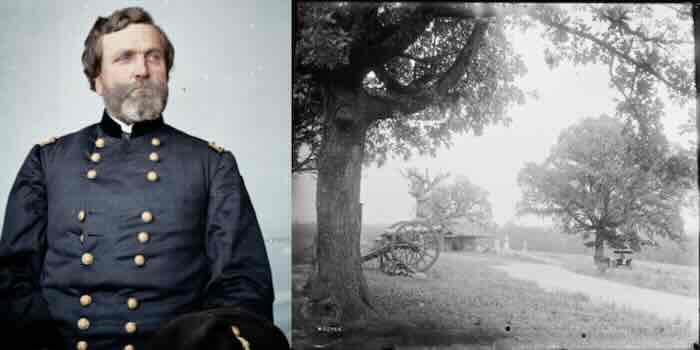
Everyone got the order to withdraw except the units under General Thomas. Without knowing that forces on both his flanks had been withdrawn, Thomas ordered that the ground they occupied be held. With only a single stronghold point left on the battlefield, Confederate forces concentrated on the curved line on the high ground in front of them. There stood Thomas and his command, which on that day included the 6th Indiana Infantry. Gen. Thomas was in a unusual position for a Union general. He had a sizeable well-supplied force on the high ground and he was under heavy attack by Confederate forces. Defense was superior on that day, too, and Thomas taught a textbook lesson.
All that day Union forces stood in their positions on the high ground, delivering devastating fire on the Confederates attacking up the steep slopes. The blue line held. Late in the day word finally came to Thomas that he was to withdraw and so he did, in good order, after dark when the threat against him was gone.
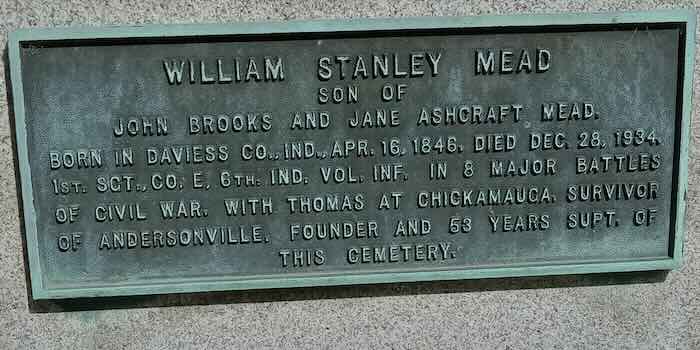
But on that day the perilous position held. Thomas gained the nickname ‘Rock of Chickamauga.’ That moniker had been made possible by the determined veteran troops Thomas commanded. One of those was William Stanley Mead, whom we now remember. Note his age in September, 1863.
By his own account Mead was in eight major battles of the Civil War and survived a notorious Confederate prison camp, but he was proudest of one of those battles, when he was -- With Thomas at Chickamauga.