Canada fell to 18th from 9th in global ranking of economic freedom
Economic Freedom of the World

Fraser Institute , Bio and Archives--October 6, 2026
Canadian News, Opinion | Comments | Reader Friendly | Subscribe | Email Us
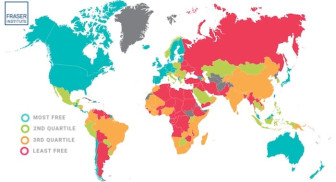
The 2026 report relies on 2024 data, which is the latest available year for which data can be compiled across 165 countries.
Economic freedom—the degree to which individuals are allowed to make their own decisions about what to buy, where to work and whether to start a business—is fundamental to prosperity. Economic freedom is measured by assessing openness to trade, tax and regulatory burdens, government spending, protection of property, and the soundness of a country’s money.
“Canadians should be worried because when people are less economically free, their standards of living tend to suffer,” said Matthew Mitchell, senior fellow at the Fraser Institute and coauthor of the report.
Three of the five areas of economic freedom drove the decline: size of government (taxation and government spending as a share of the economy), regulation, and freedom to trade internationally. The largest decline was in freedom to trade. Canada’s legal system and property rights score was virtually unchanged in the current report compared to previous reports, while its sound money score improved as inflation eased that year.
Canada has performed poorly in the size of government area for several decades. It’s relatively high tax burden and government spending put it at 101st out of 165 countries in the latest report.
In overall economic freedom, Hong Kong once again claimed top spot--although Hong Kong’s score has fallen every year since 2018.
The rankings of other major countries include Switzerland (2nd), Singapore (3rd), New Zealand (4th), U.S. (5th), United Kingdom (10th), Japan (13th), Germany (19th), France (39th), Italy (47th), Korea (53rd), Indonesia (72nd), Mexico (77th), Brazil (85th), India (88th), China (110th), and Russia (143rd).
The 10 lowest-ranked countries were the Democratic Republic of Congo, Egypt, Malawi, Algeria, Iran, Myanmar, Libya, Sudan, Zimbabwe, and Venezuela in last place.
The report relies on public data that is not immediately available in all countries, which is why its data are lagged by two years.
People living in countries with high levels of economic freedom enjoy greater prosperity, more political and civil liberties, and longer lives.
For example, in 2024 per-person GDP (an indicator of living standards) in countries in the top 25 per cent of economic freedom was US$65,596 compared to US$9,552 for countries in the least-economically free 25 per cent.
And poverty rates are lower. In the most-economically free quartile, 2 per cent of the population experienced extreme poverty (living on less than US$4.10 per day) compared to 41 per cent in the least-free quartile.
Finally, life expectancy is 81 years in the top freest countries compared to 67 years in the least free.
“Where people are free to pursue their own opportunities and make their own choices, they lead more prosperous, happier and healthier lives,” Mitchell said.
Media Contact:
Matthew Mitchell, Senior Fellow
Fraser Institute
To arrange media interviews or for more information, please contact:
Drue MacPherson, Fraser Institute
604-688-0221 ext.721
drue.macpherson@fraserinstitute.org
View Comments
The Fraser Institute is an independent Canadian public policy research and educational organization with offices in Vancouver, Calgary, Toronto, and Montreal and ties to a global network of 86 think-tanks. Its mission is to measure, study, and communicate the impact of competitive markets and government intervention on the welfare of individuals. To protect the Institute’s independence, it does not accept grants from governments or contracts for research. Visit fraserinstitute.org.
Follow the Fraser Institute on Twitter | Like us on Facebook