A Visit to Ca’D’Zan and to The Ringling Brothers Museum
As long as there are children who are dazzled by the magic, the lights, the costumes, the pageantry, and the breathtaking aerial acrobatics, the circus will live on

Dr. Ileana Johnson Paugh , Bio and Archives--November 3, 2015
American Politics, News | Comments | Reader Friendly | Subscribe | Email Us
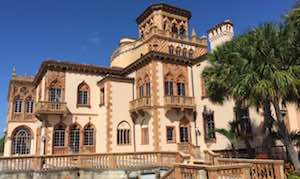 On a beautiful October day, we finally experienced Ca’D’Zan, the House of John, the 1920s Venetian Gothic palace on Sarasota Bay, home of John and Mable Ringling, their Museum of Art, and the beautiful gardens decorated with replicas of Italian statues. Located in Sarasota, Florida, the property was bequeathed to the state of Florida in 1936.
In 1927, John Ringling moved the winter quarters of the Ringling show from Bridgeport, Connecticut, to Sarasota County where it remained for over 60 years. The Ringling Bros. and Barnum & Bailey Circus now rehearses their new show in Tampa.
P.T. Barnum (1810-1891) chose Bridgeport, Connecticut, as his home where he built three mansions, Iranistan, Waldemere, and Marina. Iranistan was modeled after George IV’s Royal Pavilion in Brighton, England, with furniture made expressly for every room. It burned to the ground in 1857 during renovations. Waldemere (1868) was a Victorian-style structure overlooking the Long Island Sound in which he lived for 20 years, surrounded by treasures collected from around the world. He built Marina next to Waldemere three years before his death.
On a beautiful October day, we finally experienced Ca’D’Zan, the House of John, the 1920s Venetian Gothic palace on Sarasota Bay, home of John and Mable Ringling, their Museum of Art, and the beautiful gardens decorated with replicas of Italian statues. Located in Sarasota, Florida, the property was bequeathed to the state of Florida in 1936.
In 1927, John Ringling moved the winter quarters of the Ringling show from Bridgeport, Connecticut, to Sarasota County where it remained for over 60 years. The Ringling Bros. and Barnum & Bailey Circus now rehearses their new show in Tampa.
P.T. Barnum (1810-1891) chose Bridgeport, Connecticut, as his home where he built three mansions, Iranistan, Waldemere, and Marina. Iranistan was modeled after George IV’s Royal Pavilion in Brighton, England, with furniture made expressly for every room. It burned to the ground in 1857 during renovations. Waldemere (1868) was a Victorian-style structure overlooking the Long Island Sound in which he lived for 20 years, surrounded by treasures collected from around the world. He built Marina next to Waldemere three years before his death. P.T. Barnum built a highly successful circus that grossed $400,000 in its first year and was proclaimed in 1872 “The Greatest Show on Earth.” He partnered in 1888 with James A. Bailey to form the Barnum and Bailey Circus. This visit was a fascinating incursion into the secrets of the circus of a long time ago. There is a starry-eyed child in each of us who loved the circus growing up and remembered with fondness the big top acrobats, elephants, tigers, the daredevils, the tight rope performers, and perhaps clowns. People have fantasized about running away with the circus, to see the world through their lifestyle, and some did. The circus dates back to the period of 2000-1750 B.C. in many cultures, showcasing unusual skills and abilities of the human body. Jugglers appear on the wall of a 4000-year old Egyptian tomb. Traveling groups and later troubadours brought with them music, poetry, jugglers, news, acrobats, dancing bears, trained dogs, the strange wonders of the world, and exciting shows from outside of their small world. Country fairs in the 16th century England and the 18th century Commedia dell’Arte in Italy with its Harlequins dressed in multi-colored patched costumes would set the stage for the modern circus (1750-1840). “In 1768, a retired British cavalry officer, Phillip Astley (1742-1814) joined together feats of horsemanship with acrobatics, balancing, juggling, and comic acts and the modern circus was born.” Astley performed in London at the Royal Amphitheater of the Arts where shows were lit by three great chandeliers with five hundred candles. (Museum Archives)
The father of modern clowning is Joseph Grimaldi
The father of modern clowning is Joseph Grimaldi (1778-1837). Born in London, Grimaldi gave clowns the nickname of “Joey.” His character, “Clown,” was a mischievous and malevolent trickster. Isaac Van Amburgh (1808-1865), a New Yorker, was the greatest animal trainer of his day. He entered a cage of lions and tigers dressed as a Roman gladiator and was said to have been the first man who put his head in a lion’s mouth. The period of 1870-1938 is considered the Golden Age of the American Circus. It reached the greatest size under a tent and it capitalized on the Union Pacific Railroad and Central Pacific Railroad to move faster across the country. Traveling up to 15,000 miles and performing in 150 towns, the show needed 1,300 workers and artists, 800 animals, equipment, human food for 3,900 meals a day and grain, meat, and vegetables for all the animals in the menagerie.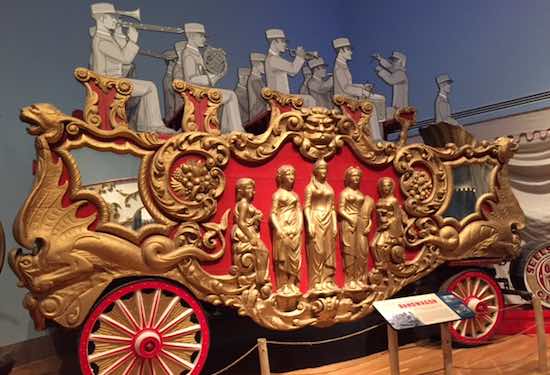 At the turn of the 20th century, there was a Circus Day in every town, an annual tradition that often closed schools and factories to allow everyone to enjoy a few moments of escape from everyday drudgery.
The excited crowds were treated to the sights, sounds, and smells of the circus, with the whistle of the calliope, the ticket sellers, concession booths with popcorn, hot dogs, cotton candy, soft serve ice cream and soda, pennants, dolls, live lizards to wear on your sleeve, and the colorful wagons with whimsical drawings of animals and fantastic characters.
Sword swallowers, Fire Proof Man, the Human Pin Cushion, dancers, Tiny Town performers lured the public to purchase tickets. For just a few cents, tickets were sold to side shows called “ballyhoo.”
The circus was the first place where many Americans saw animals from other continents. The menagerie had elephants, lions, zebras, hippopotami, giraffes, orangutans, macaws, kangaroos, and polar bears.
At the turn of the 20th century, there was a Circus Day in every town, an annual tradition that often closed schools and factories to allow everyone to enjoy a few moments of escape from everyday drudgery.
The excited crowds were treated to the sights, sounds, and smells of the circus, with the whistle of the calliope, the ticket sellers, concession booths with popcorn, hot dogs, cotton candy, soft serve ice cream and soda, pennants, dolls, live lizards to wear on your sleeve, and the colorful wagons with whimsical drawings of animals and fantastic characters.
Sword swallowers, Fire Proof Man, the Human Pin Cushion, dancers, Tiny Town performers lured the public to purchase tickets. For just a few cents, tickets were sold to side shows called “ballyhoo.”
The circus was the first place where many Americans saw animals from other continents. The menagerie had elephants, lions, zebras, hippopotami, giraffes, orangutans, macaws, kangaroos, and polar bears.
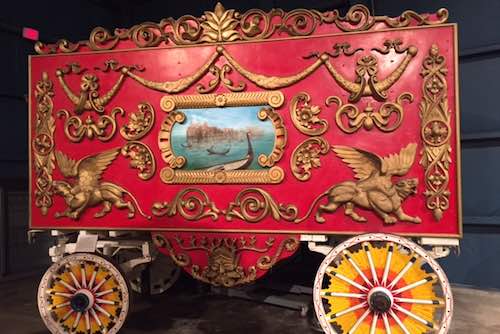 The cage wagons were beautifully and intricately carved with decorative figures and scrollwork. Panels would cover the bars to protect animals during travel.
Goliath, the giant sea elephant, weighing in at three and a quarter tons, was the main attraction, traveling in his specially-built water tank and consuming 150 pounds of fish per day. P.T. Barnum had an elephant called “Jumbo,” who was 10 feet 10 inches tall. Zebras were occasionally seen in circuses but were much harder to train than horses. Asian elephants have been part of Ringling Bros. for 141 years.
Clyde Beatty worked with large cats, lions and tigers. He “styled” them and trained them to do certain tricks but, as he said often, one can never tame them completely.
The domesticated animals such as dogs and cats were usually adopted from the pound. Horses and other hooved animals had their own blacksmiths. Four hundred baggage horses pulled wagons and heavy canvas and helped raise and tear down the tents.
The cage wagons were beautifully and intricately carved with decorative figures and scrollwork. Panels would cover the bars to protect animals during travel.
Goliath, the giant sea elephant, weighing in at three and a quarter tons, was the main attraction, traveling in his specially-built water tank and consuming 150 pounds of fish per day. P.T. Barnum had an elephant called “Jumbo,” who was 10 feet 10 inches tall. Zebras were occasionally seen in circuses but were much harder to train than horses. Asian elephants have been part of Ringling Bros. for 141 years.
Clyde Beatty worked with large cats, lions and tigers. He “styled” them and trained them to do certain tricks but, as he said often, one can never tame them completely.
The domesticated animals such as dogs and cats were usually adopted from the pound. Horses and other hooved animals had their own blacksmiths. Four hundred baggage horses pulled wagons and heavy canvas and helped raise and tear down the tents.
The centerpiece of the circus was the Big Top
The centerpiece of the circus was the Big Top. Raised in less than four hours, with six center poles, 74 quarter poles, 122 sidewall poles, 550 stakes, and 26,000 yards of canvas, the centerpiece of the circus was ready to enchant thousands of spectators each day. “In 1926 the program for each Ringling show lasted two and a half hours, without intermission, and included more than 800 artists performing in 22 displays.” The show ran concurrently in the three rings, on the four stages, around the hippodrome track or in the air above the rings. Seating could accommodate 15,000 people but, if all seats were sold, straw was spread in the front to make extra room for children in the “straw house.” (Museum Archives) The performers spent their time before and between performances in the backyard and in their own tents. The more famous the star, the more amenities from home they commanded. The circus was set up on empty lots adjacent to train stations and, on Circus Day, most towns doubled their population. More than 150 wagons had to fit on flatcars and it was the trainmaster’s duty to use the space properly. Before the show ended, the Flying Squadron was already on its way to the next stop where the circus was to perform. The logistics was so intricate that even the military watched them closely to copy their complex organizational skills. Agile acrobats, fearless flyers, tumblers, foot jugglers, Russian bar acrobats, trick cyclers and teeterboard pushed the boundaries of athletic ability, timing, execution, spectacular charisma, and skill. Lillian Leitzel performed a record 249 one-arm “planges” high above the center ring before she fell to her death in 1931 in Copenhagen. Nik Wallenda, seventh generation member of the famous Wallenda family, set the Guinness world record in 2008 for the longest distance and greatest height ever traveled by bicycle on a high wire. His achievements include: walking across the Allegheny River in 2009, walking over Niagara Falls in 2012 and in 2013, and crossing the Colorado River Gorge near the Grand Canyon on a two-inch steel cable, 1,500 feet above the river. The leotard is named after Jules Leotard, the first to perform the flying trapeze. Brian was the first human arrow to launch from a self-made crossbow. In the 1920s Con Colleano was famous for his dancing and forward somersaults on the wire. Hugo Zacchini, the Human Cannonball, flew more than 200 feet from a cannon. It is one of the most dangerous stunts at the circus. Daredevils use weighted projectiles to test their equipment before performance. An empty lot was magically transformed in a few hours into a wonderland of color and spectacular showmanship, but, as soon as it arrived, it disappeared with all its clowns, props, tents, trapeze artists, and animals, and the lot became vacant once again.Ringling Bros. and Barnum & Bailey Clown College
The famous clown Irvin Feld (1918-1984) founded in 1968 the Ringling Bros. and Barnum & Bailey Clown College to preserve the art of clowning. A year later, Reggie Montgomery (1948-2002), the first black clown, graduated from said college. Michael “Coco” Poliakovs (1923-2009) helped create in 1963 the famous fast food mascot, Ronald McDonald. Pinto Colvig made his television debut in 1948 as “Bozo the Clown.” Emmett Kelly’s “Weary Willie” character became the mascot for the Brooklyn Dodgers in 1956. Otto Griebling (1896-1972) and Emmett Kelly (1899-1979) portrayed hobo characters, surviving the difficulties faced by many Americans in the Great Depression. (Museum Archives) Clowns could be scary to some, but their circus characters exaggerated the quirks and foibles of everyday people, a grandma, a country bumpkin, a rube, a policeman, a hobo, or a tramp/wanderer. More than 1300 clown graduated from the RBBB “Clown College.” Interestingly, “electric light appeared in a circus big top in 1879, the same year Thomas Edison developed his incandescent bulb.” Parallel with the circus, the “Wild West” shows traveled the country and the world, re-enacting daring rescues, heroic battles, Native American dances, and runaway stagecoaches. Buffalo Bill’s Wild West shows, Pawnee Bill, and The Miller Bros. 101 Ranch fascinated audiences far and wide. These shows were uniquely American, romanticizing life on the Western Frontier based on James Fenimore Cooper’s five novels and the real life hunter and scout William Frederick “Buffalo Bill” Cody. The stereotyped life in these shows was later picked up by the motion picture industry.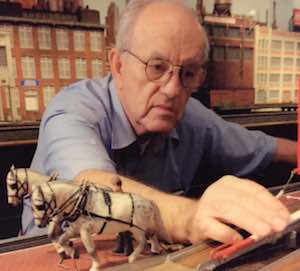 Howard Tibbals created the most accurate replica of the canvas city called the Howard Bros. Circus, modeled after the Ringling Bros. and Barnum & Bailey circus. He used historic photographs and measurements from existing equipment. The 3,800 square foot model depicts the American tented circus from the 1919-1938 period of the Golden Age.
Howard Tibbals began work in 1956 on his Howard Bros. Circus model in the basement of his Tennessee home, using photographs he had collected. In 1958, Tibbals met Harold Dunn, a skilled model builder whose miniature circus was displayed around the country. Tibbals built his miniature circus working at least 20 hours weekly for fifty years. He continued to add elements to his masterpiece even after the completion of the installation in 2005.
The Howard Bros. Circus miniature made its premiere in 1982 at the World’s Fair in Knoxville, Tennessee. Howard Tibbals began the installation of his miniature in November 2004 in the Circus Museum’s Tibbals Learning Center and it took him over a year to finish his labor of love.
Cirque du Soleil, founded in 1984 in Quebec, the Big Apple Circus, founded in 1977, and Kenneth Feld’s Ringling Circus empire, delight audiences with masterpiece extravaganzas. The circus is still very much part of the American pop culture to this day, with performances under tents, in arenas, and in theaters. As long as there are children who are dazzled by the magic, the lights, the costumes, the pageantry, and the breathtaking aerial acrobatics, the circus will live on.
Howard Tibbals created the most accurate replica of the canvas city called the Howard Bros. Circus, modeled after the Ringling Bros. and Barnum & Bailey circus. He used historic photographs and measurements from existing equipment. The 3,800 square foot model depicts the American tented circus from the 1919-1938 period of the Golden Age.
Howard Tibbals began work in 1956 on his Howard Bros. Circus model in the basement of his Tennessee home, using photographs he had collected. In 1958, Tibbals met Harold Dunn, a skilled model builder whose miniature circus was displayed around the country. Tibbals built his miniature circus working at least 20 hours weekly for fifty years. He continued to add elements to his masterpiece even after the completion of the installation in 2005.
The Howard Bros. Circus miniature made its premiere in 1982 at the World’s Fair in Knoxville, Tennessee. Howard Tibbals began the installation of his miniature in November 2004 in the Circus Museum’s Tibbals Learning Center and it took him over a year to finish his labor of love.
Cirque du Soleil, founded in 1984 in Quebec, the Big Apple Circus, founded in 1977, and Kenneth Feld’s Ringling Circus empire, delight audiences with masterpiece extravaganzas. The circus is still very much part of the American pop culture to this day, with performances under tents, in arenas, and in theaters. As long as there are children who are dazzled by the magic, the lights, the costumes, the pageantry, and the breathtaking aerial acrobatics, the circus will live on.View Comments
Dr. Ileana Johnson Paugh——Bio and Archives
Dr. Ileana Johnson Paugh, Ileana Writes is a freelance writer, author, radio commentator, and speaker. Her books, “Echoes of Communism”, “Liberty on Life Support” and “U.N. Agenda 21: Environmental Piracy,” “Communism 2.0: 25 Years Later” are available at Amazon in paperback and Kindle.