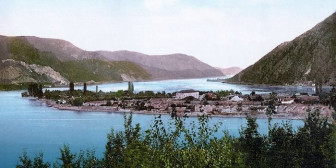
The tiny island survived wars of nations and fights against the Ottoman Empire
The population spoke Turkish and delighted in growing roses, serving Turkish delights for dessert in the afternoon, and making unfiltered coffee in heated sand, so bitter that one’s numbed tongue failed to register the amount of caffeine poured from tiny copper pots, with enough grounds left to read one’s future in the images on the insides of the cup.
The tiny island survived wars of nations and fights against the Ottoman Empire, a no man’s land that no longer exists on any map. The entire island is now submerged in the Danube’s waters transformed into the hydro-power lake of the Iron Gates I and II (Portile de Fier).
At a depth of dozens of meters, a diver can find the fortress wall, narrow paved streets people no longer walk on, and lost homes submerged by a development agreed upon by the former Yugoslavia and Romania on which territories the Danube traversed. A few powerful men decided to drown a part of history in the name of progress.
In the twenty-first century, the Danube, the second largest river after the Volga, flows 1,775 miles from the Black Forest Mountains in Germany through (or borders) countries before it flows into the drainage basin by Black Sea – Austria, Slovakia, Hungary, Croatia, Serbia, Romania, Bulgaria, Moldova, and Ukraine. The river was once a frontier of the Roman Empire.
Close to the Romanian town of Orsova, the island was a strategic point for centuries in the conflicts that Europe had experienced, particularly the advancement and occupations of the Ottoman Empire. Fortified by Austria in the 18th century to keep the Ottoman Empire at bay, the island was eventually occupied by the Turks, fast becoming an enclave with a strange statute unlike any other.