

 Liberal social critic Michael Harrington published in 1962 a book entitled, “The Other America,” describing those who were ill clothed and fed in the land of plenty, in a nation where obesity was a problem. Harrington proclaimed that there was a “cycle of poverty” that could be broken only by government action. His book profoundly influenced Lyndon Johnson who declared “War on Poverty” in 1964. Forty-seven years later, after we have spent billions of dollars on the poor, so-called downtrodden Americans, we have lost this war on poverty.
The government adopted an official definition of poverty. In 1964, those families who made less than $3,000 a year were poor. President Johnson’s goal was to get every American above the poverty line by 1976, the bicentennial of our country. The poverty line was adjusted every year to reflect changes in the cost of living.
Being Poor in America
The lines become blurred and thus poverty becomes income inequality, making progressives scream that we must bring about social justice
 Liberal social critic Michael Harrington published in 1962 a book entitled, “The Other America,” describing those who were ill clothed and fed in the land of plenty, in a nation where obesity was a problem. Harrington proclaimed that there was a “cycle of poverty” that could be broken only by government action. His book profoundly influenced Lyndon Johnson who declared “War on Poverty” in 1964. Forty-seven years later, after we have spent billions of dollars on the poor, so-called downtrodden Americans, we have lost this war on poverty.
The government adopted an official definition of poverty. In 1964, those families who made less than $3,000 a year were poor. President Johnson’s goal was to get every American above the poverty line by 1976, the bicentennial of our country. The poverty line was adjusted every year to reflect changes in the cost of living.
The federal poverty line for a family of four in 2011 is set at $22,350. Each state has a lower or higher number, depending on their cost of living adjustment.
According to the federal government, 35 percent of the poor are children. This is an interesting data to ponder since children do not live alone, do not earn an income, and few are likely to have accumulated wealth. If they do, they cannot touch it until they become of age.
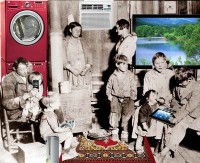
The 2010 Census Bureau’s exaggerated definition of poverty includes 40 million Americans in the category of poor. These families have air conditioning, TV, cable television, refrigerators, vacuum cleaners, XBOX game players, washers and dryers, a heated home, adequate shelter, and microwaves.
Progressives bemoan the homelessness, illegitimacy, drug dependency, and ill health of the poor. Conservatives argue that official data badly overstate the numbers because official definition should include free goods received such as education, public housing, healthcare, food, cell phones, and other assistance.
If you ask ten individuals if they are poor, you are likely to get the same answer, yes, they are poor but for 10 different reasons. Some will actually say they are cash poor in the bank, some are cash poor in their pockets, some consider themselves poor because they do not own a home or the car of their dreams, some because they do not have enough scholarships or grants to go to college, others who do not have wealth, cannot go on vacations ever or as often as they want, or cannot retire to the golf range.
People confuse cash with income and accumulated wealth
People confuse cash with income and accumulated wealth. Cash is something on hand to spend, income is derived through hard work on a bi-weekly, monthly, or yearly basis, and accumulated wealth is either inherited or derived from hard work and entrepreneurship over time, taking risk with business ideas and investing capital to bring ideas to reality. The optimistic economic concept of poverty is absolute – if you fall short of a minimum standard of living, you are poor. If you pass this standard by one dollar, you are no longer poor. The pessimistic concept of poverty is relative – if you fall too far behind the average income, you are poor. Absolute poverty is obviously arbitrary. Who is to decide what is too far behind? I am sure Romanians would be very happy and would consider themselves prosperous to have much less than the poor in this country. Americans in the 1900s would have considered themselves rich to have what the poor in America have today. Poverty is determined culturally and is thus a relative concept. The European Union (EU) determines the poverty line to be half the average national income. If the EU becomes richer, the poverty line rises and thus people become richer.Taking from the rich and give to the poor, the tenets of Marxism
The lines become blurred and thus poverty becomes income inequality, making progressives scream that we must bring about social justice, taking from the rich and give to the poor, the tenets of Marxism. Our market system does not guarantee income equality. Progressives write and talk ad nauseam about the distribution of income in the U.S. having grown substantially more unequal since the 1980s. Liberals demand that incomes be equal. If their demands were rational, they would understand that it is impossible, even under their beloved communism to have income equality. There are many reasons why incomes are unequal:- People have different capabilities, some can do math quicker, speak better, run faster, ski better, type more accurately, paint better, have better entrepreneurial skills, better IQs, are more inventive, more creative, more musical than others
- People can work longer hours than others, labor more intensely – such disparities of income are largely voluntary
- People take risks with stock market, a new business – Bill Gates and Steve Jobs come to mind
- People work in dangerous jobs that are reflected in compensating wage differentials – people who work the night shift receive higher wages
- People who are schooled or better trained receive higher pay; they have sacrificed current income to study in order that they may receive a higher income in the future
- More work experience commands higher wages
- People who have inherited wealth do not necessarily derive their income from work – think of the Rockefellers
- People who inherit human capital wealth command higher wages – persons whose families have attended Ivy League colleges will likely benefit from this tradition and attend the same college, thus the process will result in higher wages for them.
- Luck is an insidious cause of wage differentials – good or bad fortune can help one digger to find gold or oil and other to find water or just rocks
Why is the federal government deliberately keeping a large portion of the U.S. population dependent on welfare
In spite of our escalating debt ceiling problems, we spend nearly one trillion dollars a year on welfare although many recipients are not the typical poor in need of government assistance. Many people on welfare and Medicaid drive up to pharmacy windows to pick up their prescriptions in brand-new expensive SUVs. In the recession of 2009, only about 4 percent of the poor became temporarily homeless. Rector and co-author Rachel Sheffield writes, “The media ‘amplified’ the Census Bureau’s annual misrepresentation of poverty over the past 40 years. News reports routinely suggest that poor Americans typically are homeless and hungry — and U.S. foes and rivals such as Iran, China, and Russia are delighted to report the same.” “Regrettably, most discussions of poverty in the U.S. rely on sensationalism, exaggeration, and misinformation,” Rector says. “But an effective anti-poverty policy must be based on an accurate assessment of actual living conditions and the causes of deprivation.” Are we then truly poor in the U.S. and why is the federal government deliberately keeping a large portion of the U.S. population dependent on welfare and other social programs while bankrupting the country with its out-of-control spending?Email Us | Reader Friendly | Comments
Dr. Ileana Johnson Paugh——Bio and Archives
Dr. Ileana Johnson Paugh, Ileana Writes is a freelance writer, author, radio commentator, and speaker. Her books, “Echoes of Communism", "Liberty on Life Support" and "U.N. Agenda 21: Environmental Piracy," "Communism 2.0: 25 Years Later" are available at Amazon in paperback and Kindle.