Bradley effect in 2016?
With the oceans of bad press Trump has been getting, some poll respondents may indeed be reluctant or unwilling to express a preference for Trump

Matthew Vadum , Bio and Archives--August 18, 2016
American Politics, News | Comments | Reader Friendly | Subscribe | Email Us
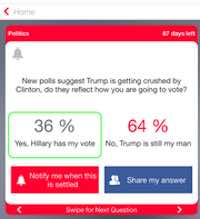 Some Donald Trump supporters are saying the fact that Hillary Clinton is ahead in virtually all national polls doesn’t mean a thing. Look at the huge crowds Trump keeps drawing to his campaign rallies and the tremendous support for him in social media, they say.
I’m not quite ready to accept that.
It reminds me of Election Day 2004 when more than a few John Kerry supporters were very confident the Democrat challenger would oust George W. Bush because he was leading exit polls. When Bush (barely) won reelection the Left suffered a mental breakdown claiming the exit polls were more reliable than the actual results.
Some Donald Trump supporters are saying the fact that Hillary Clinton is ahead in virtually all national polls doesn’t mean a thing. Look at the huge crowds Trump keeps drawing to his campaign rallies and the tremendous support for him in social media, they say.
I’m not quite ready to accept that.
It reminds me of Election Day 2004 when more than a few John Kerry supporters were very confident the Democrat challenger would oust George W. Bush because he was leading exit polls. When Bush (barely) won reelection the Left suffered a mental breakdown claiming the exit polls were more reliable than the actual results.And then there was the 2012 election where Mitt Romney seemed to be surging in the final days. He seemed (to some) to have momentum. His speeches were well-received. He sounded presidential. But in the end it was just psychological. Romney supporters wanted him to win so they convinced themselves he was winning. On his August 8 radio show, Rush Limbaugh cautioned against reflexively rejecting poll data. “I guess what I’m saying is it’s a risk here to just throw the polls out and say they don’t matter because you end up creating a false reality for yourself that isn’t true.” Now comes an app maker named Crazy Raccoons whose app suggests Trump will win in a landslide. (Crazy Raccoons self identifies as a “technology think tank providing simple solutions to complex problems.”) From a USA Today report:
“Based on the stats we see, he looks strong,” says Ric Militi, co-founder of San Diego-based Crazy Raccoons, maker of the Zip question and answer app. His app poses questions and polls responses based on an average of 100,000 daily users. “I go with Trump, based on what we see.” […] How can Zip’s results be so different? “We’re not a poll. We’re a conversation, and 100% anonymous,” Militi says. “People feel comfortable answering questions without fear of being bullied or being called a racist. People can express themselves safely, and you get a pure answer.”Does this mean this year’s election will be subject to some kind of “Bradley effect”? And what is the Bradley effect, you may ask. According to Ballotopedia,
The Bradley effect, sometimes called the Wilder effect, is a concept that attempts to explain discrepancies between voter opinion polls and outcomes in elections where white candidates campaign against minority candidates. Adherents of the Bradley effect believe that some voters will tell pollsters that they are undecided or likely to vote for a minority candidate but will vote against the minority candidate on Election Day. It was named for Tom Bradley, an African-American candidate who lost the 1982 California gubernatorial race despite having a lead in the polls going into the election. A related concept is social desirability bias, which describes the tendency of individuals to “report inaccurately on sensitive topics in order to present themselves in the best possible light.” According to New York University professor Patrick Egan, “Anyone who studies survey research will tell you one of the biggest problems we encounter is this notion of social desirability bias.” Some researchers and pollsters theorize that a number of white voters may give inaccurate polling responses for fear that, by stating their true preference, they will open themselves to criticism of racial motivation. Some analysts have dismissed the Bradley effect theory; others have argued that it has played a diminishing role in recent elections. One analysis of 180 Senate and gubernatorial elections between 1989 and 2006 suggested that “before 1996, the median gap [in public polling data and actual vote share] for black candidates was 3.1 percentage points, while for subsequent years it was -0.3 percentage points.”[Although Donald Trump versus Hillary Clinton isn’t a case of a black candidate running against a white candidate, with the oceans of bad press Trump has been getting, some poll respondents may indeed be reluctant or unwilling to express a preference for Trump.
View Comments
Matthew Vadum——Bio and Archives
Matthew Vadum, matthewvadum.blogspot.com, is an investigative reporter.
His new book Subversion Inc. can be bought at Amazon.com (US), Amazon.ca (Canada)
Visit the Subversion Inc. Facebook page. Follow me on Twitter.