Canada must build 840 solar-power stations or 16 nuclear power plants to meet Ottawa’s 2050 emission-reduction target
Rapid Decarbonization of Electricity and Future Supply Constraints

Fraser Institute , Bio and Archives--February 11, 2025
Canadian News, Opinion | Comments | Reader Friendly | Subscribe | Email Us
Ottawa's 2050 electricity emissions reduction targets are impractical, requiring unrealistic energy development
VANCOUVER—The federal government’s plan to eliminate greenhouse gas (GHG) emissions from electricity generation by 2050 is impossible in practical terms, finds a new study published today by the Fraser Institute, an independent, non-partisan Canadian public policy think-tank.
Ottawa's 2050 electricity emissions reduction targets are impractical, requiring unrealistic energy development
Due to population growth, economic growth and the transition to electrified transportation, electricity demand in Canada will increase substantially in coming years.
“To meet existing and future electricity demand with low-emitting or zero-emitting sources within the government’s timeline, Canada would need to rapidly build infrastructure on a scale never before seen in the country’s history,” said Kenneth P. Green, senior fellow at the Fraser Institute and author of Rapid Decarbonization of Electricity and Future Supply Constraints.
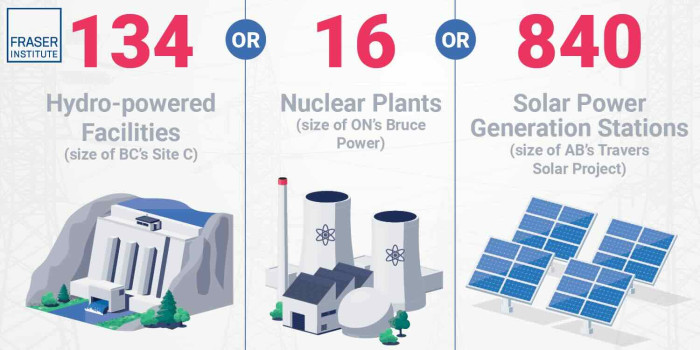
For example, to generate the electricity needed through 2050 solely with solar power, we’d need to build 840 solar-power generation stations the size of Alberta’s Travers Solar Project. At a construction time of two years per project, this would take 1,680 construction years to accomplish.
If we relied solely on wind power, Canada would need to build 574 wind-power installations the size of Quebec’s Seigneurie de Beaupre wind-power station. At a construction time of two years per project, this would take 1,150 construction years to accomplish.
If we relied solely on hydropower, we’d need to build 134 hydro-power facilities the size of the Site C power station in British Columbia. At a construction time of seven years per project, this would take 938 construction years to accomplish.
If we relied solely on nuclear power, we’d need to construct 16 new nuclear plants the size of Ontario’s Bruce Nuclear Generating Station. At a construction time of seven years per project, this would take 112 construction years to accomplish.
Currently, the process of planning and constructing electricity-generation facilities in Canada is often marked by delays and significant cost overruns. For B.C.’s Site C project, it took approximately 43 years from the initial planning studies in 1971 to environmental certification in 2014, with project completion expected in 2025 at a cost of $16 billion.
“When Canadians assess the viability of the federal government’s emission-reduction timelines, they should understand the practical reality of electricity generation in Canada,” Green said.
Media Contact:
Kenneth P. Green, Senior Fellow, Fraser Institute
To arrange media interviews or for more information, please contact:
Mark Hasiuk, Fraser Institute
604-688-0221 ext. 517
mark.hasiuk@fraserinstitute.org
View Comments
The Fraser Institute is an independent Canadian public policy research and educational organization with offices in Vancouver, Calgary, Toronto, and Montreal and ties to a global network of 86 think-tanks. Its mission is to measure, study, and communicate the impact of competitive markets and government intervention on the welfare of individuals. To protect the Institute’s independence, it does not accept grants from governments or contracts for research. Visit fraserinstitute.org.
Follow the Fraser Institute on Twitter | Like us on Facebook