Cardinal Burke Making The Latin Mass Count at the Vatican Once Again
The hauntingly beautiful Marian Hymn Salve Regina has, for a long time, held a special place in my life;

Judi McLeod , Bio and Archives--October 27, 2025
Cover Story | Comments | Reader Friendly | Subscribe | Email Us
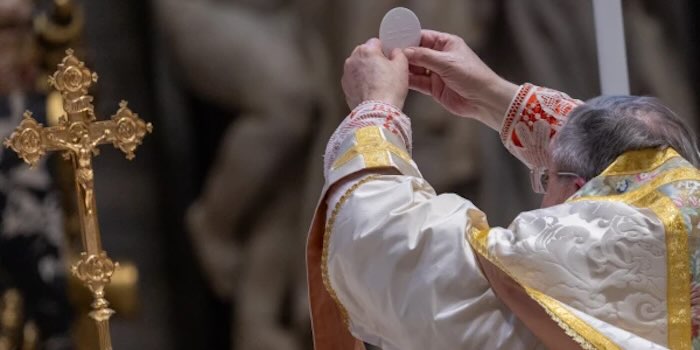
The tiny Acadian fishing village in Nova Scotia that Canada Free Press now calls home is far too many miles away from St. Peter’s Basilica in Rome—but Cardinal Raymond Leo Burke’s closing hymn at Saturday’s traditional Latin Mass took me there in soul and spirit.
Almighty God Blesses each and every one of us who keep standout Catholic Church protecter Cardinal Burke in our most fervent prayers.
The hauntingly beautiful Marian Hymn Salve Regina has, for a long time, held a special place in my life.
The last time I heard the hymn in person was at the last Latin Mass in Kinkora, Ontario’s beautiful St. Patrick’s Church, where my dear friend, Fr. Paul Nicholson was then Pastor.
Knowing how crushed the faithful in attendance would feel in knowing that this would be the last Latin Mass at St. Patrick’s, Father gently asked us not to weep as we were leaving Mass that day—but graciously didn’t chide me when I made my departure in tears.
Didn’t know back then that the impact of COVID would drive us out of Ontario because of CFP’s support of the Truckers’ Freedom Convoy, or that we would end up in a province where there is no Latin Mass.
Over the years, we stayed in touch with Fr. Paul, the youngest of six brothers, who now, serves his priesthood in faraway Cyprus.
Nor after leaving Kinkora, did I ever stop looking for any mention online of the hauntingly beautiful Salve Regina.
Having lost my 3-month-old baby boy to Spina Bifida when I was 18, I had also been following up online about the cause of the disease.
You can imagine my surprise when I discovered that St. Hermann, author of Salve Regina, suffered among many physical setbacks, debilitating painful Spina Bifida.
In my joyful discovery, I reached out to Fr. Paul to tell him about my having found St. Hermann.
“No, you did not find St. Hermann,” was Fr. Paul’s response. Thinking that he didn’t believe me, I asked him why.
“You didn’t find St. Hermann, Judi, because it was St. Hermann who found YOU, is a response that will carry through the rest of my life.
"Blessed Hermann of Reichenau or Herman the Cripple (18 July 1013 – 24 September 1054), also known by other names, was an 11th-century Benedictine monk and scholar. (Wikipedia)
- “Hermann was a son of the Count of Altshausen. He was disabled due to a paralytic disease from early childhood. He was born on 18 July 1013 with a cleft palate and cerebral palsy and is said to have had spina bifida. Based on the evidence, however, more recent scholarship indicates Hermann possibly had either amyotrophic lateral sclerosis or spinal muscular atrophy. As a result, he had great difficulty moving and could hardly speak. At seven, he was placed in a Benedictine monastery by his parents who could no longer look after him.
- “He grew up in the Abbey of Reichenau, an island on Lake Constance in Germany. He learned from the monks and developed a keen interest in both theology and the world around him. At twenty, Hermann entered their order as a Benedictine monk, becoming literate in several languages (including Arabic, Greek and Latin) and contributing to all four arts of the quadrivium.
- “He wrote about history, mathematics, astronomy, and Christianity. He wrote a treatise on the science of music, several works on geometry and arithmetics, and astronomical treatises including instructions for the construction of an astrolabe which caused him to sometimes be credited as its inventor. As an historian, he wrote a detailed chronicle from the birth of Christ to his own present day, ordering them after the reckoning of the Christian era. It was later extended by his pupil Berthold of Reichenau.
- “He was a renowned religious poet and musical composer. Among his surviving works are officia for St. Afra and St. Wolfgang. When he went blind in later life, he began writing hymns. He was famous enough that he appears to have been credited with compositions by later writers; among the works traditionally attributed to him are the Salve Regina ("Hail Queen"), Veni Sancte Spiritus ("Come Holy Spirit"), and Alma Redemptoris Mater ("Nourishing Mother of the Redeemer").
- “Herman died on Reichenau on 24 September 1054, aged 41. The Roman Catholic Church beatified him in 1863.”
After finding the great St. Hermann online, I end my mostly every day morning prayers in a prayer to Him.
Prayed while overlooking the front lawn sycamore tree from inside, I start my prayers by saying: “Thank You Almighty Father for your Creation. Thank you for knowing each and every one of us before placing each and every one of us in our mothers’ wombs.”
I end with this prayer to St. Hermann: “Thank you for all you did for us when down here on Earth, in spite of many physical setbacks, including painful, debilitating Spina Bifida.Thank You especially for leaving us the beautiful Salve Regina, which Brian and I cry out from our souls to hear again someday soon.
“As you know, my precious little baby boy, Robert Christopher, my precious little baby boy now and forever, succumbed to Spina Bifida at only 3 months of age, breaking this mother’s heart.
If it is God Almighty’s Will, can you keep him under wing, and can the two of you pray for all sinners on Earth, including me, the Baby’s mother?”
Meanwhile, heartfelt gratitude to all Catholic clerics who still pray the Latin Tridentine Mass, which ends with the Salve Regina, and in particular to Cardinal Burke, who brought our beloved ‘Mass of the Saints’ back to the St. Peter’s Basilica, Saturday after an interminably long 4-year absence.
(Michael Matt): Please, Holy Father, for the sake of Christ the King, free the Latin Mass!
Salve Regina Lyrics
Latin:
Salve, Regina, Mater misericordiae,
vita, dulcedo, et spes nostra, salve.
ad te clamamus
exsules filii Evae,
ad te suspiramus, gementes et flentes
in hac lacrimarum valle.
Eia, ergo, advocata nostra, illos tuos
misericordes oculos ad nos converte;
et Iesum, benedictum fructum ventris tui,
nobis post hoc exsilium ostende.
O clemens, O pia, O dulcis Virgo Maria.
English:
Hail, holy Queen, Mother of Mercy,
our life, our sweetness and our hope.
To thee do we cry, poor banished children of Eve;
to thee do we send up our sighs,
mourning and weeping in this valley of tears.
Turn then, most gracious advocate,
thine eyes of mercy toward us;
and after this our exile,
show unto us the blessed fruit of thy womb, Jesus.
O clement, O loving, O sweet Virgin Mary.
Pray for us O holy Mother of God, that we may be made worthy of the promises of Christ.
View Comments