“As previous governments have done before, a comprehensive line-by-line review of Ottawa’s spending is required to identify those programs or initiatives that are not fulfilling their purpose, or are not providing good value for tax dollars.”
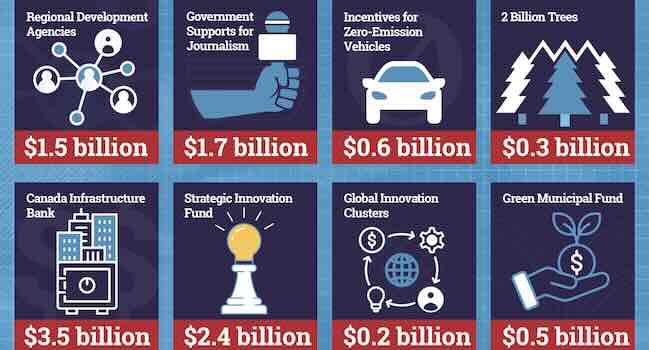
The study, Identifying Potential Savings from Specific Reductions to Federal Government Spending, highlights eight federal programs where government spending does not appear to be accomplishing its stated goals, or where government funding is unnecessary:
- $1.5 billion — Regional Development Agencies
- $1.7 billion — Federal support for journalism
- $587.6 million — Federal support for electric vehicle production and purchases
- $340.0 million — Two Billion Trees program
- $3.5 billion — Canada Infrastructure Bank
- $2.4 billion — Strategic Innovation Fund
- $202.3 million — Global Innovation Clusters
- $530.0 million — Green Municipal Fund
Critically, eliminating these eight programs could reduce federal government spending by $10.7 billion in 2024-25:
“Though just a starting point, a savings of $10.7 billion would meaningfully improve federal finances and help Ottawa put the country’s finances back on a stable footing,” Fuss said.
This study is part of a larger series of collected essays on federal policy reforms, Federal Blueprint for Prosperity, edited by Fraser Institute Senior Fellows Jock Finlayson and Lawrence Schembri.
The essay series, also released today, details federal policy reforms in health care, environmental and energy regulations, tax policy, immigration, housing, trade, etc. to increase prosperity for Canadians and improve living standards.
To learn more and to read the entire collected essay series, visit www.fraserinstitute.org.
Media Contact:
Jake Fuss, Director, Fiscal Studies, Fraser Institute
To arrange media interviews or for more information, please contact:
Emily Rigden, Fraser Institute
604-688-0221 ext. 620
emily.rigden@fraserinstitute.org