War-plans for mercs, Americans and the Kuwaiti ruling class all start with a mad scramble for that Saudi border
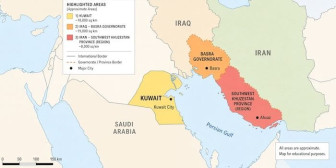
Our off-road drivability map is hourglass-shaped. Vehicles leaving Khuzestan either funnel into highways all the way to Basra City, or navigate labyrinths of pipelines threading around salt-marshes and silt-pits that swallow vehicles whole. Westbound traffic leaving Basra City bottlenecks further into a 15 X 15-k box centered on Az-Zubayr. Exiting Az-Zubayr, vehicles may fan-out--hardpacked gravel subsurface provides excellent offroad driving all along Kuwait’s barrier. Moreover, except for the avoidable Mukla Ridge, these conditions prevail right into Metro. (Average distance from barrier to Metro: 95-k; closest distance: 55-k.) Salamander dune-buggies could enter Metro in 40 minutes; unless Kuwait improvises a perimeter.
Iran’s 7,000-piece artillery arsenal includes 1,000 truck-towable M-46 field-guns. These guns fire six 34-kg rounds per minute. Shrapnel rounds have 30-m kill-radii. Rocket-assisted rounds have 40-k ranges. Reconnaissance drones greatly improve accuracy. M-46s and improvised perimeters don’t jibe.
Aerial defense of Kuwait will be an all-American act. Iran will divide US air power with simultaneous proxy blitzes in Djibouti, Lebanon, Israel, Iraq and Jordan; and with amphibious assaults on Bahrain and Oman. These initiatives should pre-occupy aircraft carriers (which are, already, too far from Kuwait).
US aircraft, with combat radii of 600-k to 1,200-k, will flyout from Israeli airbases over 1,200-k from Kuwait. Flying evasive, loitering maneuvres over Kuwait requires multiple mid-air refuelings per mission. Choreographing upper-tropospheric ballets requires more prep-time than blitzkriegs allow. Additionally, much US air-to-ground ordnance only works on stationary targets. Dispersed, mobile army units make difficult, uneconomical targets. Finally, Iran invests heavily in mobile anti-aircraft systems. In sum, the US cannot fly nearly enough missions to prevent Iran’s overrunning of Kuwait.
An immemorial ten months ago, America’s 16,000+ Kuwait-based personnel, together with elite KLF and Guard battalions, could have rapidly fielded 400+ armored fighting vehicles, plus hundreds of powerful, precise surface-to-surface missiles. They could have fulfilled their “tripwire” (stop-gap) mission. KLF now stands alone. KLF’s 15,000 troops are 80% foreign mercenary or stateless Bedouin.
Fewer than 500 US military personnel remain. They join similar numbers of US government employees and US-citizen gov-contractors--a veritable hostage trove.
War-plans for mercs, Americans and the Kuwaiti ruling class all start with a mad scramble for that Saudi border.