Governments ignored scientists’ warnings that climate scare was based on implausible scenarios
The Climate Change Reconsidered series by the NIPCC should be used to inform public policy, serving as excellent compilations of unbiased climate science by experts from around the world;
Tom Harris , Bio and Archives--September 21, 2026
Global Warming-Energy-Environment | Comments | Reader Friendly | Subscribe | Email Us
The United Nations has been regularly releasing apocalyptic reports for decades in an attempt to justify extreme cuts to our carbon dioxide (CO2) emissions and a major overhaul to our modern way of life. Yet the most cited future forecast, the Representative Concentration Pathway 8.5 (RCP8.5), is fundamentally flawed. This is one of the scenarios (along with SSP5-8.5 and SSP3-7.0) of greenhouse gas emissions that have been used to create dire forecasts and as a baseline in climate change research and policy-making. By forecasting economic growth rate and related emissions of greenhouse gases, the RCP scenarios use computer models to then estimates future warming. Even though RCP8.5 has been officially retired this year due to its implausibility, new studies continue to cite it and so its damaging impact also continues.
On The American Energy Institute’s webpage, They Knew, they detail how scientists have been flagging the implausibility of RCP8.5 since 2017. RCP8.5 projected a warming of approximately 4 – 5 °C, but it was built upon unrealistic assumptions. These scenarios have been continued to be used by governments, central banks, the world bank, courts, and throughout the education system. In a paper released this past April, researchers responsible for developing scenarios such as RCP8.5 for the Intergovernmental Panel on Climate Change (IPCC) have deemed it “implausible.” The authors write that its high emission levels “have become implausible, based on trends in the costs of renewables, the emergence of climate policy and recent emission trends.”
Yet well before this paper was published, the latest of the Climate Change Reconsidered (CCR) series of reports from the Nongovernmental International Panel on Climate Change (NIPCC) also called out RCP8.5. The CCR series cites thousands of peer-reviewed scientific references that detail the current state of climate science. The NIPCC has produced fourteen reports since 2009 from an international panel of experts who are, importantly, nongovernment scientists and scholars and so lack the inherent bias that those whose salaries are paid by the government obviously have. On their website, they explain,
“NIPCC seeks to objectively analyze and interpret data and facts without conforming to any specific agenda. This organizational structure and purpose stand in contrast to those of the United Nations’ Intergovernmental Panel on Climate Change (IPCC), which is government-sponsored, politically motivated, and predisposed to believing that climate change is a problem in need of a U.N. solution.”
The NIPCC reports show clearly that today’s climate is not unusual and that there is very weak evidence for future climate catastrophe, concluding that “There is no compelling scientific evidence of long-term trends in global mean temperatures or climate impacts that exceed the bounds of natural variability.”
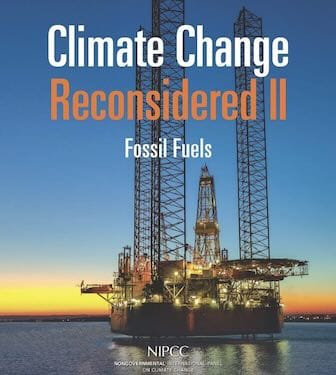
The 2019 CCR report, “Climate Change Reconsidered II - Fossil Fuels,” specifically denounced RCP8.5 as implausible. The researchers write that “RCP8.5 is an extreme outlier in the climate science literature, assuming abnormally high estimates of world population growth and energy use and the absence of any technological improvements in energy efficiency that would lower per-capita growth…RCP8.5 would result in more greenhouse gas emissions than 90% of any emissions scenarios published in the technical literature.”
It is not even possible to accurately measure greenhouse gas emissions, and projected economic growth is guesswork at best. The 2019 report continues to say that “most IAMs [integrated assessment models, which are used to forecast future economic growth and climate change] rely on emission scenarios that are little more than guesses and speculative ‘storylines.’ Even current greenhouse gas emissions cannot be measured accurately, and technology is likely to change future emissions in ways that cannot be predicted.”
Moreover, they explain that “Doiron (2016) observes RCP8.5 assumes that by 2100 there would be 930 ppm of CO2 in the atmosphere. This is 55% more than the 600 ppm of CO2 that could be generated by burning all the currently known worldwide reserves of coal, oil, and natural gas, according to the U.S. Energy Information Administration’s estimates [my bold].” Such vastly inaccurate estimates should have been widely reported upon in the press, but the media continued, and continue, to pander to the alarmist narrative.
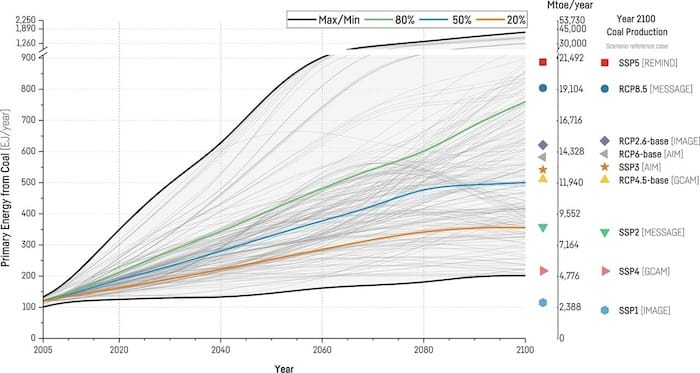
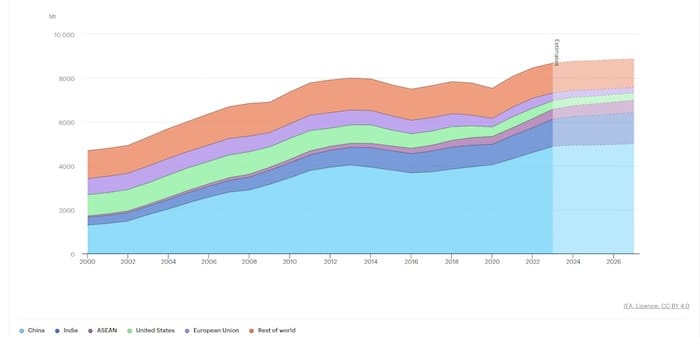
The following graph illustrates projected coal use until 2100 under different scenarios, from Why do climate change scenarios return to coal? by Ritchie and Dowlatabadi (2017). We can see that RCP8.5 assumed an eight-times increase in primary energy generation from coal (the dark blue circular icon in comparison with the light blue one). To meet this increase in coal use, there would have needed to have been more than a 100% increase in coal use from the early 2000s to today. Instead, we saw a smaller increase, as seen in the second graph below from the International Energy Agency.
Projected Coal Production from 2005 to 2100
Global Coal Consumption from 2000 and projected up until 2026, measure in Megatonnes (Mt)
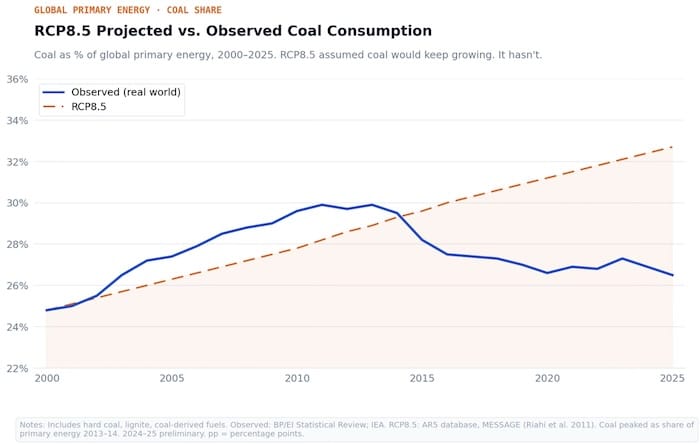
The implausibility of the RCP8.5 coal consumption forecast is even more pronounced when coal usage is plotted as a percentage of global primary energy, as seen in the following figure from No, RCP8.5 Did Not Become Implausible Because of Climate Policy.
As explained earlier, even though RCP8.5 and similar scenarios have now been officially dropped, new studies continue to use their results. The American Energy Institute tracks the misuse of these scenarios, and they find roughly 25 every day. It will take time for the overhaul of these faulty scenarios to be fully accepted, but by highlighting the work of organizations such as the American Energy Institute and the illuminating the original NIPCC reports, we hope that sensible climate science will eventually be adopted more readily
President Trump recently calling out the National Academy of Sciences, Engineering, and Medicine (NASEM) for publishing fraudulent manuals on climate change is yet another nail in the coffin for climate alarmism. These documents, which scientist Dr. David Wojick at Committee for a Constructive Tomorrow (CFACT) calls “the flagship of American alarmism,” along with RCP8.5 and other nonsensical scenarios, should be loudly condemned until they are no longer accepted as proper scientific documents. Instead, reports such as the Climate Change Reconsidered series by the NIPCC should be used to inform public policy, serving as excellent compilations of unbiased climate science by experts from around the world.
_________________________________________________________________________
Tom Harris is executive director of International Climate Science Coalition—Canada.
Note: Mary-Jean Harris, BSc, MSc (physics), contributed to this article.
Sample of some of the videos in which ICSC has boosted the NIPCC’s Climate Change Reconsidered (CCR) series of reports:
- 2013: Developed world to be held responsible for trillions of dollars in climate compensation
- 2013: Climate Change Reconsidered-II" - correcting UN climate alarmism
- 2014: GOV'T FLOATING TRIAL CLIMATE BALLOON?
- 2014: STAND UP FOR CLIMATE REALISM
- 2015: Government tricking public on UN climate deal
- 2019: DEBUNKING CLIMATE ALARMISM - COMBAT ZONE PODCAST
- 2021: March 25: CLIMATE CHANGE RECONSIDERED REPORTS
View Comments
Tom Harris is Executive Director of the Ottawa, Canada-based International Climate Science Coalition at http://www.icsc-climate.com.