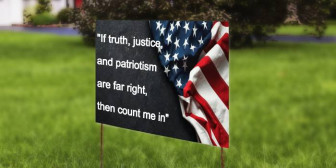
"If truth, justice, and patriotism are far right, then count me in"
Freedom of Speech;
David Robb , Bio and Archives--September 30, 2025
American Politics, News | Comments | Reader Friendly | Subscribe | Email Us
Absolute freedom of speech is as essential to a Republic as free elections. There has been a lot of discussion and controversy recently around free speech and what limits might be appropriate, if any. I would note that, if any limits are imposed, even for the "best" of reasons, speech is no longer free.
In the interest of clarifying the meaning and value of free speech, I offer the following thoughts.
Any attempts to limit freedom of speech by labeling it as disinformation, misinformation, hate speech, or any other label, relies on someone's opinion. That opinion may be biased, subject to political or ideological controls, or simply wrong. Each individual must be able to judge for themselves the truth, falsity, value, or interest of speech, and to interpret it as they see fit.
Freedom of speech simply means that anyone is free to say whatever they wish in whatever medium will accept that speech to whatever audience will listen. It does not require any medium to carry that speech, nor any audience to listen. It does not require the content of the speech to be true, palatable, inoffensive, accurate, in any particular language, or even coherent. Any prospective listener can decide for themselves if they wish to listen or not.
The function of free speech in a Republic is to ensure that all viewpoints, opinions, ideas, and policies get fair hearing and can be discussed openly to arrive at a best result. If there is any bias, any censorship, any attempt to restrict discussion to "acceptable" directions or policies, the results of such discussions will no longer reflect the consensus of the population, and will leave significant portions disaffected, angry, and potentially seeking other means to be heard.
Freedom of speech does not mean that listeners must agree with the speaker or accept his views or positions. It simply means that each person must be able to contribute to the discussion. People are free to listen, hear the arguments, and still disagree.
Spreading lies about someone to cause deliberate harm is still subject to libel and slander laws
It also does not mean that there may be no consequences that result from the speech. Freedom of speech does not mean freedom from consequences. It simply means that one is free to say whatever they wish, even if some others find it objectionable or hateful, or false. Yelling "fire!" in a crowded theatre is still a bad thing to do.
Spreading lies about someone to cause deliberate harm is still subject to libel and slander laws. Encouraging overthrow of the government is still subject to laws against sedition. Speaking truth, though, does not justify violence or murder.
Freedom of speech was one of the basic principles of Enlightenment philosophy, and a foundation of Classical Liberalism. Unfortunately, that foundation has been lost in today's neoliberalism. "I may disagree with what you say, but I will defend to the death your right to say it" has become "I may disagree with what you say and that gives me the right to punish you for saying it".
Instead of freedom of speech, with the responsibility of each individual to judge for themselves the value of what they hear, we have been overtaken with "kindness", where each person is charged with refraining from saying something that another might find hurtful or offensive. Entire nations, notably the UK, have criminalized speech that might offend someone. Since it is impossible to predict what might be offensive, the practical result is to limit any and all speech.
Who, though, decides what constitutes "hate speech"?
Often certain speech forms are labeled as "hate speech" and are explicitly prohibited. Who, though, decides what constitutes "hate speech"? I feel that being called a Nazi or Fascist when I am emphatically neither should qualify as hate speech, yet such expressions are upheld as examples of freedom of speech. Should I, though, state that there are only two natural genders - male and female- I would be accused of hate speech against those who claim otherwise, and might even find myself arrested for violating a hate speech law.
We started by being responsible for and in control of our own feelings. Now we are responsible for and in control of everyone else's feelings. We must constrain our own words and actions to avoid hurting someone else's feelings, but who will protect ours?
Feelings are individual responses to external stimuli and are conditioned by prior individual experiences and both prior and current disposition.
I have had the experience of positive feelings resulting from the smell of new-mown hay, while someone immediately next to me was disgusted by the same odor. My response was conditioned by memories of enjoyable experiences on my grandparents' farm, while they recalled an experience of a sewage processing facility. Same stimulus, radically different feelings.
A stark recent example is how a significant portion of the population felt happiness, and even joy at a brutal murder, while much of the remainder felt horror, sadness and grief at such a violent, barbaric act. To say that we should be held accountable for the feelings of another in response to simple speech is irrational, and only serves to empower one group over another.
We have been compelled to champion and encourage things we find deplorable, perverse, and destructive lest we suffer attack
For decades we have allowed the legitimate rights of the many to be trampled to promote the questionable rights of the few. Rather than encouraging tolerance of differences, we have been compelled to champion and encourage things we find deplorable, perverse, and destructive lest we suffer attack. It started with restriction of speech where use of certain words and phrases were discouraged. It has progressed to where many expressions are not only discouraged, but have even been made illegal, while other expressions are mandatory. Canada has even criminalized use of pronouns if someone objects.
This transformation of stable, consistent law into capricious, ill-defined whimsy has expanded beyond the borders of speech to encompass many of the concepts we considered inviolate only a few short years ago. Things we have taken for granted as fundamental rights have been opened for question. The First Amendment lists freedom of speech as a foremost right, along with freedom of the press and of assembly and the right to petition government for redress. All of these rights have been abridged in one way or another, always for the best of reasons, of course. Likewise, the right to defend ourselves from attack and from tyranny, the right to fair trial, and especially the right to be secure in our property have suffered greatly at the hands of those who resent any limitations on their power.
We have gone from "a man's home is his castle to do with as he sees fit" to "a man's home is his temporary residence subject to the sufferance of the state" Governments seeking ever more sources of money have even enacted taxes on personal property so that those who do not pay can have their property seized. Long gone is the idea that "every many shall sit beneath his own vine and fig tree, and none shall make him afraid."
The attacks on freedom of speech are only the latest in a long line of attacks that compromise and erode basic liberties
Such confiscations have been justified by arguments that the property owner benefitted from the protections and services of the State, so it is only reasonable that they should contribute to those protections and services. Such arguments can be expanded almost without limit to justify a broad range of questionable acts. They follow along the same lines used to restrict speech "for the good of the people". Which people, though?
The attacks on freedom of speech are only the latest in a long line of attacks that compromise and erode basic liberties. The Left, in particular, has been most vicious in its attacks, but we have also seen a few on the Right who support similar limitations. Both are wrong. The choice is binary. There can be no half measures, no little bit pregnant.
While there are problems associated with the concept of absolute rights as envisioned by our founders, there are greater problems associated with limitations on rights. Once begun, there will always be those who will seek to draw the line between permitted and forbidden along ever more restrictive borders, until the socialist ideal of: “Everything which is not compulsory is forbidden.” is reached.
By labeling values that most ordinary people share, the Left is turning the appellation "far-right" into a badge of honor. Instead of being ashamed, people have begun asking "if that belief is "far-right" and that is what I believe to be true and honorable, then perhaps being far-right is something to be proud of. It might not be long before we start to see yard signs "proud member of the far right". and "if truth, justice, and patriotism are far right, then count me in".
View Comments
David Robb is a practicing scientist and CTO of a small firm developing new security technologies for detection of drugs and other contraband. Dave has published extensively in TheBlueStateConservative, and occasionally in American Thinker.