Far Better Than DrudgeUnfiltered News • Daily Headlines

Kent Cigarettes, Blue Jeans, and Cassette Players as Commodity Money

Bribery was a way of life and survival;


Most people have never heard of commodity money unless they lived in a society like communism. Economists define commodity money as an object used as a medium of exchange, but which also has a substantial value in alternative, non-monetary uses. The process of accepting commodity money is bartering.


I encountered one of the most frequent bartering exchanges, Kent cigarettes

Examples of commodity money include salt (salarium in Roman times), stone (on Yap Island), ivory (whale tooth) on Fiji, elephant hair (Africa), tobacco (many places), brick tea money (Siberia), East Indian money tree, copper money (Alaskan natives), owl coin (Athens), Drachma (Tessaly), pine tree shilling (Spain), Round money (Japan), wooden nickels (U.S.A.), animal skins, beads, cigarettes, nylons (stockings), lipstick, soap, shampoo, blue jeans, cassette players, all used in bartering exchanges in place of actual paper money or coins.

Leaving Romania in 1978, I encountered one of the most frequent bartering exchanges, Kent cigarettes. At the airport, an armed officer at the gate became a momentary obstacle on the way to my flight to the U.S. and to my freedom. My inattention almost cost me dearly. He noticed that my brand-new passport which took two years to obtain had not been signed. I asked him meekly if I could sign it in front of him and he refused unless my American husband would go upstairs to the duty-free shop and purchase in dollars a carton of Kent cigarettes. He immediately complied and a $20 carton of Kent cigarettes bought me freedom at the airport--the officer let me sign my own passport, and I was able to board the flight to New York.

Kent cigarettes and other foreign brand cigarettes were purchased on the black market not necessarily to smoke but to use as commodity money to buy a service, a favor, or for a problem which you had hoped to solve such as getting a lab tech to speed up your blood test, your x-ray, to bribe a doctor to take better care of you, or exchange it for another hard to find commodity and service.


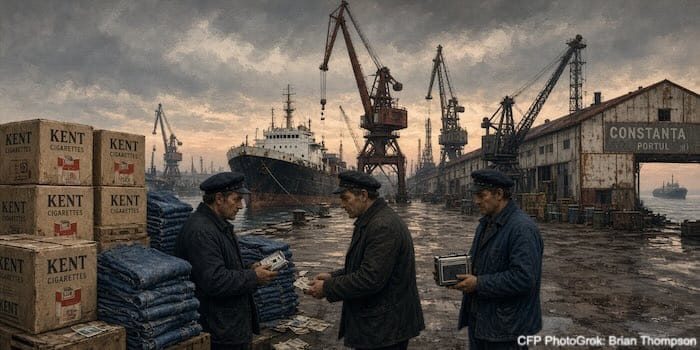
Sailors bought blue jeans, whiskey, cigarettes, soaps, shampoos, and other items used domestically as commodity money

How did these foreign made products make it into the country which had made it impossible to cross borders, protected by heavily armed soldiers trained to shoot and to sniff out anything that a person would bring in from abroad?

The main venue was the Constanta port at the Black Sea. Sailors would make it abroad where they bought items hard or impossible to find domestically. They were allowed to bring a limited number of items for themselves and their families.

However, they brought in much more than that. Sailors talked about merchants who would show up by the ship with items for sale and a list of prices. Sailors bought blue jeans, whiskey, cigarettes, soaps, shampoos, and other items used domestically as commodity money. The merchandise was hidden in many spaces aboard the ship, including the engine room. Once back in the port of Constanta, sailors had to hide the merchandise in trucks that carried approved shipping containers and even special trucks that watered the flower beds in the city. They used ingenious ways to fool the gate guards.

Once they made it into the city, the merchandise was divided between relatives and the rest sold or bartered on the black market. People who had never exited the country were thus wearing the forbidden blue jeans bought on the black market.

The Kent cigarettes continued their journey from hand to hand. They were valuable commodity money, and everyone accepted them as a medium of exchange through bartering of goods and services.

Another commodity money people used were cassette players with radio and blue jeans. Sometimes purchased from a tourist, these items were gifted to clerks or doctors to resolve complex problems that otherwise would linger in the state’s bureaucracy for years. Bribery was a way of life and survival.


Read next: Ontario Premier Doug Ford: Froze Trucker’s Protest Money, Now Putting Freeze On Others To Keep Power With A Snap Election

Email Us | Reader Friendly | Comments

Dr. Ileana Johnson Paugh—— Dr. Ileana Johnson Paugh, Ileana Writes is a freelance writer, author, radio commentator, and speaker. Her books, “Echoes of Communism", "Liberty on Life Support" and "U.N. Agenda 21: Environmental Piracy," "Communism 2.0: 25 Years Later" are available at Amazon in paperback and Kindle.